

Chemistry: investigate the world of substances Lesson 14 of 22
What does an element card tell us?
Separate a chemical symbol, atomic number and relative atomic mass without guessing neutron counts by rounding.
Support map
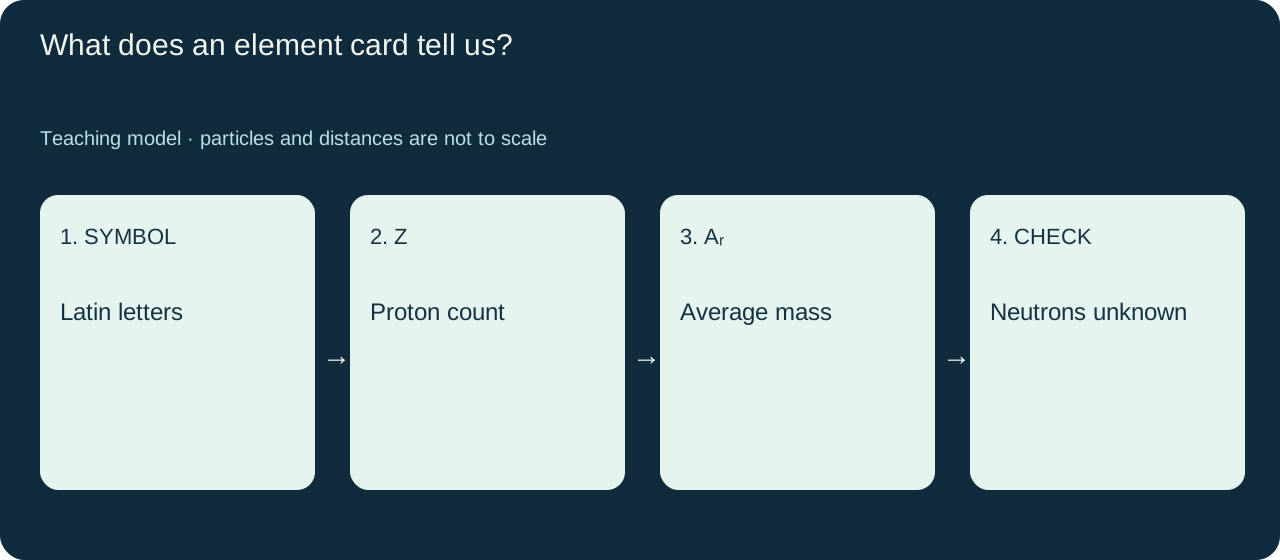
Teaching model · particles and distances are not to scale
Situation and question
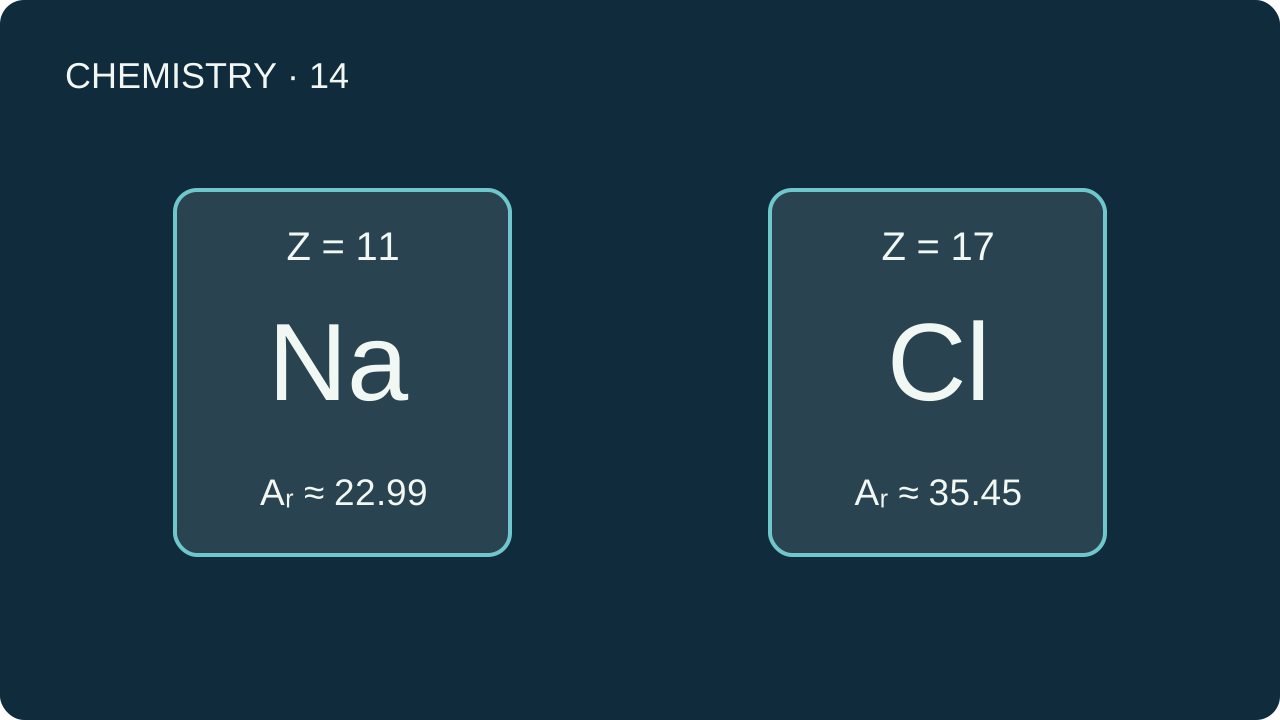
Our salt investigation now has two cards: Na with 11, and Cl with 17. Below them are 22.99 and 35.45. Why does each element have two different numbers? First record what proton count already tells you and what still needs explaining. This investigation uses information on paper, not samples of the substances.
New terms, fully explained
A chemical symbol identifies an element internationally using Latin letters. The first is uppercase and any second letter is lowercase: Na, Cl, He. The atomic number Z is the number of protons in a nucleus. A neutral atom has the same number of electrons. Relative atomic mass Aᵣ compares the average atomic mass with an agreed unit; lesson 20 explains the calculation. It is neither a proton count nor a sample mass in grams.
Predict first
Predict before checking: does a neutral Na atom have 11 electrons or 23? Does Cl with 35.45 mean every chlorine atom contains a fractional neutron? Explain your choice in a full sentence and identify the number you used. Write the prediction before looking at the worked example, so you can later see whether your reasoning changed.
Investigate or analyse given data
Draw three cards: Na — Z=11, Aᵣ≈22.99; Cl — Z=17, Aᵣ≈35.45; He — Z=2, Aᵣ≈4.00. Leave lines for symbol, protons, neutral-atom electrons and what remains unknown. Copy the symbols carefully: the l in Cl is a lowercase L, not the numeral 1. Use only paper cards or the screen; no chemical experiment is needed.
Worked example
For Na, record Na, 11 protons and 11 electrons in a neutral atom. The 22.99 describes average relative mass, not electron count. For Cl, record 17 protons and 17 electrons. To determine a particular atom’s neutrons, you need its isotope and mass number A. The tabulated average alone is insufficient; rounding 35.45 does not reveal the mass number of every chlorine atom.
A common mistake
Mistake: treating whichever number is printed largest as the mass, or changing a symbol’s capitalisation. Co identifies cobalt; CO is a formula involving carbon and oxygen. These are different notations. Tables may put numbers in different places, so read the legend. A card’s colour is also the table designer’s choice, not the colour of an atom.
Transfer to a new case
A new card says Mg, Z=12, Aᵣ≈24.31. A particle has 12 protons and 10 electrons. Identify the element and charge, then decide whether losing two electrons changes the element symbol. Separate information supplied by the table from the task’s additional electron count. Z alone does not specify the charge of every possible particle.
Answer and recall
Check: it is Mg²⁺, with charge +2. The element remains magnesium because it still has 12 protons. Without an electron count, the card identifies the element but not an arbitrary ion’s charge. Close the table and reconstruct its three fields in words. Keep the question about average mass in your notebook for lesson 20 rather than replacing it with a guess.
Exercise
- What does Z=17 tell you?
- Can Aᵣ≈35.45 give neutron count?
- How do Co and CO differ?
Answers
Show the answers
17 protons; no, an isotope is needed; Co is cobalt, CO is carbon monoxide’s formula.
Notebook record
Record your initial answer, the evidence used, the corrected explanation and the limit of your conclusion. Close the example and explain a new case in your own words. If you made an error, identify the step: reading the card, counting particles, choosing a model or drawing a conclusion.
When to revisit
Close the page and, after 10 minutes, reconstruct the map, define the terms in your own words and solve the new case. Repeat without hints after a day and a week. If an error persists, return to the worked example and write down the missing step.
Sources and model limits
If you have found a mistake or a typo in this article, tell us about it
Comments (0)
Log in to leave a comment →
No comments yet. Be the first.