

Chemistry: investigate the world of substances Lesson 18 of 22
Metals and nonmetals: what do properties show?
Compare several properties and explain why conducting graphite does not make carbon a metal.
Support map
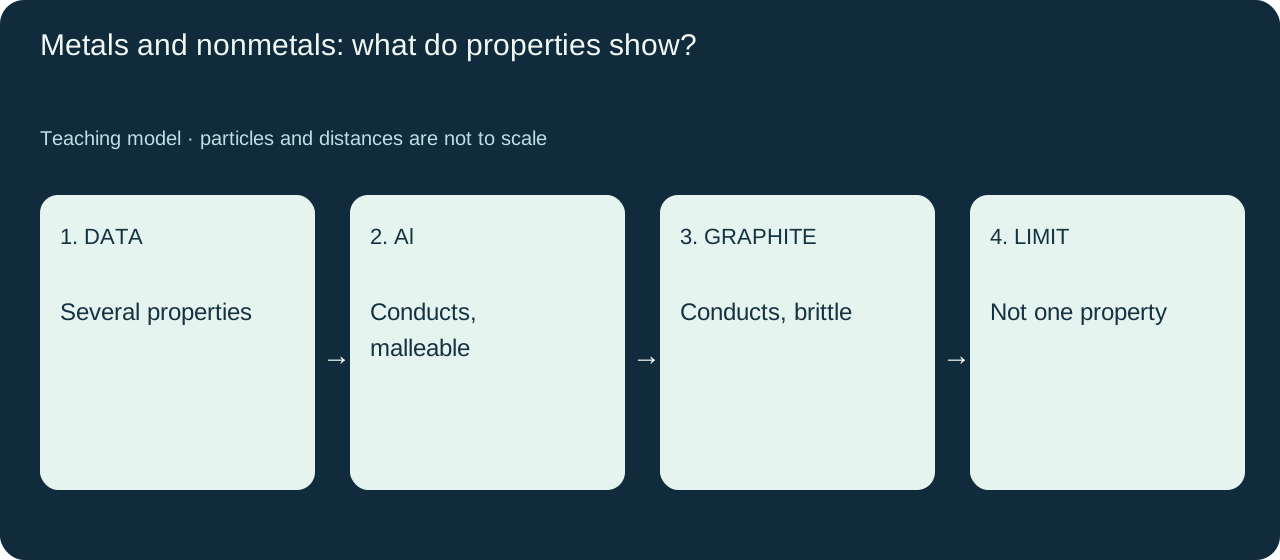
Teaching model · particles and distances are not to scale
Situation and question
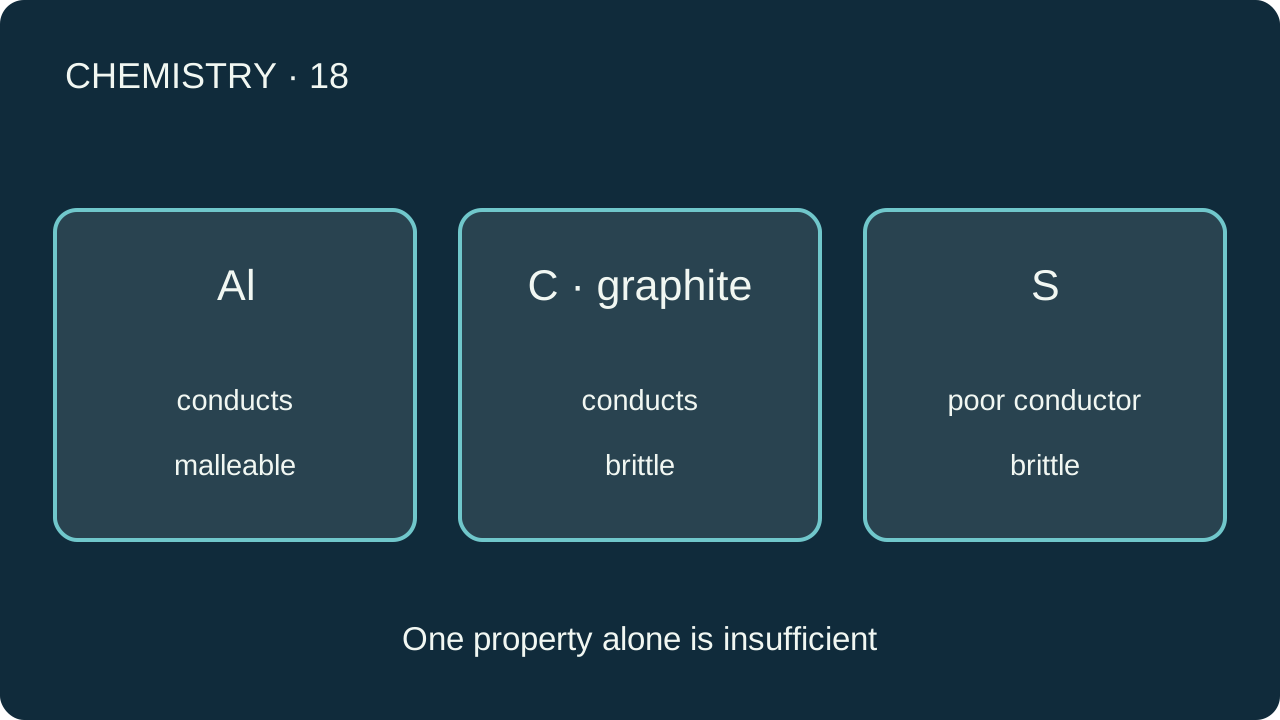
You have three rows of reference data, not unknown samples. Aluminium conducts electricity and can undergo plastic deformation. Graphite conducts electricity but is brittle. Sulfur is brittle and conducts poorly. Is the single property “conducts” enough to classify a substance as a metal? Write a testable rule before checking it.
New terms, fully explained
Here a metal is a class of simple substances with a characteristic combination of properties, such as conductivity and plasticity. Plasticity means changing shape without breaking under suitable conditions. Brittleness is a tendency to fracture during deformation. A nonmetal is not necessarily a gas. Properties concern a substance and its structure, not the colour of an element’s table square.
Predict first
Predict what happens to the rule “every conductor is a metal” when applied to graphite. Record your prediction first. Recall that water and ice differ in properties despite sharing their chemical composition: structure and conditions matter.
Investigate or analyse given data
Make a paper table: substance, conductivity, deformation, conclusion, limit of conclusion. Use the supplied information about Al, graphite C and S. Do not connect materials to a socket, battery or instrument. Do not heat or crush substances. We are analysing supplied data rather than conducting electrical tests.
Worked example
Both aluminium properties fit metallic behaviour. Graphite combines conductivity with brittleness; it is a known form of carbon, a nonmetallic element. One property alone therefore fails as a reliable classification rule. Sulfur gives another combination. Diamond is also carbon but differs from graphite in structure and electrical properties.
A common mistake
Mistake: identifying every shiny object as metal or every nonmetal as an insulator without exceptions. Many materials shine, and objects can be coated or made of mixtures. Table position provides guidance, but a photograph cannot establish that an unknown household object is a pure simple substance.
Transfer to a new case
A new material X is shiny and conducts electricity. Its composition and deformation behaviour are unknown. Have you proved that it is pure aluminium? Name two kinds of further evidence you would request. Separately explain why metallic sodium and table salt need not share their properties.
Answer and recall
Check: pure Al has not been established; composition and additional properties under specified conditions are needed. NaCl is a compound with its own structure, not a piece of sodium metal. Distinguish classifying a known substance from identifying an unknown one in the notebook. Recall a counterexample to “conductors are always metals” and explain which evidence changed the rule.
Exercise
- Which studied nonmetal conducts?
- Does shine identify Al?
- Are graphite and diamond identical?
Answers
Show the answers
Graphite; no; both are carbon but their structures and properties differ.
Notebook record
Record your initial answer, the evidence used, the corrected explanation and the limit of your conclusion. Close the example and explain a new case in your own words. If you made an error, identify the step: reading the card, counting particles, choosing a model or drawing a conclusion.
When to revisit
Close the page and, after 10 minutes, reconstruct the map, define the terms in your own words and solve the new case. Repeat without hints after a day and a week. If an error persists, return to the worked example and write down the missing step.
Sources and model limits
If you have found a mistake or a typo in this article, tell us about it
Comments (0)
Log in to leave a comment →
No comments yet. Be the first.