

Chemistry: investigate the world of substances Lesson 21 of 22
Does an ion move its element in the table?
Keep atomic number fixed when electron count changes and distinguish matching electrons from matching elements.
Support map
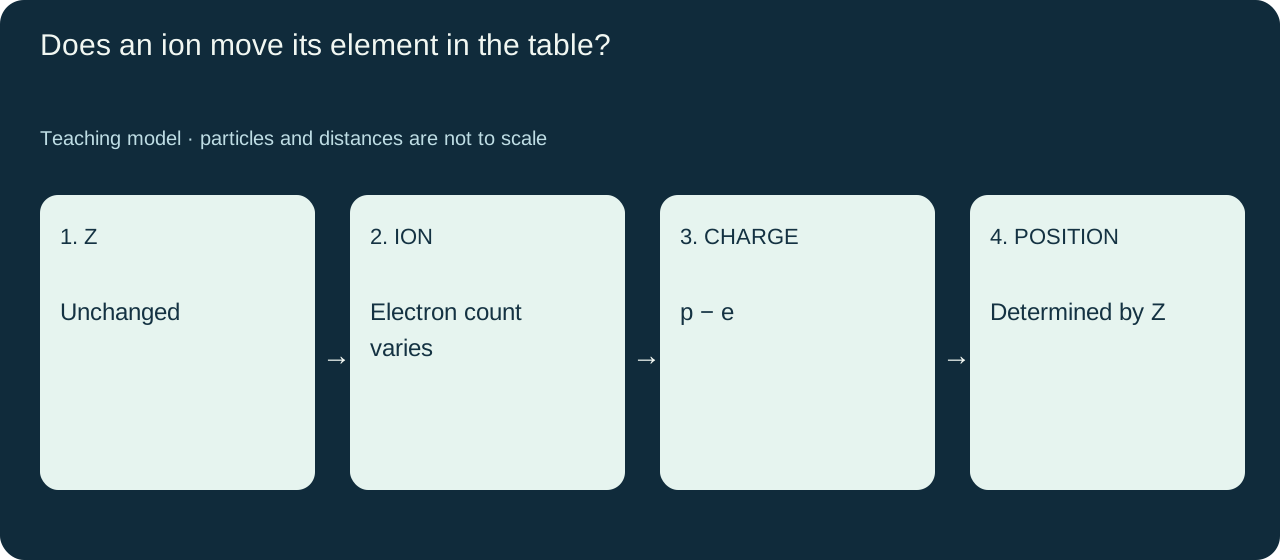
Teaching model · particles and distances are not to scale
Situation and question
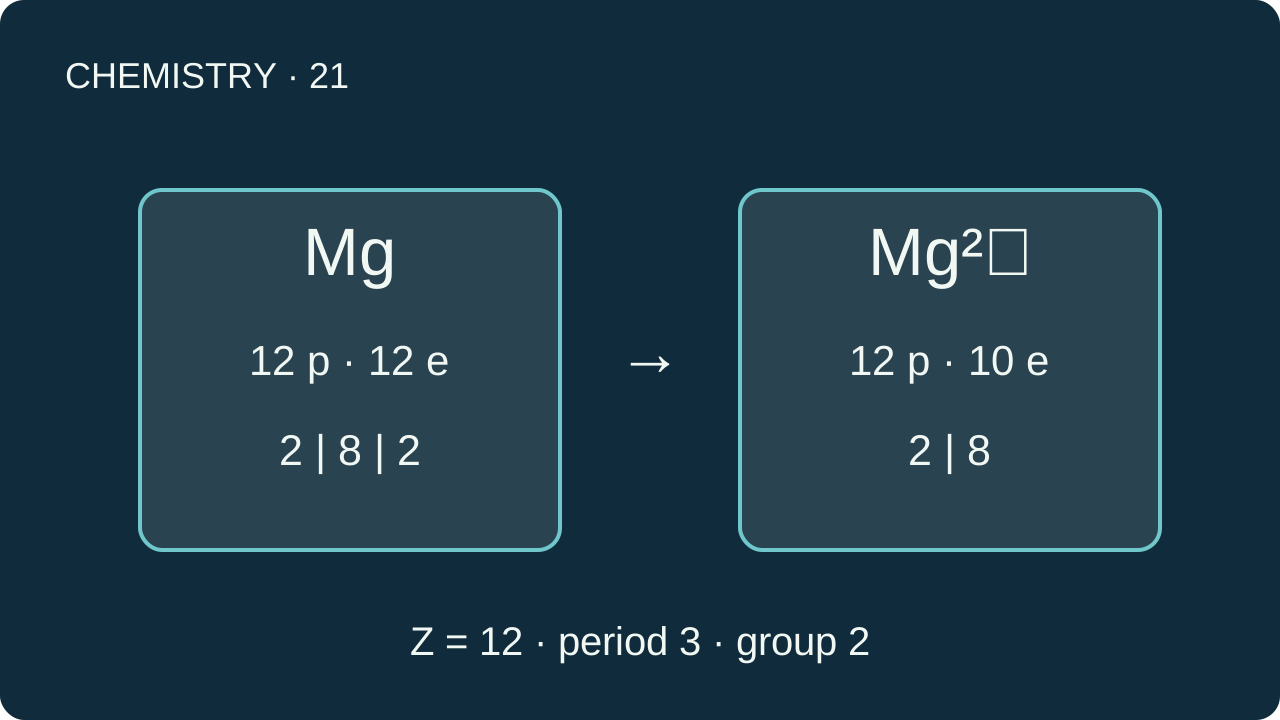
Neutral Mg has arrangement 2,8,2. After Mg²⁺ forms, 2,8 remains. Has magnesium moved into period 2? This tests the boundary of lesson 16’s rule. There we counted occupied shells in neutral ground-state atoms, not arbitrary charged particles.
New terms, fully explained
An ion is a particle with a net electric charge. Forming the monatomic ions studied here changes electron count while proton count stays fixed. A cation has positive charge; an anion has negative charge. Charge in elementary-charge units equals p−e. The table orders elements by Z, their proton count, rather than their current electron count.
Predict first
Predict the charge of a particle with 12 protons and 10 electrons. Compare it with neutral Ne, containing 10 protons and 10 electrons. Do equal electron counts make the nuclei and element names identical? Write separate answers before checking.
Investigate or analyse given data
Complete a paper table: particle, p, e, charge, shell arrangement, element. Rows: Mg with 12p and 12e; Mg²⁺ with 12p and 10e; Ne with 10p and 10e; Cl⁻ with 17p and 18e. Do not try making ions from household materials. The electron changes here are supplied conditions, not instructions for an experiment.
Worked example
For Mg, 12−12=0 and the arrangement is 2,8,2. For Mg²⁺, 12−10=+2 and the arrangement is 2,8. Both have Z=12: magnesium remains the element in period 3, group 2. Ne has Z=10 and remains neon. For Cl⁻, 17−18=−1 and the arrangement is 2,8,8. Chlorine remains in period 3, group 17.
A common mistake
Mistake: moving an ion into period 2 because it has two occupied shells, or turning Na⁺ into Ne because both have ten electrons. Matching electrons do not mean matching nuclei. A group does not guarantee only one possible ion charge for every element; do not extend early main-group rules to the entire table without checking.
Transfer to a new case
A new pair consists of Na⁺ with 11p and 10e and F⁻ with 9p and 10e. Find their charges and their elements’ positions in the teaching table. Explain why two arrangements of 2,8 do not make them one element. What would need to change for the element itself to change?
Answer and recall
Check: Na⁺ has charge +1; sodium is in period 3, group 1. F⁻ has charge −1; fluorine is in period 2, group 17. Changing the element would require changing proton count; ordinary formation of these ions does not do that. Close the example and explain the error “Mg²⁺ moved into period 2”. You can now label Na⁺ and Cl⁻ in the salt case without confusing them with neutral atoms.
Exercise
- What charge comes from 12p and 10e?
- Does Mg²⁺ move to period 2?
- Is Na⁺ neon?
Answers
Show the answers
+2; no, Mg remains in period 3; no, proton counts differ.
Notebook record
Record your initial answer, the evidence used, the corrected explanation and the limit of your conclusion. Close the example and explain a new case in your own words. If you made an error, identify the step: reading the card, counting particles, choosing a model or drawing a conclusion.
When to revisit
Close the page and, after 10 minutes, reconstruct the map, define the terms in your own words and solve the new case. Repeat without hints after a day and a week. If an error persists, return to the worked example and write down the missing step.
Sources and model limits
If you have found a mistake or a typo in this article, tell us about it
Comments (0)
Log in to leave a comment →
No comments yet. Be the first.