

Chemistry: investigate the world of substances Lesson 16 of 22
How are electrons arranged in the first 20 elements?
Use a limited shell model for neutral atoms without turning it into a rule for the entire periodic table.
Support map
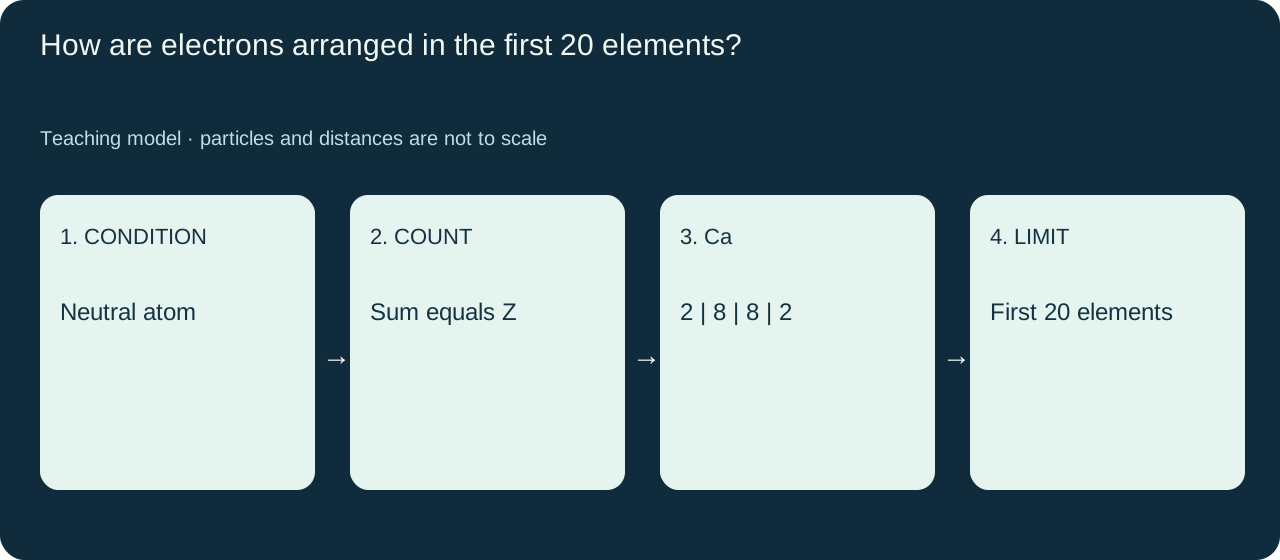
Teaching model · particles and distances are not to scale
Situation and question
The cards for Ne and Na contain 10 and 11 electrons. Why does adding just one electron accompany a new period? Recall when electron count equals Z. If you leave out the condition that the atom is neutral, applying the next rule to an ion will give a wrong result. Write the conditions before you start.
New terms, fully explained
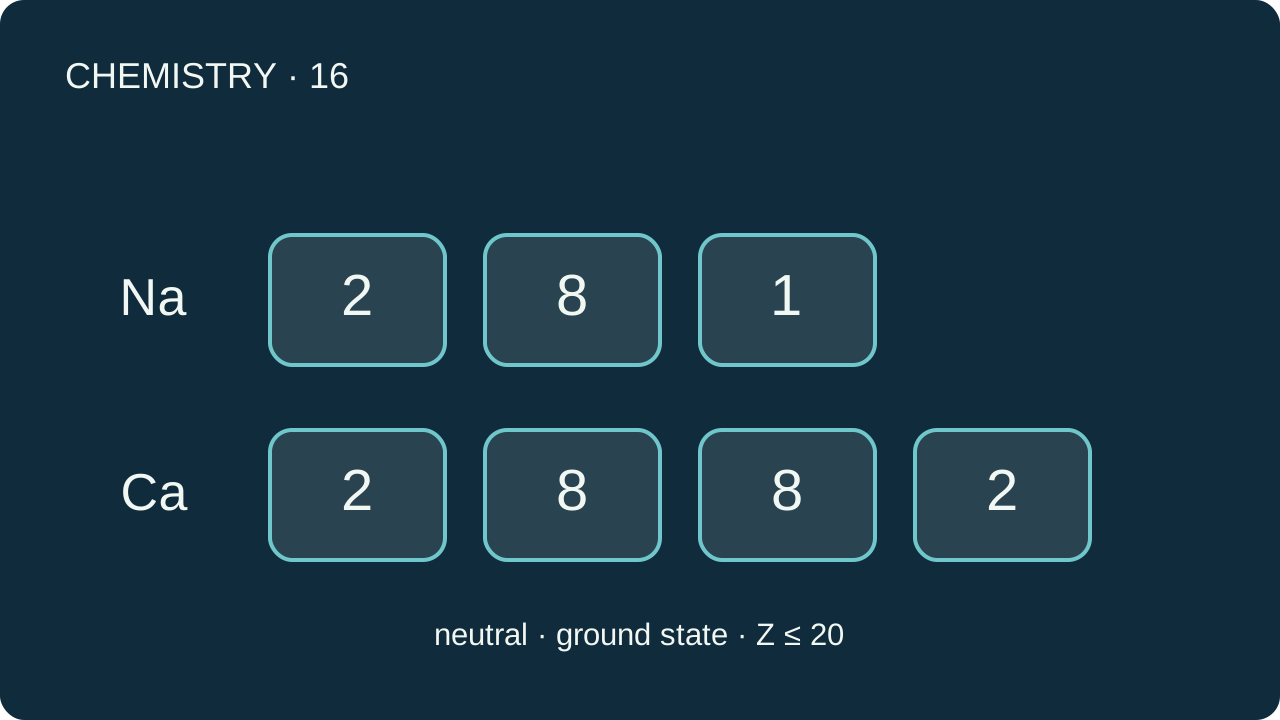
An electron shell is a simplified description of electron populations in energy levels. The ground state is an atom’s lowest-energy state. For neutral atoms of the first 20 elements we use shell populations: H — 1; He — 2; Ne — 2,8; Na — 2,8,1; Ar — 2,8,8; K — 2,8,8,1; Ca — 2,8,8,2. Commas separate shells rather than making a decimal number. Electrons do not travel along these written sequences like planets on tracks.
Predict first
Predict the arrangements for Mg with Z=12 and Cl with Z=17. Check that the numbers add to Z, not to the approximate atomic mass. Then predict how many occupied shells Ca has. State the scope: neutral atoms, ground state and the first 20 elements. Without those conditions, the claim becomes too broad.
Investigate or analyse given data
Draw four columns for shells 1–4. Distribute paper marks for O, Mg, Cl and Ca using the reference data. Each row must contain Z marks in total. Do not connect electrical devices or investigate unknown materials. This is a counting model on paper, not an experiment for detecting electrons or observing their paths.
Worked example
For Mg, 2+8+2=12 gives 2,8,2. For Cl, 2+8+7=17 gives 2,8,7. Both have three occupied shells and are in period 3. Ca has four: 2+8+8+2=20, so it is in period 4. Mg and Cl have different outer-shell populations despite sharing a period. For the neutral atoms studied here, period agrees with the number of occupied shells.
A common mistake
Mistake: claiming that the third shell can never contain more than eight electrons. Its full capacity is larger; filling beyond Ca needs a more detailed subshell model. Our lists do not cover every element or excited state. Drawn shell spacing, dot sizes and individual dot positions are symbolic, not measured atomic geometry.
Transfer to a new case
One card gives Z=13 and 2,8,3. Identify its element, period and outer-electron count. Another card with the same Z has only 10 electrons. Can you keep the neutral atom’s arrangement unchanged? Do not look for a new element: return to the proton and electron counts and calculate the charge first.
Answer and recall
Check: Z=13 identifies Al in period 3, with three outer electrons in the neutral atom. The particle with 10 electrons has charge +3 and arrangement 2,8 in this model. Its nucleus is still aluminium’s; lesson 21 examines ions’ table positions. Explain both the model’s usefulness and its limit to the first 20 neutral ground-state atoms without looking at the reference.
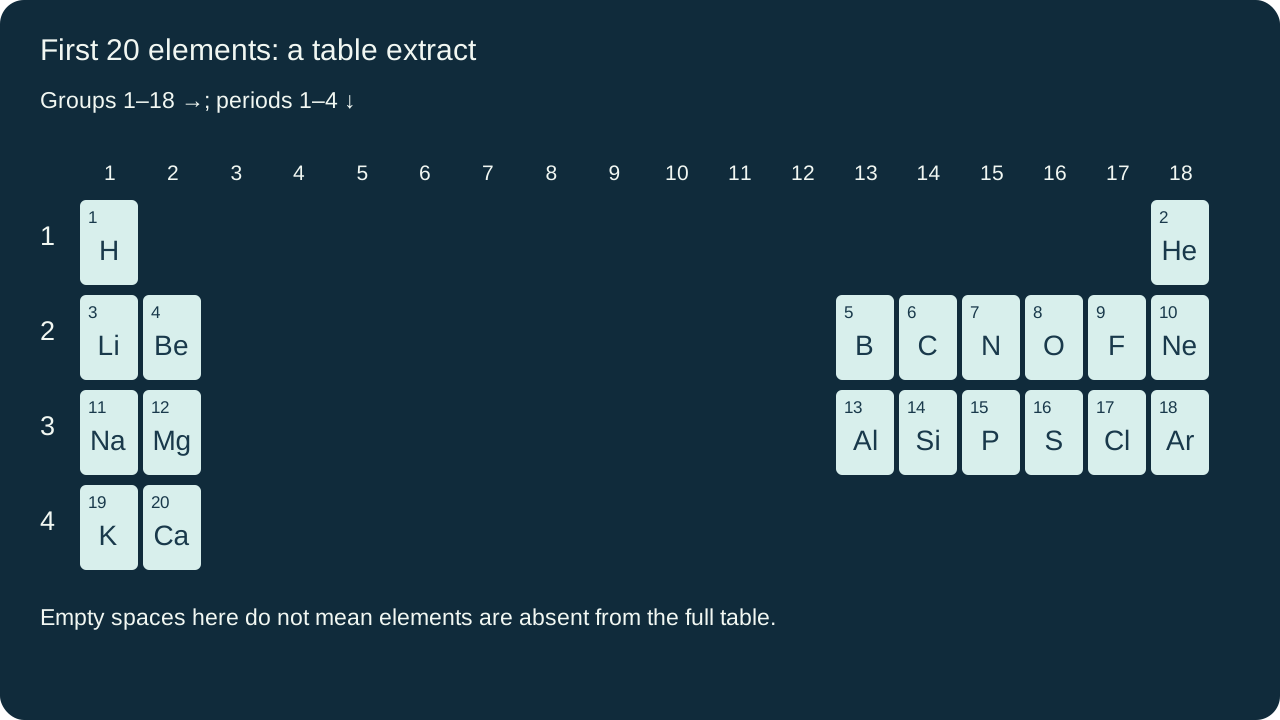
Empty spaces here do not mean elements are absent from the full table.
| Z | symbol | period | group | electrons by shell |
|---|---|---|---|---|
| 1 | H | 1 | 1 | 1 |
| 2 | He | 1 | 18 | 2 |
| 3 | Li | 2 | 1 | 2, 1 |
| 4 | Be | 2 | 2 | 2, 2 |
| 5 | B | 2 | 13 | 2, 3 |
| 6 | C | 2 | 14 | 2, 4 |
| 7 | N | 2 | 15 | 2, 5 |
| 8 | O | 2 | 16 | 2, 6 |
| 9 | F | 2 | 17 | 2, 7 |
| 10 | Ne | 2 | 18 | 2, 8 |
| 11 | Na | 3 | 1 | 2, 8, 1 |
| 12 | Mg | 3 | 2 | 2, 8, 2 |
| 13 | Al | 3 | 13 | 2, 8, 3 |
| 14 | Si | 3 | 14 | 2, 8, 4 |
| 15 | P | 3 | 15 | 2, 8, 5 |
| 16 | S | 3 | 16 | 2, 8, 6 |
| 17 | Cl | 3 | 17 | 2, 8, 7 |
| 18 | Ar | 3 | 18 | 2, 8, 8 |
| 19 | K | 4 | 1 | 2, 8, 8, 1 |
| 20 | Ca | 4 | 2 | 2, 8, 8, 2 |
Exercise
- Give Ca’s shell arrangement. How do you check the sum?
- Is eight the third shell’s full capacity?
Answers
Show the answers
2,8,8,2; total 20=Z; no, it is not the shell’s full capacity.
Notebook record
Record your initial answer, the evidence used, the corrected explanation and the limit of your conclusion. Close the example and explain a new case in your own words. If you made an error, identify the step: reading the card, counting particles, choosing a model or drawing a conclusion.
When to revisit
Close the page and, after 10 minutes, reconstruct the map, define the terms in your own words and solve the new case. Repeat without hints after a day and a week. If an error persists, return to the worked example and write down the missing step.
Sources and model limits
If you have found a mistake or a typo in this article, tell us about it
Comments (0)
Log in to leave a comment →
No comments yet. Be the first.