

Chemistry: investigate the world of substances Lesson 17 of 22
Why do elements form families?
Compare alkali metals, halogens and noble gases, including the hydrogen and helium exceptions.
Support map
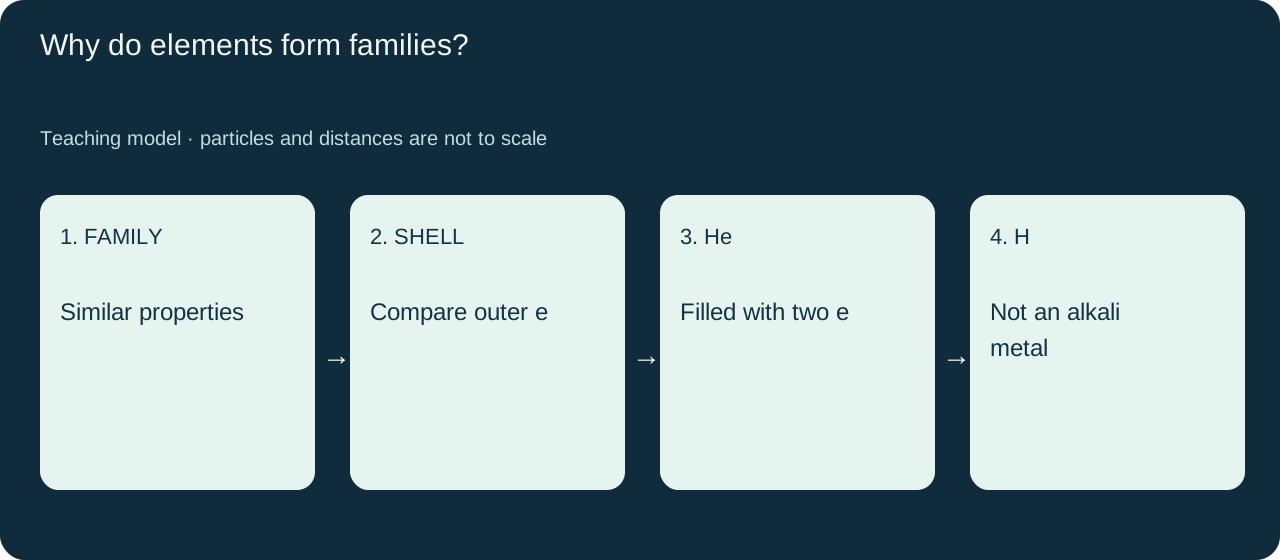
Teaching model · particles and distances are not to scale
Situation and question
The notebook contains a hypothesis: because Na is above K, their simple substances must be identical. What actually unites members of a group? Use element cards rather than samples of metals or gases. Similar structure supports a search for patterns; it does not remove every difference between substances.
New terms, fully explained
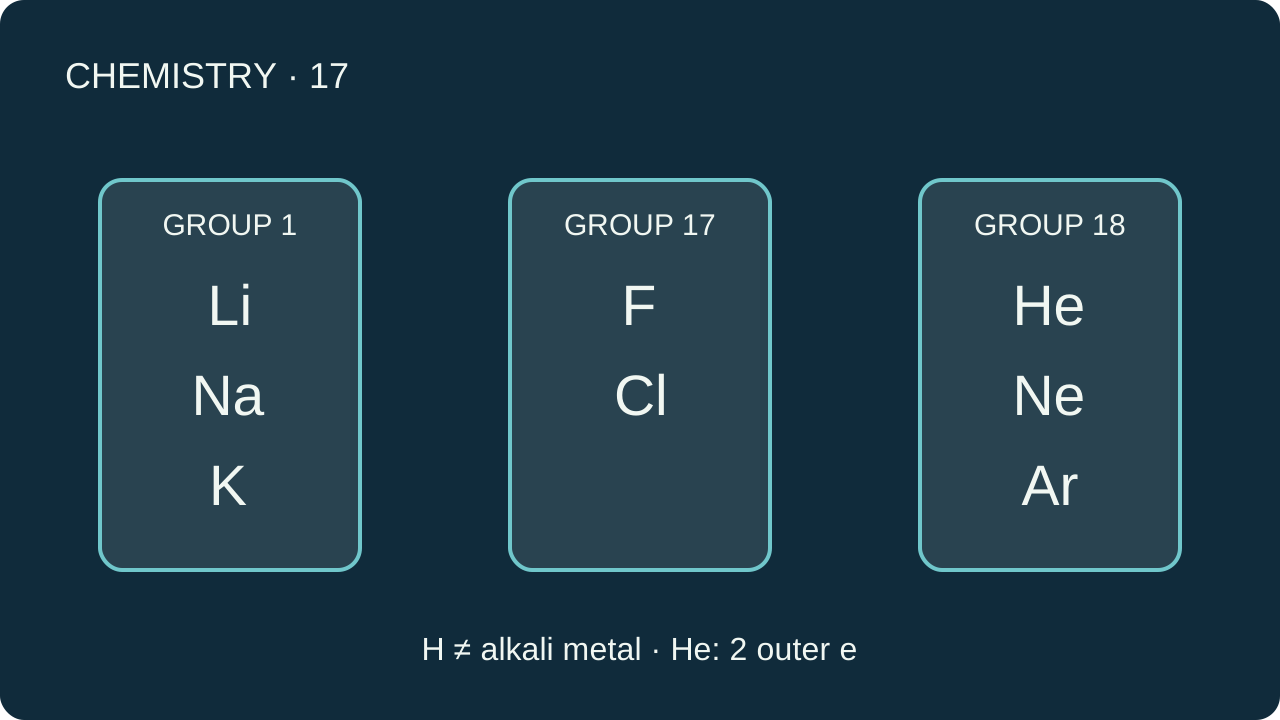
An element family is a name for a group with shared chemical features. Li, Na and K are alkali metals in group 1. H is in that group but is not an alkali metal. Mg and Ca are alkaline earth metals in group 2. F and Cl are halogens in group 17. He, Ne and Ar are noble gases in group 18.
Predict first
Predict which pair has more similar outer-shell structure in its neutral atoms: Li and Na, or Na and Cl. Write a reason before checking. Separately decide whether H being above Li makes hydrogen a metal. A question about atomic structure is different from a question about a substance’s appearance.
Investigate or analyse given data
Make a paper table: element, group, electron arrangement, outer-shell population. Data: Li 2,1; Na 2,8,1; K 2,8,8,1; Mg 2,8,2; Ca 2,8,8,2; F 2,7; Cl 2,8,7; He 2; Ne 2,8; Ar 2,8,8. Find repeated final numbers before comparing their group positions.
Worked example
Li and Na each have one outer electron but different numbers of occupied shells. F and Cl each have seven outer electrons. Ne and Ar have eight; He has a filled first and only shell containing two. This is why requiring eight outer electrons of every group 18 element would fail for helium.
A common mistake
Mistake: treating similarity as a promise of identical reaction rates, melting points or safety. Properties vary within a family. “Noble gas” does not mean “never forms compounds”. Do not test alkali metals with water or make halogens. All work in this lesson uses supplied data.
Transfer to a new case
A new neutral-atom card shows 2,8,8,2. Identify its element and a studied relative in the same family. What extra information would you need to compare their substances’ melting points? Separate a prediction of similarity from a property that needs its own measurements.
Answer and recall
Check: the element is Ca, group 2; compare it with Mg. Obtain melting points from reliable reference data under comparable conditions, rather than calculating them from outer electrons. Recall four family names and the two exceptions discussed here. For the salt case, record that Na and Cl belong to different families; their compound’s properties need a separate explanation.
Exercise
- Is H an alkali metal?
- How many outer electrons do He and Ne have?
- Why compare Li and Na?
Answers
Show the answers
No; two and eight; Li and Na each have one outer electron.
Notebook record
Record your initial answer, the evidence used, the corrected explanation and the limit of your conclusion. Close the example and explain a new case in your own words. If you made an error, identify the step: reading the card, counting particles, choosing a model or drawing a conclusion.
When to revisit
Close the page and, after 10 minutes, reconstruct the map, define the terms in your own words and solve the new case. Repeat without hints after a day and a week. If an error persists, return to the worked example and write down the missing step.
Sources and model limits
If you have found a mistake or a typo in this article, tell us about it
Comments (0)
Log in to leave a comment →
No comments yet. Be the first.