

Chemistry: investigate the world of substances Lesson 19 of 22
Periodic trends and the limits of prediction
Explain selected changes in atomic size without turning a trend into a universal rule.
Support map
Teaching model · particles and distances are not to scale
Situation and question
Proton count increases along Li, Na, K. Must the atom therefore become smaller? Occupied electron shells matter alongside nuclear charge. We will compare two sets of neutral atoms. Sizes below express qualitative relationships, not measurements made with a ruler on a drawing.
New terms, fully explained
A periodic trend is a recurring direction of change in a property within a specified part of the table. Atomic radius describes size under an agreed definition; an electron cloud has no hard boundary. Do not mix different radius definitions or compare atomic and ionic radii as though they were the same quantity. Here we compare covalent radii: half the distance between the nuclei of two identical atoms joined by a single chemical bond. The next block develops bonding; for now, keep the size definition consistent. This lesson gives no numerical radii.
Predict first
Predict separately the size changes down Li → Na → K and across the short series Na → Mg → Al. Where is an occupied shell added? Where does shell count stay the same? Record two explanations before checking the answers.
Investigate or analyse given data
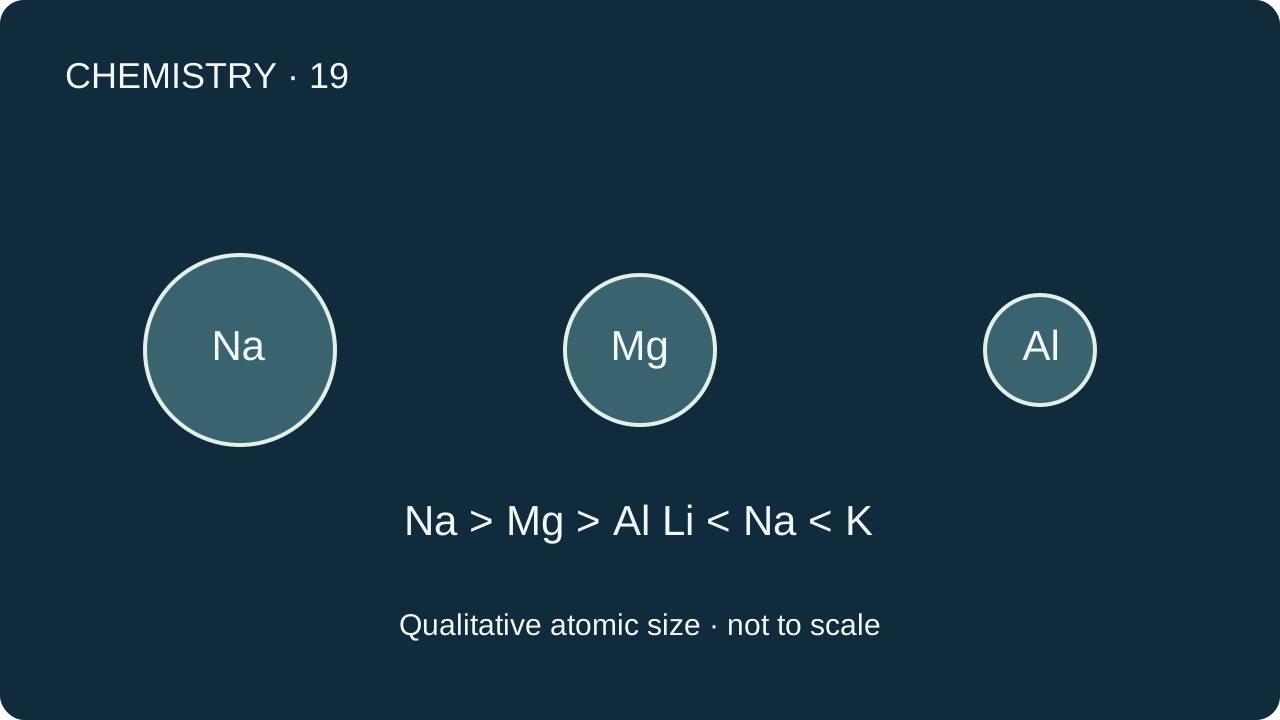
Qualitative data for the selected covalent radii: Li is smaller than Na, and Na smaller than K; Na is larger than Mg, and Mg larger than Al. Beside these, write 2,1; 2,8,1; 2,8,8,1 and 2,8,1; 2,8,2; 2,8,3. Draw circles only to show the order of sizes. Label them “symbolic, not to scale”. Use paper rather than material samples.
Worked example
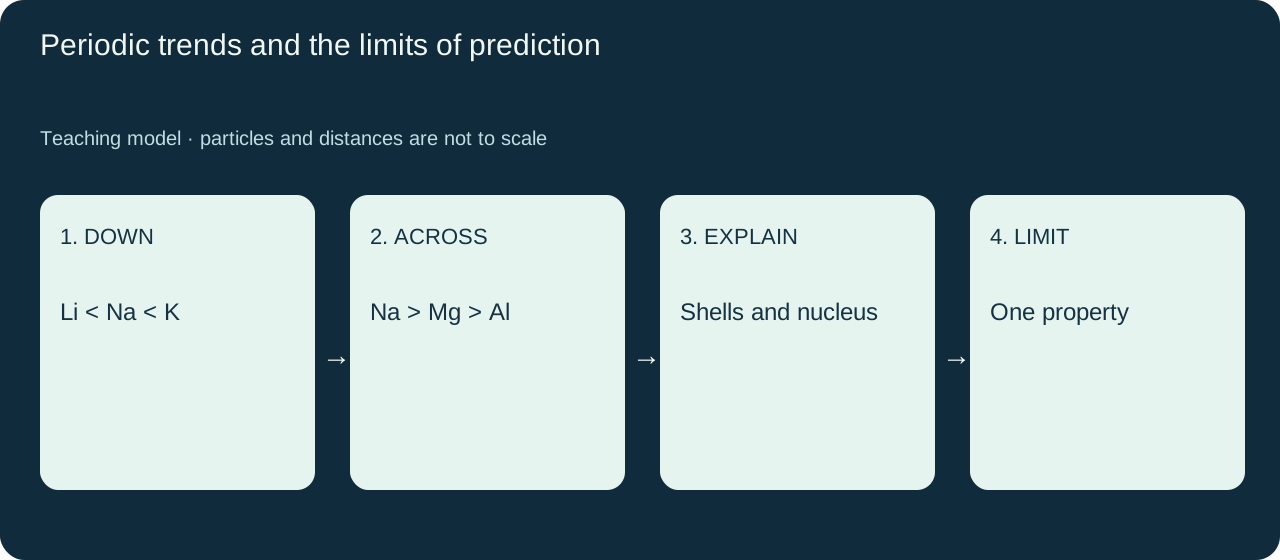
Down group 1, additional occupied shells place outer electrons farther from the nucleus on average. Across this selected part of period 3, occupied-shell count stays constant while nuclear charge rises. Allowing for shielding, this helps explain decreasing size from Na to Mg to Al. Counting protons alone cannot explain both series.
A common mistake
Mistake: assuming that every property changes strictly and identically across every row. Melting point depends on a substance’s structure, not just an isolated atom’s size. Other table regions and precise values need reference data with the quantity defined. A symbol’s colour or printed size is not a measurement.
Transfer to a new case
Apply the explanation to Mg and Ca, with arrangements 2,8,2 and 2,8,8,2. Which atom is generally larger under a consistent radius definition? Can that calculate a melting point or the rate of any reaction? Identify the conditions and data missing from such a claim.
Answer and recall
Check: Ca is generally larger than Mg and has an additional occupied shell. This does not calculate numerical melting points or arbitrary reaction rates. Put two trend arrows in the notebook, with their scope and a reminder about radius definitions. Explain them in your own words rather than substituting “that is how the table works” for a cause.
Exercise
- How does size change Li → Na → K?
- Order Na, Mg and Al. Does this calculate melting points?
Answers
Show the answers
It increases downwards; Na > Mg > Al under a consistent radius definition; no.
Notebook record
Record your initial answer, the evidence used, the corrected explanation and the limit of your conclusion. Close the example and explain a new case in your own words. If you made an error, identify the step: reading the card, counting particles, choosing a model or drawing a conclusion.
When to revisit
Close the page and, after 10 minutes, reconstruct the map, define the terms in your own words and solve the new case. Repeat without hints after a day and a week. If an error persists, return to the worked example and write down the missing step.
Sources and model limits
- IUPAC: periodic table
- RSC: periodic trends
- RSC: sodium radii
- RSC: magnesium radii
- RSC: aluminium radii
If you have found a mistake or a typo in this article, tell us about it
Comments (0)
Log in to leave a comment →
No comments yet. Be the first.