

Chemistry: investigate the world of substances Lesson 23 of 40
Why do atoms form chemical bonds?
Connect attraction and repulsion with stability without saying that an atom “wants” something.
Support map
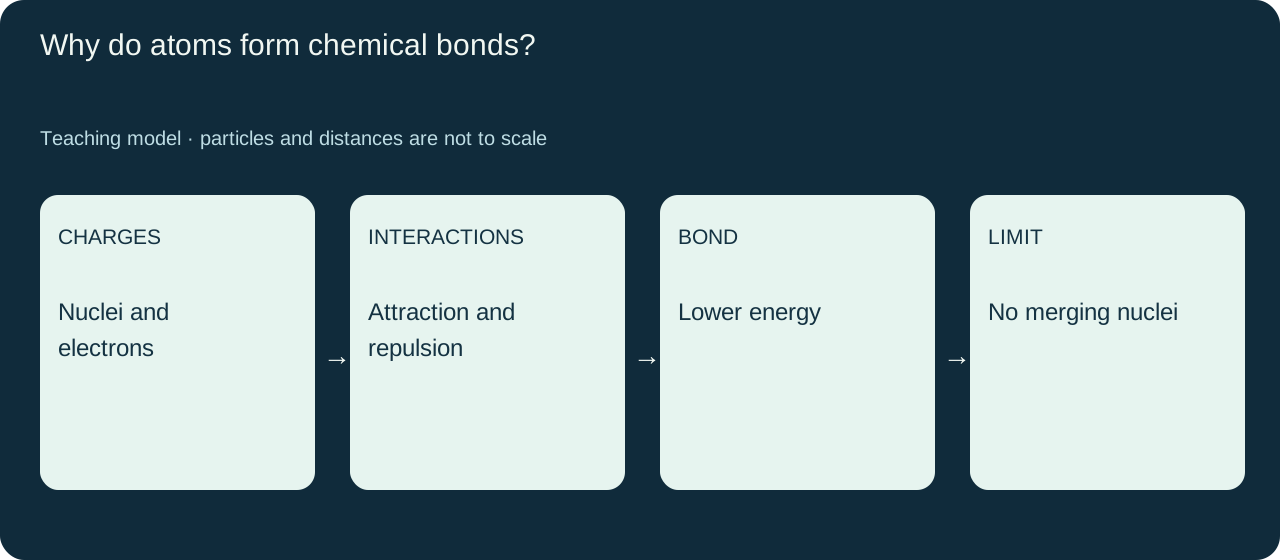
Model diagram
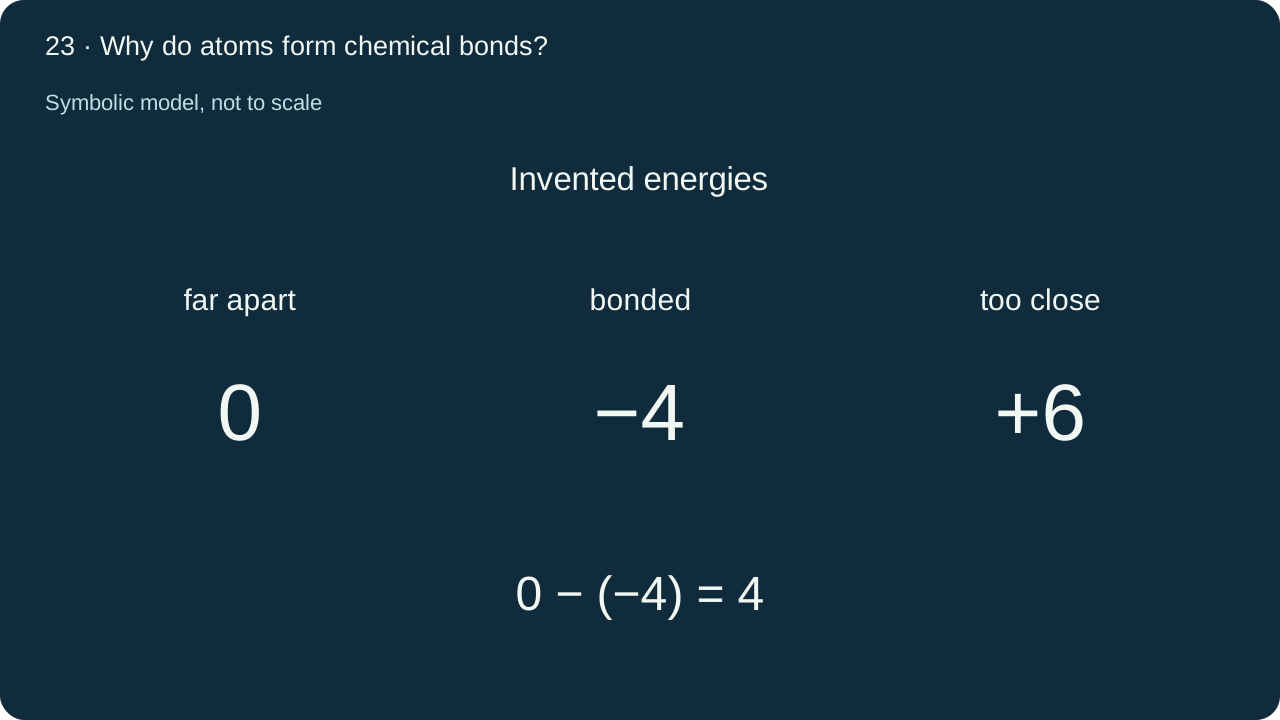
Teaching model · particles and distances are not to scale
Use paper and supplied data only. Do not produce gases, heat substances or use electrical equipment; do not touch, taste or smell unknown substances.
Situation and question
Your notebook contains H and H₂. Both refer to hydrogen but denote different particles. Why can two neutral atoms remain together when each has zero total charge? Record a prediction. Use drawings only; do not produce hydrogen. Neither the colour of a model sphere nor a line connecting spheres is an observation of actual electrons.
New terms, fully explained
A chemical bond is an interaction holding atoms or ions together in a substance. Atoms contain positive nuclei and negative electrons. Charged particles attract or repel one another. System energy helps compare states: H₂ at a suitable separation has lower energy than two distant H atoms. Breaking that bond requires an input of energy.
Predict first
Predict whether the nuclei keep approaching until they merge. Does a neutral atom contain no charged particles? Mark where you know the total charge and where the internal structure matters. Check your prediction after using the data; simply writing “stability” does not explain the interaction.
Investigate or analyse given data
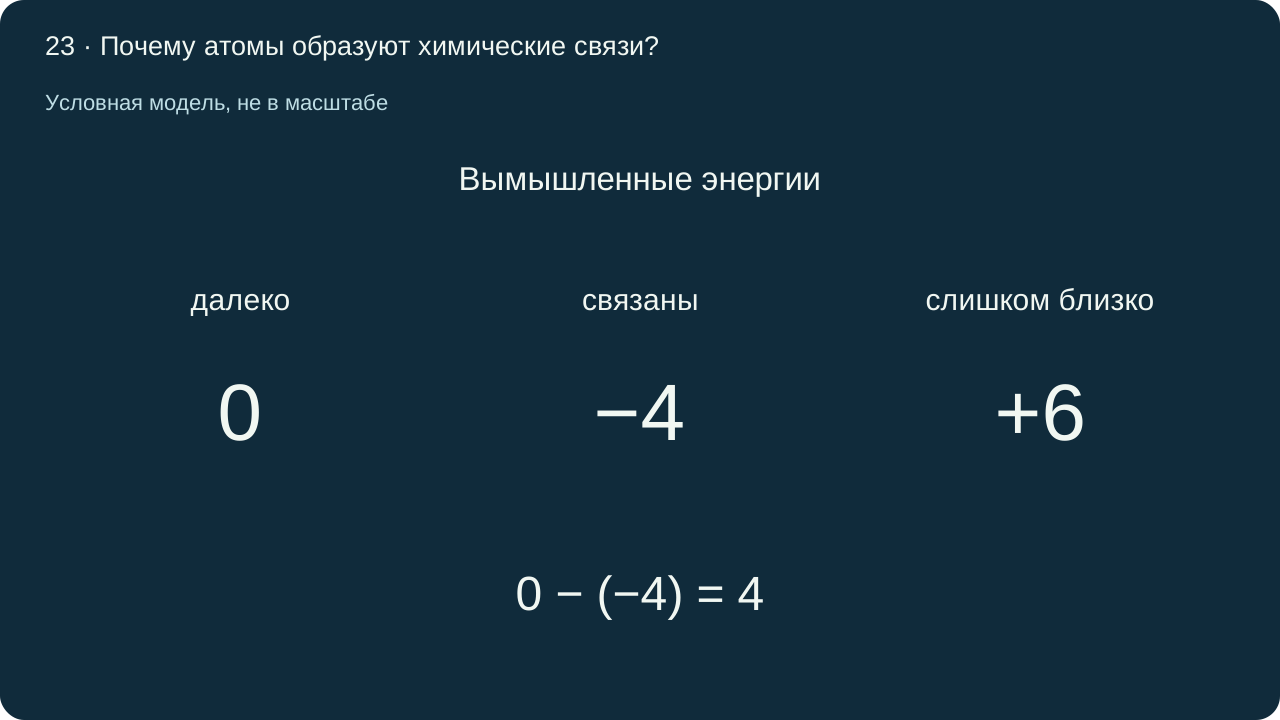
Analyse these invented values for two H atoms: far apart, energy 0; suitable separation, −4; too close, +6. These are teaching values in arbitrary units, not measured hydrogen energies. Draw the three arrangements and label attraction to electrons and repulsion between nuclei. Compare states of the same pair of atoms.
Worked example
The lowest of the three values is −4. At excessively short separation, repulsion matters and the energy rises to +6. A bond therefore does not mean that nuclei merge. Moving from −4 to distant atoms at energy 0 requires 4 arbitrary energy units in this model.
A common mistake
Mistake: “atoms want eight electrons”. Atoms have no wishes; a filled-shell rule is a useful model for some simple cases, not a universal cause. Hydrogen has a filled shell with two electrons, not eight. Bond formation releases energy, but a whole reaction may require energy because other bonds must also be broken.
Transfer to a new case
A new pair model has energy 0 far apart, −7 in its bonded state and +9 when too close. Select the lowest-energy state and calculate the energy required to separate the particles. Can these values tell you the substance’s colour or prove that every pair of elements forms the same sort of compound?
Answer and recall
Check: −7; separation requires 7 arbitrary units. Colour and the composition of other substances remain unknown. Reconstruct “charges → interactions → suitable separation → lower energy”. State the limit: this is a qualitative model of the given pair, without real scales or a calculation of every possible substance.
Exercise
- Does breaking a bond into distant atoms require or release energy?
- Does H have a filled shell with two or eight electrons?
- Which state has lowest energy in a 0 / −5 / +8 model?
Answers
Show the answers
Requires energy; two; −5. Energy lowering for one bond does not determine the energy change of a whole reaction.
Investigator’s notebook
Record your first answer before reading the explanation. For each error, identify the step: particle model, electron count, charge balance, brackets or limits of inference. Correct the explanation, invent a new example and solve it without hints.
When to revisit
Close the page and, after 10 minutes, reconstruct the map, define the terms in your own words and solve the new case. Repeat without hints after a day and a week. If an error persists, return to the worked example and write down the missing step.
Sources and limits
If you have found a mistake or a typo in this article, tell us about it
Comments (0)
Log in to leave a comment →
No comments yet. Be the first.