

Chemistry: investigate the world of substances Lesson 35 of 40
How can we balance a reaction without changing formulas?
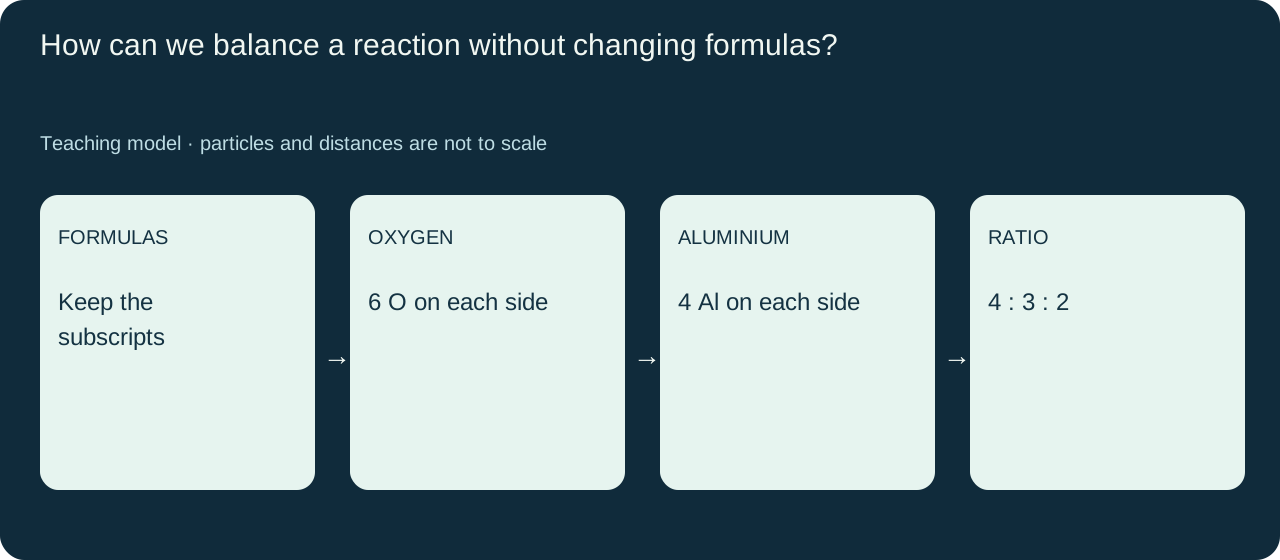
Choose integer coefficients, check every element and reduce any common factor.
Support map
Model diagram
Use paper and supplied data only. Do not produce gases, heat substances or use electrical equipment; do not touch, taste or smell unknown substances.
Situation and question
In Al + O₂ → Al₂O₃, oxygen has two atoms on the left and three on the right. Writing Al₂O₂ would simplify counting but change the specified product. How do we preserve formulas? Use paper cards and arithmetic only; no aluminium, oxygen or heating is required.
New terms, fully explained
A coefficient before a formula multiplies every atom in it. Balancing preserves the compositions of the specified reactants and products: change coefficients, not subscripts. Our final school notation uses the smallest positive integers. One is normally omitted; fractions may help intermediate bookkeeping, but we convert them to integers here.
Predict first
Predict a convenient number of O atoms divisible into both pairs and threes. Once O is reconciled, how many Al atoms are required? Check the second element before declaring success. Record your method before comparing it with the worked example.
Investigate or analyse given data
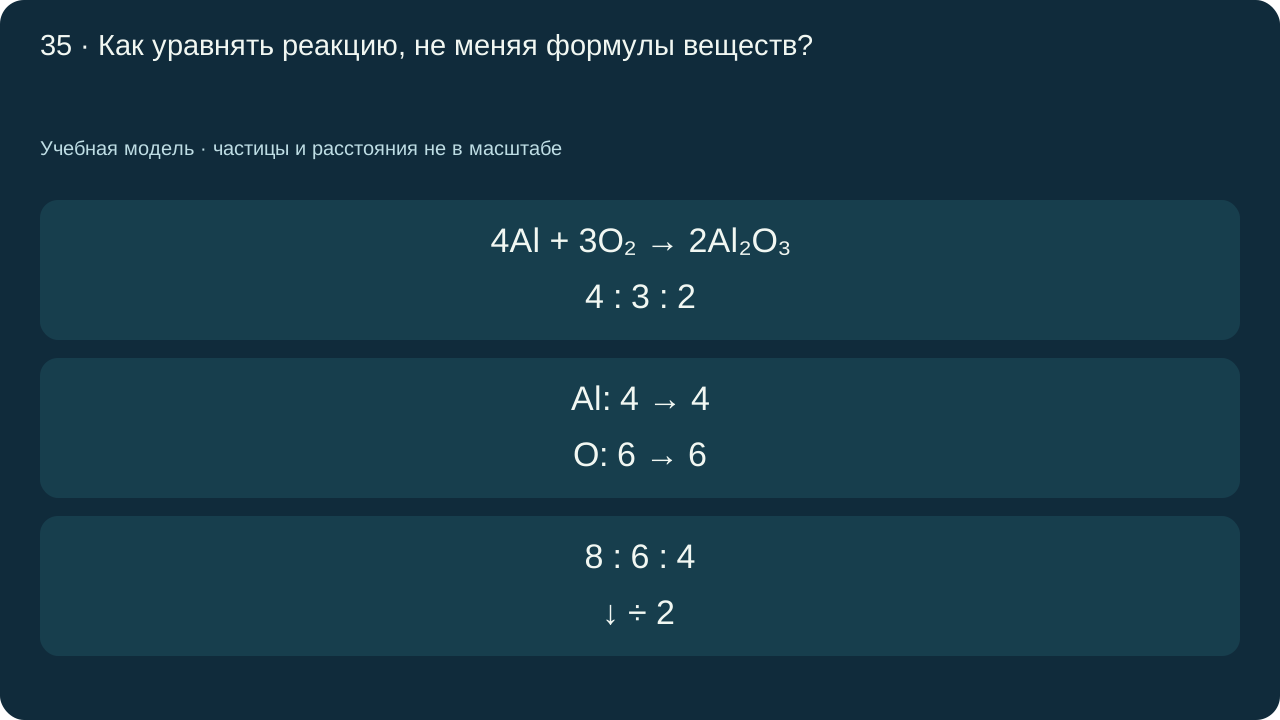
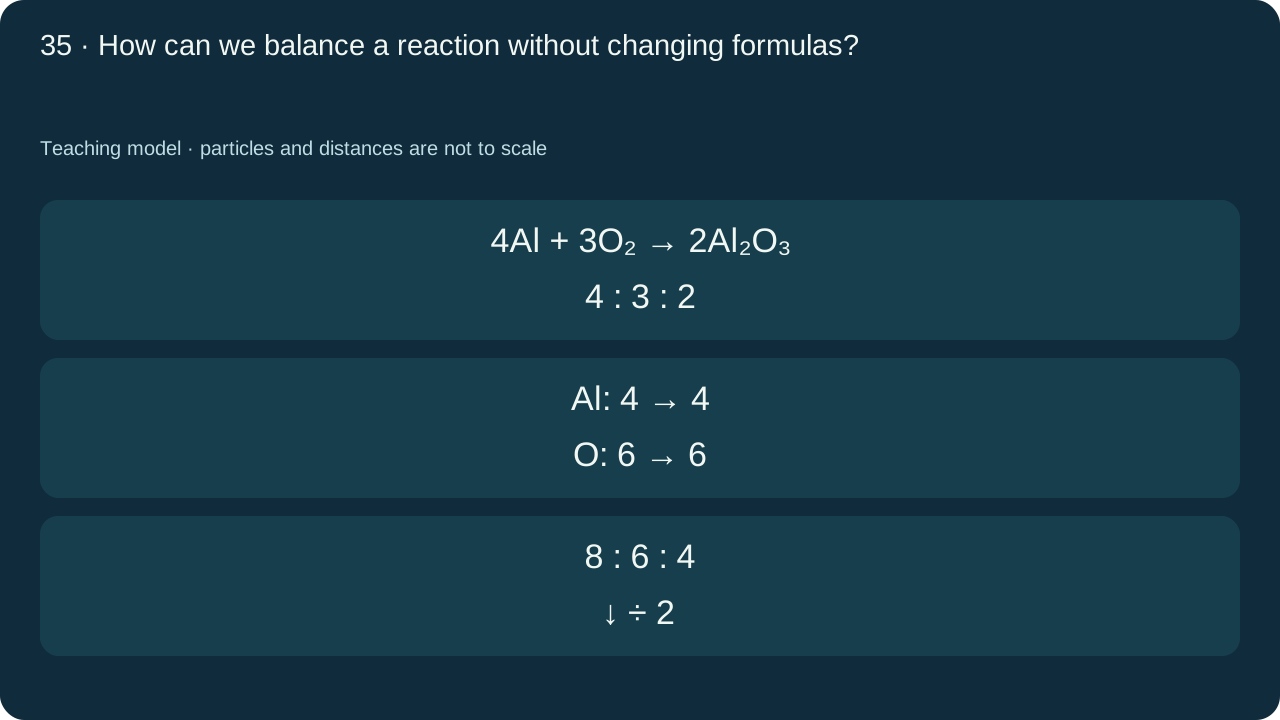
Choose six O atoms: three O₂ and two formula units of Al₂O₃. Two Al₂O₃ units contain four Al atoms. Write coefficients 4 : 3 : 2 and build a check table. “Formula unit” does not turn the solid oxide into isolated molecules.
4Al + 3O₂ → 2Al₂O₃
| Data / element | Before / left | After / right |
|---|---|---|
| Al | 4 | 4 |
| O | 6 | 6 |
Worked example
The result is 4Al + 3O₂ → 2Al₂O₃, with Al=4, O=6 on both sides. Doubling all coefficients gives 8 : 6 : 4 and still balances atoms, but the common divisor two reduces it to 4: 3: 2. Coefficients express relative amounts, not equal masses in grams.
A common mistake
Mistake: replacing Al₂O₃ with Al₂O₂ to repair an O shortage; forgetting the coefficient multiplies both Al and O; checking only one element. The method operates on given products, rather than determining which product actually forms under particular conditions.
Transfer to a new case
Balance Fe + O₂ → Fe₂O₃, taking Fe₂O₃ as the specified product, and N₂ + H₂ → NH₃. The first example does not claim all rust is pure Fe₂O₃. Show element totals and check common factors separately for each equation.
Answer and recall
Check: 4Fe + 3O₂ → 2Fe₂O₃ has Fe=4, O=6; N₂ + 3H₂ → 2NH₃ has N=2, H=6. Ammonia-production conditions are not instructions to perform a reaction, and balance alone does not predict products. Recall “fixed formulas → coefficients → each element → simplest ratio” and explain why changing a subscript is wrong.
Exercise
- Balance Al + O₂ → Al₂O₃.
- May Al₂O₃ be replaced by AlO?
- Why reduce 8:6:4?
Answers
Show the answers
4:3:2; no, that changes composition; all coefficients share a factor of 2. Check 4 Al and 6 O on each side after reducing.
Investigator’s notebook
For each error, identify its cause: wrong composition, changed subscript, missing atom, neglected system boundary, or confusion between heat and temperature. Correct your explanation and check another example without hints.
When to revisit
Close the page and, after 10 minutes, reconstruct the map, define the terms in your own words and solve the new case. Repeat without hints after a day and a week. If an error persists, return to the worked example and write down the missing step.
Sources and limits
If you have found a mistake or a typo in this article, tell us about it
Comments (0)
Log in to leave a comment →
No comments yet. Be the first.