

Chemistry: investigate the world of substances Lesson 28 of 40
How do we build a formula from given ion charges?
Find the smallest neutral ratio instead of blindly swapping charge numbers.
Support map
Model diagram
Teaching model · particles and distances are not to scale
Use paper and supplied data only. Do not produce gases, heat substances or use electrical equipment; do not touch, taste or smell unknown substances.
Situation and question
Two cards say Mg²⁺ and Cl⁻. MgCl looks concise, but its charges sum to +1. How can you represent a neutral compound without changing the ions themselves? Draw cards on paper. Charges are supplied here; do not infer them from an unidentified sample or alter them to obtain a convenient answer.
New terms, fully explained
A subscript at the lower right gives the number of atoms or groups; one is omitted. For an ionic compound it expresses a ratio. Electrical neutrality means positive and negative charges sum to zero. Use the smallest whole-number ratio of the specified ions. This handles simple given compositions, not every possible compound of the elements.
Predict first
Predict how many Cl⁻ ions balance one Mg²⁺. Is one ion of each enough for Al³⁺ and O²⁻? Write the charge sum before selecting a formula. If it is not zero, change ion counts rather than the charge of an individual ion.
Investigate or analyse given data
Make columns for ion pair, counts, charge sum and result. Use Na⁺/Cl⁻, Mg²⁺/Cl⁻, Al³⁺/O²⁻ and Ca²⁺/O²⁻. Try small whole numbers. Check both neutrality and the absence of a common divisor of the counts. Numerical work requires no salts, metals or oxygen in a container.
Worked example
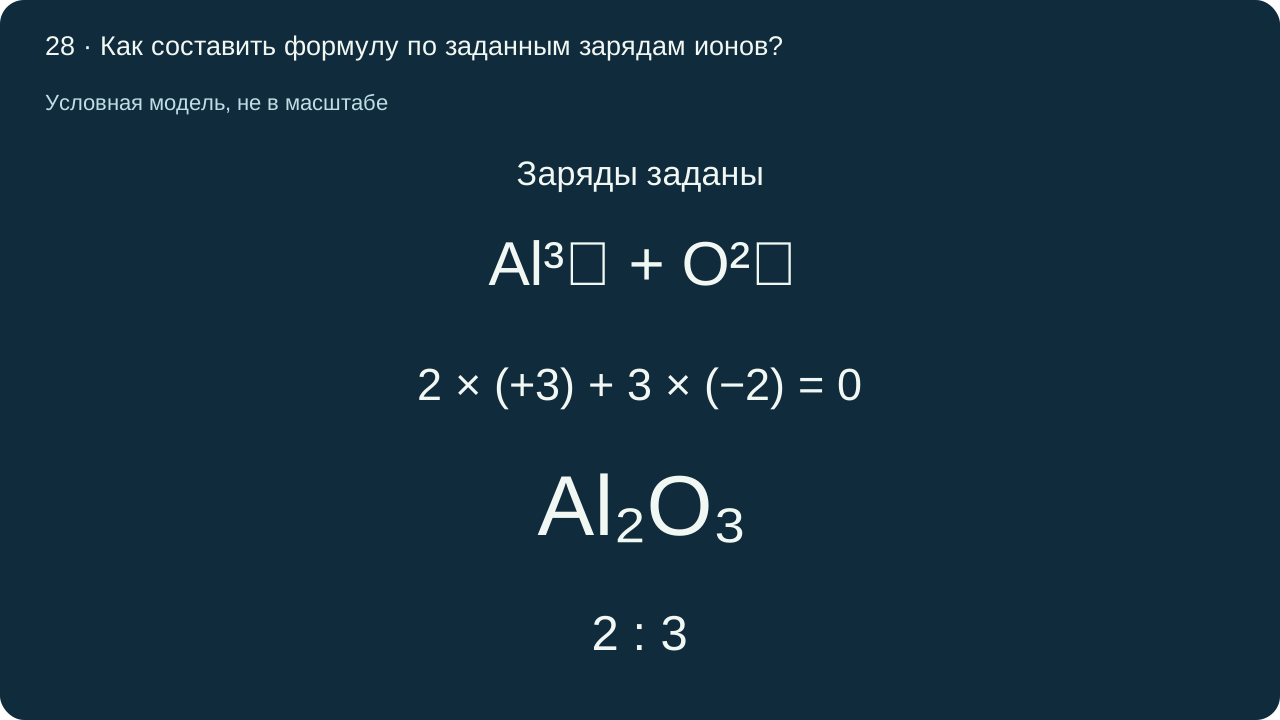
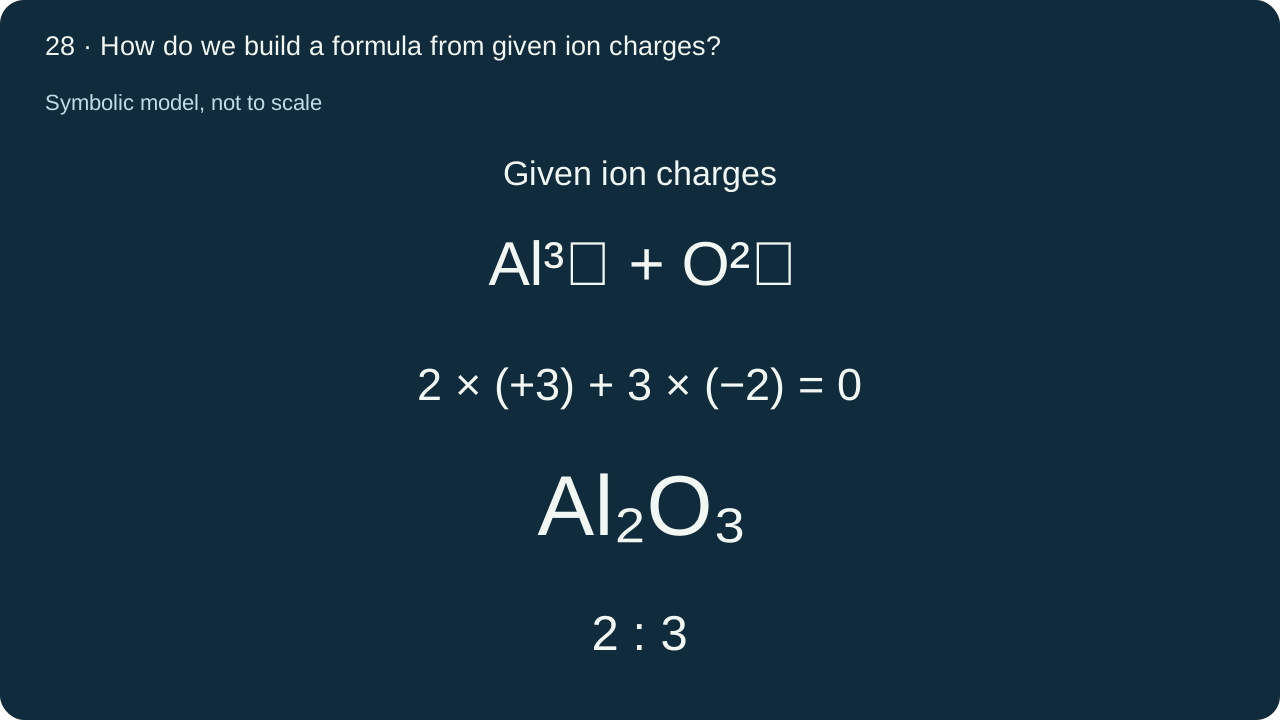
One Mg²⁺ and two Cl⁻ give +2+2×(−1)=0: MgCl₂. Two Al³⁺ and three O²⁻ give 2×3+3×(−2)=0: Al₂O₃. Ca²⁺ and O²⁻ need 1:1, so CaO. Ca₂O₂ is neutral but is not the simplest expression of this ionic ratio.
A common mistake
Mistake: putting charge signs into a neutral formula or confusing MgCl₂ with Mg²Cl. A charge describes an ion; a subscript describes a count. Iron can form different ions, so an element name alone cannot fix a unique formula without charges or other conditions. A correct formula also does not establish a powder’s purity.
Transfer to a new case
Try Ca²⁺/N³⁻ and K⁺/S²⁻. Find the simplest neutral ratios and formulas. Then compare Fe²⁺/Cl⁻ with Fe³⁺/Cl⁻: do they give the same formula? N³⁻ and S²⁻ cards specify ions in compounds, not free particles to produce at home.
Answer and recall
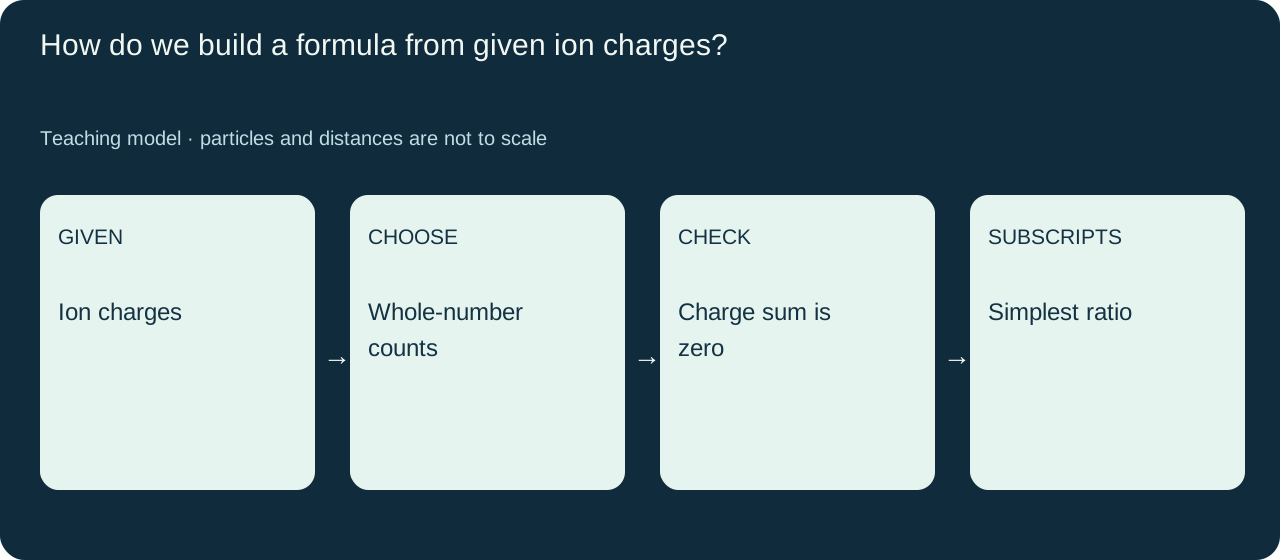
Check: Ca₃N₂ gives 3×2−2×3=0; K₂S gives 2−2=0. Iron gives FeCl₂ and FeCl₃ respectively. Recall “charges → counts → zero sum → reduce ratio → subscripts”. Explain why this procedure does not allow you to reduce a given molecular formula H₂O₂.
Exercise
- What formula combines Al³⁺ and Cl⁻?
- What is the charge sum for MgCl₂?
- Should Ca₂O₂ be reduced for specified Ca²⁺ and O²⁻?
Answers
Show the answers
AlCl₃; +2−2=0; yes, to CaO. Reduce the ion ratio, not an arbitrary molecular formula.
Investigator’s notebook
Record your first answer before reading the explanation. For each error, identify the step: particle model, electron count, charge balance, brackets or limits of inference. Correct the explanation, invent a new example and solve it without hints.
When to revisit
Close the page and, after 10 minutes, reconstruct the map, define the terms in your own words and solve the new case. Repeat without hints after a day and a week. If an error persists, return to the worked example and write down the missing step.
Sources and limits
If you have found a mistake or a typo in this article, tell us about it
Comments (0)
Log in to leave a comment →
No comments yet. Be the first.