

Chemistry: investigate the world of substances Lesson 40 of 40
The salt case: how do we check a transformation without losing matter?
Connect observations, atoms, mass and energy, separating supported conclusions from guesses about composition.
Support map
Model diagram
Use paper and supplied data only. Do not produce gases, heat substances or use electrical equipment; do not touch, taste or smell unknown substances.
Situation and question
A supplied report identifies A as CaCO₃ and solution B as containing HCl. Product analysis identifies CaCl₂, H₂O, CO₂. Two weighing models are given: the whole closed system 150.00 → 150.01 g, each measurement uncertain by ±0.02 g; an open apparatus 150.00 → 149.56 g, with CO₂ its only material outflow. This is a paper problem: never seal real gas-producing mixtures.
New terms, fully explained
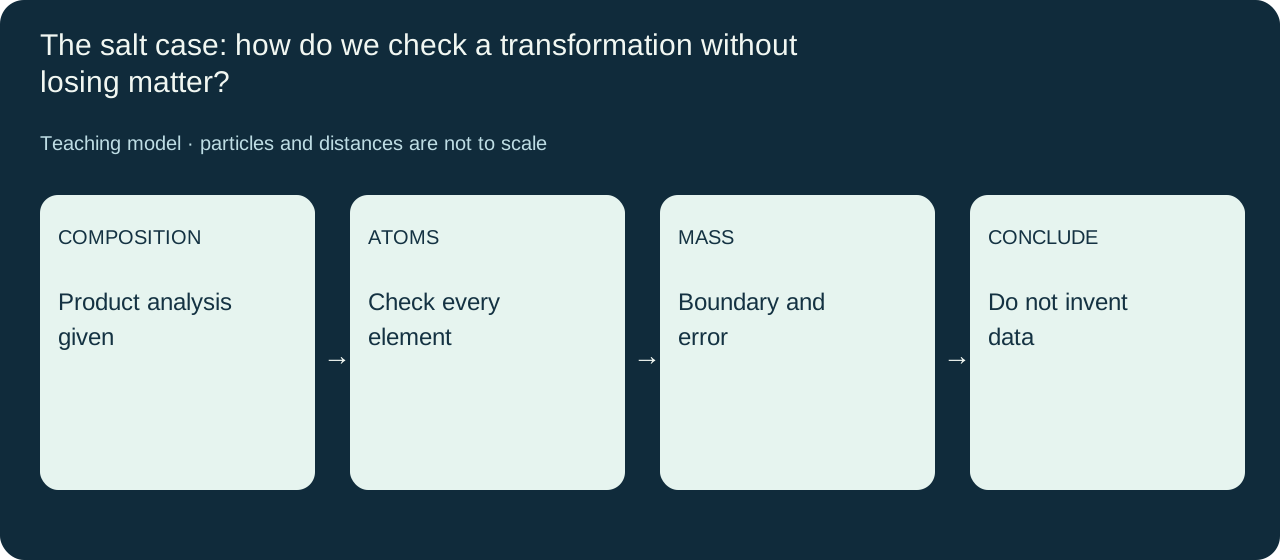
Recall four distinct checks. Observations suggest questions about reaction. Atom balance checks consistency with element conservation. Mass accounting needs a boundary and material flows. Energy accounting compares energy costs and releases. No one check independently determines an unidentified powder’s formula.
Predict first
Evaluate three claims before the explanation: “escaping gas means mass was destroyed”; “a 0.01 g difference proves mass appeared”; “we may change H₂O into H₂O₂ to balance”. Correct each reason. Then predict the HCl coefficient in CaCO₃ + HCl → CaCl₂ + H₂O + CO₂.
Investigate or analyse given data
Make notebook columns for evidence, calculation, conclusion and limit. Count Ca, C, O, H, Cl first. Separately calculate the escaped CO₂ mass and assess the closed readings. Product formulas are supplied from analysis; do not attempt to derive them from one mass difference.
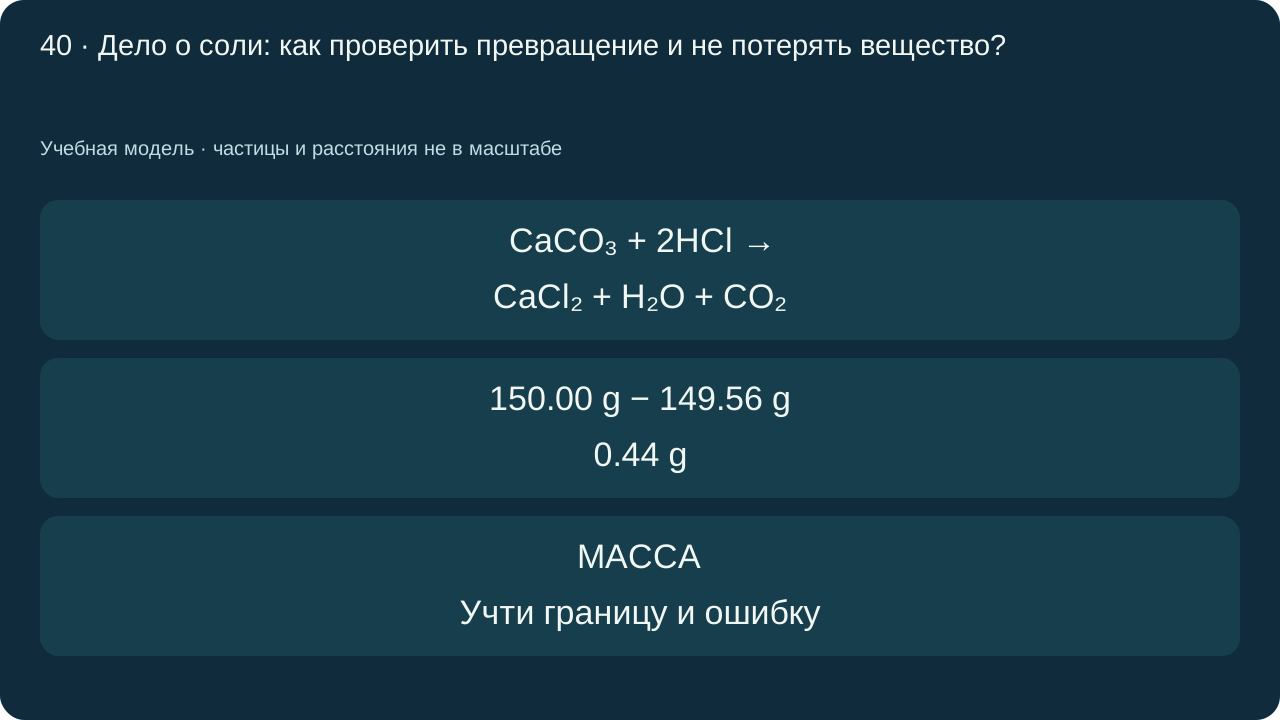
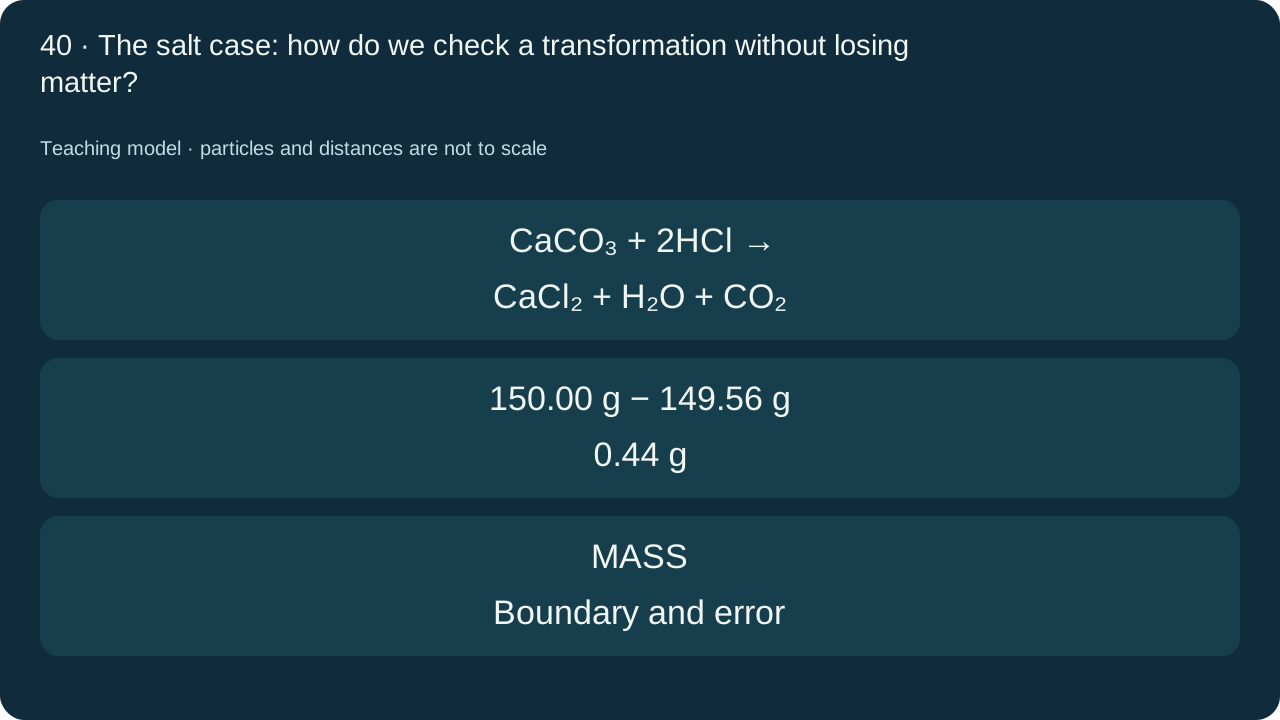
CaCO₃ + 2HCl → CaCl₂ + H₂O + CO₂
| Data / element | Before / left | After / right |
|---|---|---|
| Ca | 1 | 1 |
| C | 1 | 1 |
| O | 3 | 3 |
| H | 2 | 2 |
| Cl | 2 | 2 |
Worked example
The equation is CaCO₃ + 2HCl → CaCl₂ + H₂O + CO₂. Both sides have Ca=1, C=1, O=3, H=2, Cl=2. In the open case, 150.00−149.56=0.44 g CO₂ crossed the boundary. The closed-system 0.01 g difference is smaller than the stated uncertainty and does not establish a significant mass change.
A common mistake
Mistake: combining all questions into “a reaction is proved”. Here product identification relies on the supplied analysis, not bubbles alone. The arrow does not give rate, temperature or every stage. Escaped CO₂ mass alone cannot calculate heat without additional energy information.
Transfer to a new case
Final transfer: balance Na₂CO₃ + HCl → NaCl + H₂O + CO₂. Another open system changes 80.00 → 79.20 g with gas as its only outflow. Find the mass but do not guess its formula. An independent energy model has costs 50 and release 65 arbitrary units: determine the net transfer direction.
Answer and recall
Check: Na₂CO₃ + 2HCl → 2NaCl + H₂O + CO₂; 0.80 g left but its formula is unknown from weighing; 50−65=−15, so the system releases 15 units. Assess five skills separately: observation versus evidence, equation reading, balancing, boundaries and energy explanations. Retry new cases after a day and a week. The next block adds quantitative language for particles and calculations.
Exercise
- Balance CaCO₃ + HCl → CaCl₂ + H₂O + CO₂.
- 150.00 → 149.56 g, only CO₂ leaves. How much?
- Can mass loss alone identify a gas?
Answers
Show the answers
Coefficients 1:2:1:1:1; 0.44 g; no. Gas identity is supplied by separate analysis in this case. Separate atom balance, mass balance and evidence of composition.
Investigator’s notebook
For each error, identify its cause: wrong composition, changed subscript, missing atom, neglected system boundary, or confusion between heat and temperature. Correct your explanation and check another example without hints.
When to revisit
Close the page and, after 10 minutes, reconstruct the map, define the terms in your own words and solve the new case. Repeat without hints after a day and a week. If an error persists, return to the worked example and write down the missing step.
Sources and limits
Why classify reactions when their formulas are already known?
If you have found a mistake or a typo in this article, tell us about it
Comments (0)
Log in to leave a comment →
No comments yet. Be the first.