

Chemistry: investigate the world of substances Lesson 26 of 40
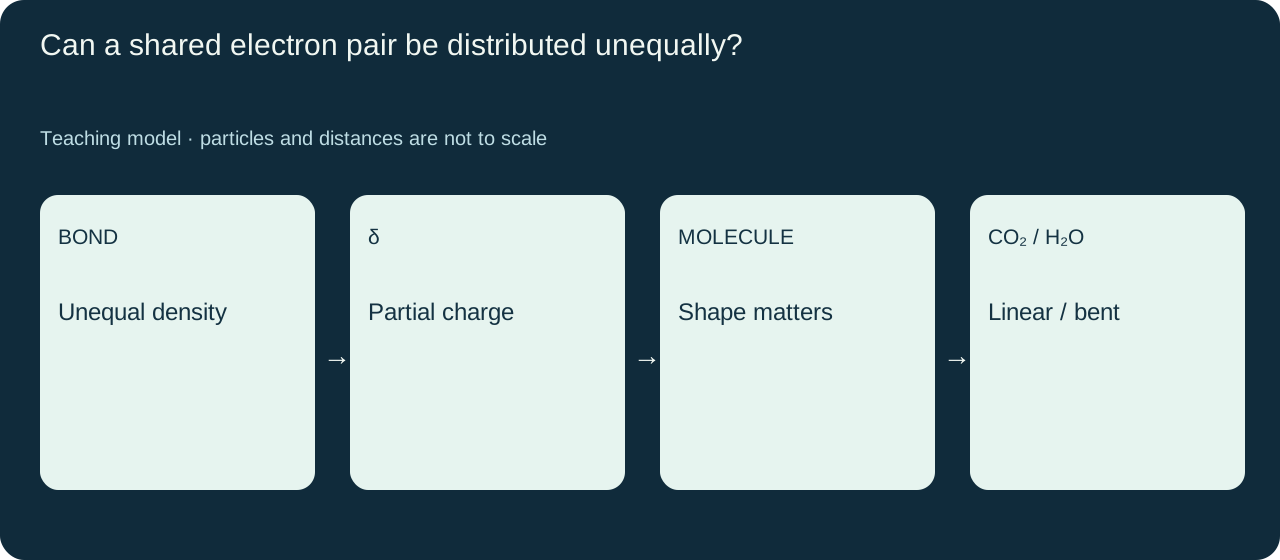
Can a shared electron pair be distributed unequally?
Distinguish a polar bond from an ion charge and from the polarity of a whole molecule.
Support map
Model diagram
Teaching model · particles and distances are not to scale
Use paper and supplied data only. Do not produce gases, heat substances or use electrical equipment; do not touch, taste or smell unknown substances.
Situation and question
We drew one shared pair in H₂ and in HCl. Does the same line imply the same distribution of electron density? Compare identical partners with different partners. A tug-of-war analogy helps pose the question, but an electron is not a rope and does not travel along the drawn line.
New terms, fully explained
Electronegativity is a bonded atom’s ability to attract electron density. In a polar covalent bond, that density is unevenly distributed. δ⁺ and δ⁻ denote partial charges, not the loss or gain of a whole electron. Molecular polarity depends on both bond polarity and the spatial arrangement of bonds.
Predict first
Predict which end of H—Cl receives δ⁻ if Cl attracts shared electron density more strongly. Must a molecule containing polar bonds be polar overall? Record both answers before testing the second against different molecular shapes.
Investigate or analyse given data
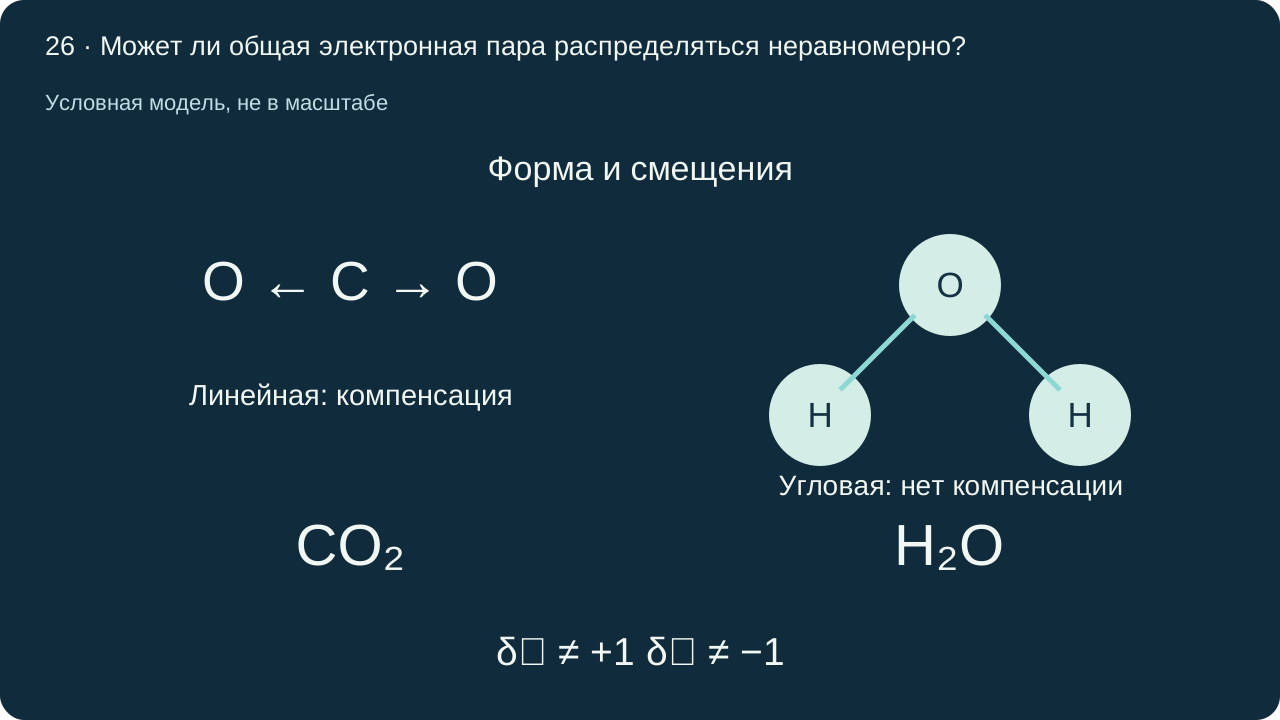
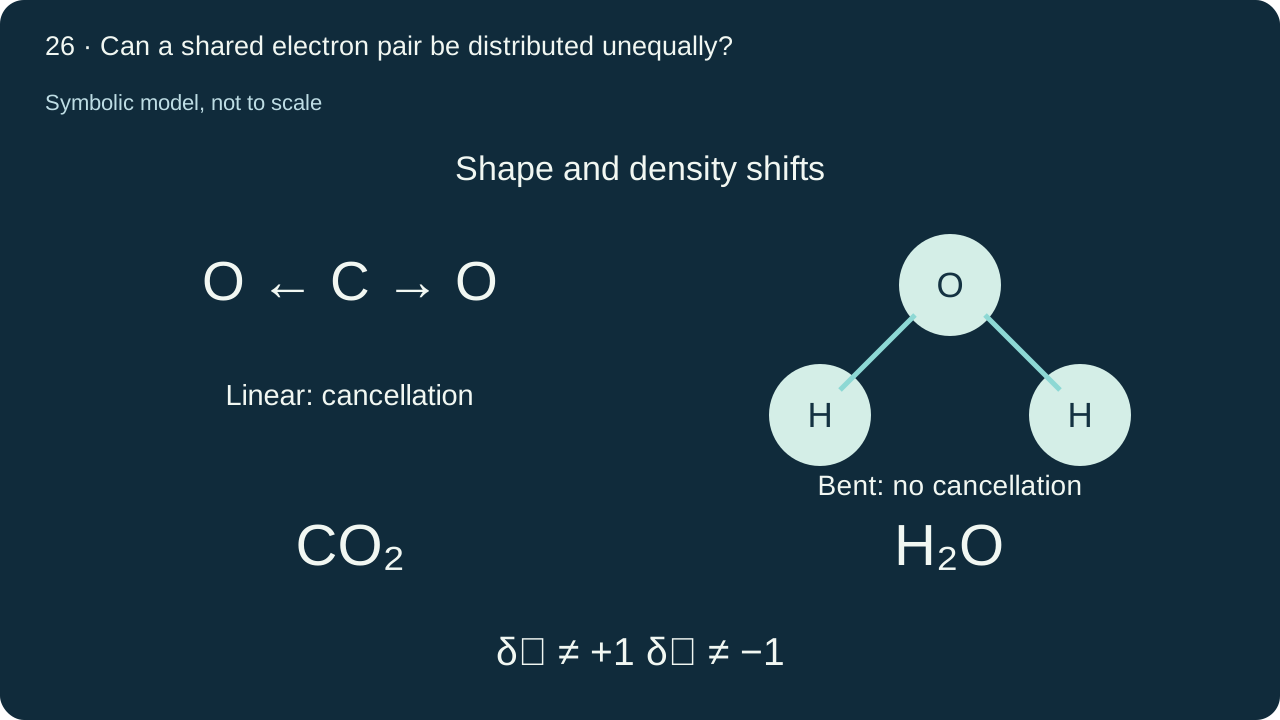
Use these supplied facts: H₂ contains identical atoms; HCl electron density shifts towards Cl; CO₂ is linear, O=C=O; H₂O is bent. In C—O and O—H bonds, density shifts towards O. Mark the directions on paper. No gases, heating or electrical apparatus are required.
Worked example
H₂ has a nonpolar bond between identical atoms. HCl is Hδ⁺—Clδ⁻ and is a polar molecule. In linear CO₂, two identical shifts point in opposite directions and cancel: the molecule is nonpolar. In bent H₂O, the shifts do not cancel: the molecule is polar. A formula without shape information cannot replace a spatial model.
A common mistake
Mistake: reading Hδ⁺ as H⁺ or treating every polar bond as ionic. Partial charge differs from the charge of a separate ion. Electronegativity scales and numerical cutoffs are approximations; we do not impose a universal boundary using one number here. Polarity is not a universal test of toxicity or solubility.
Transfer to a new case
A model molecule X—Y—X has identical bonds with density shifting from Y towards each X. First arrange it strictly linearly, then in a bent shape. The letters are placeholders. Compare cancellation of the directions. Could rotating the entire drawing on the paper change the answer?
Answer and recall
Check: the shifts cancel in the symmetric linear model but not in the bent model. Rotating an entire molecule does not change its polarity. Reconstruct three distinctions: bond versus molecule, partial versus full charge, formula versus shape. Explain them with CO₂ and H₂O rather than saying “oxygen means polar”.
Exercise
- Does δ⁻ mean one whole electron has been gained?
- Is symmetric linear CO₂ polar?
- Why is bent H₂O polar?
Answers
Show the answers
No; no; the electron-density shifts do not cancel. Distinguish a polar bond from a polar molecule.
Investigator’s notebook
Record your first answer before reading the explanation. For each error, identify the step: particle model, electron count, charge balance, brackets or limits of inference. Correct the explanation, invent a new example and solve it without hints.
When to revisit
Close the page and, after 10 minutes, reconstruct the map, define the terms in your own words and solve the new case. Repeat without hints after a day and a week. If an error persists, return to the worked example and write down the missing step.
Sources and limits
If you have found a mistake or a typo in this article, tell us about it
Comments (0)
Log in to leave a comment →
No comments yet. Be the first.