

Chemistry: investigate the world of substances Lesson 34 of 40
What is conserved when molecules rearrange?
Count each element’s atoms and explain why the number of molecules can change.
Support map
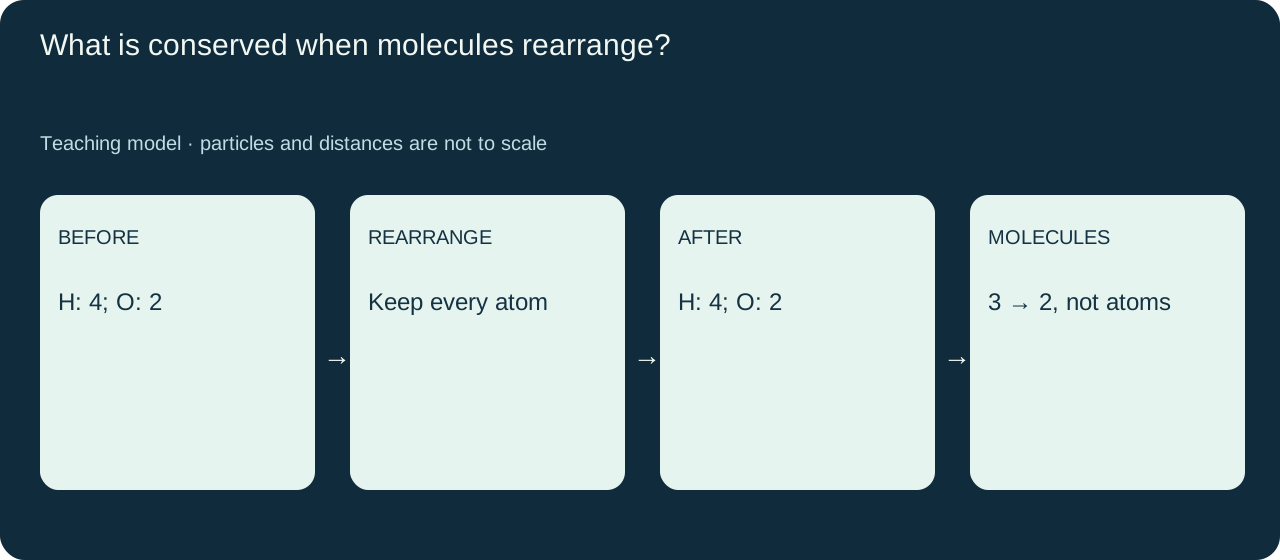
Model diagram
Use paper and supplied data only. Do not produce gases, heat substances or use electrical equipment; do not touch, taste or smell unknown substances.
Situation and question
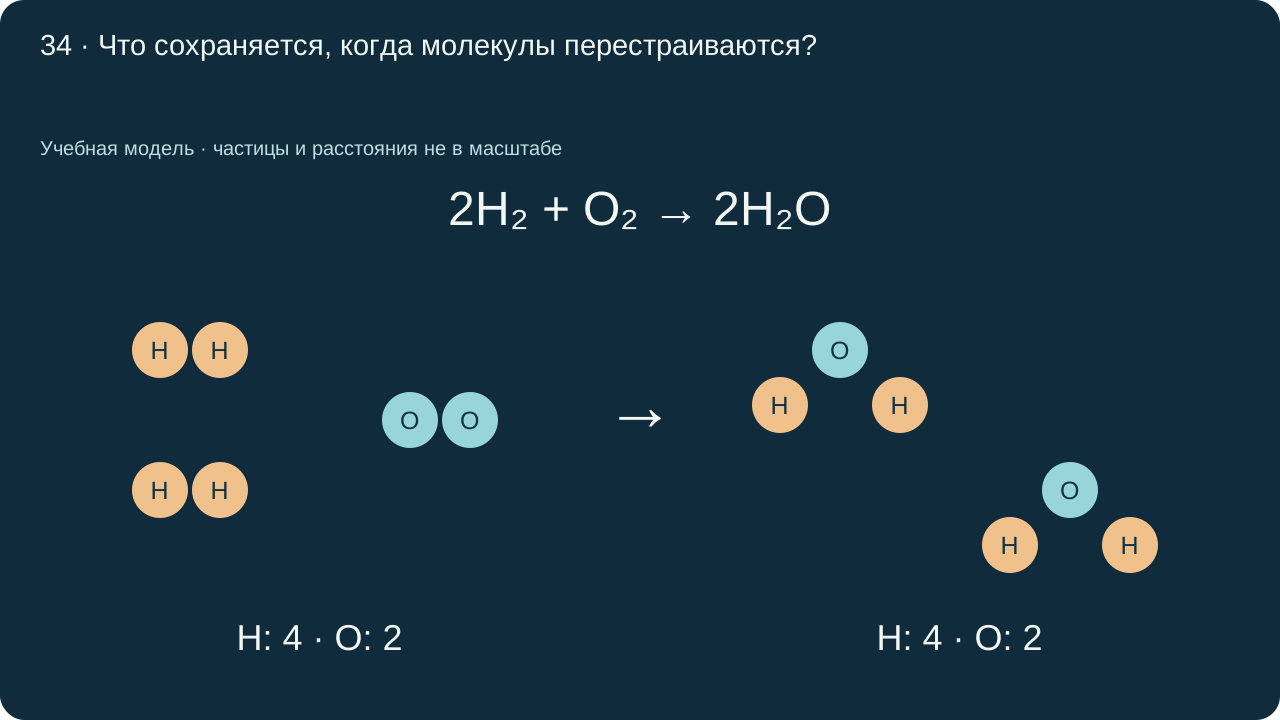
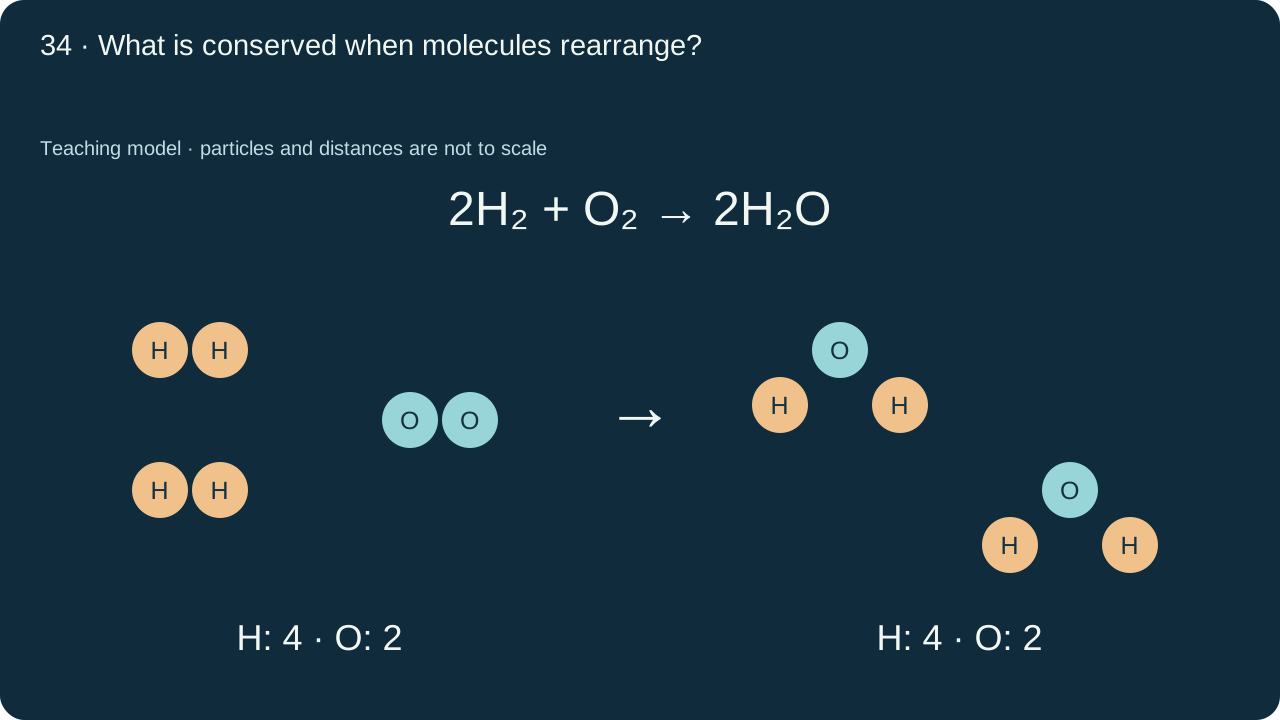
Cards show two H₂ molecules and one O₂ on the left, and two H₂O on the right. Three particles appear to become two: has matter disappeared? Draw the starting groups first. This is a paper model of a specified reaction, not a reason to obtain, mix or ignite gases.
New terms, fully explained
In an ordinary chemical reaction, atoms regroup while nuclei do not turn into nuclei of different elements. The number of atoms of each element is therefore conserved within the system being considered. Molecule count differs from atom count: changing group sizes can change the former without changing the latter. Nuclear processes are outside this block.
Predict first
Predict H atoms, O atoms, total atoms and molecules on each side separately. Is an equal total enough without checking elements? Could two H atoms become two O atoms merely because the total number of model pieces would remain unchanged?
Investigate or analyse given data
Use H-labelled or light cards and O-labelled or dark cards. Make H–H, H–H and O–O on the left, then two H–O–H groups on the right. Transfer every card exactly once, retaining its letter. A model colour must not change an atom’s element identity.
2H₂ + O₂ → 2H₂O
| Data / element | Before / left | After / right |
|---|---|---|
| H | 4 | 4 |
| O | 2 | 2 |
Worked example
For 2H₂ + O₂ → 2H₂O, the left has H=4, O=2: six atoms in three molecules. The right has H=4, O=2: six atoms in two molecules. This confirms atom balance, not the reaction mechanism, real dimensions, temperature or speed.
A common mistake
Mistake: demanding equal molecule counts or checking only total atoms. Four H plus two O cannot become two H plus four O: the total stays six but the composition changes. Check each element; later, ionic equations will also require a total-charge check.
Transfer to a new case
A new case gives 2CO + O₂ → 2CO₂. Count C, O and molecules. Explain why correct bookkeeping does not make CO safe: hazards depend on substance properties, not a neatly written formula. No gas sample is needed.
Answer and recall
Check: both sides have C=2, O=4; molecule counts are three and two. Every C and O has a counterpart, but grouping changes. Reconstruct two element-count columns from memory. For an unfamiliar equation, find the first mismatched element rather than changing a model piece’s colour.
Exercise
- Count H and O on the left of 2H₂ + O₂ → 2H₂O.
- Is molecule count conserved?
- Is the same total atom count enough?
Answers
Show the answers
H: 4, O: 2; no, 3 → 2; no, each element must balance. Molecules rearrange; atomic nuclei are not transformed in this chemical model.
Investigator’s notebook
For each error, identify its cause: wrong composition, changed subscript, missing atom, neglected system boundary, or confusion between heat and temperature. Correct your explanation and check another example without hints.
When to revisit
Close the page and, after 10 minutes, reconstruct the map, define the terms in your own words and solve the new case. Repeat without hints after a day and a week. If an error persists, return to the worked example and write down the missing step.
Sources and limits
If you have found a mistake or a typo in this article, tell us about it
Comments (0)
Log in to leave a comment →
No comments yet. Be the first.