

Chemistry: investigate the world of substances Lesson 30 of 40
How do we read subscripts, brackets and coefficients?
Count atoms in 3H₂O and Ca(OH)₂ without changing composition to obtain a convenient number.
Support map
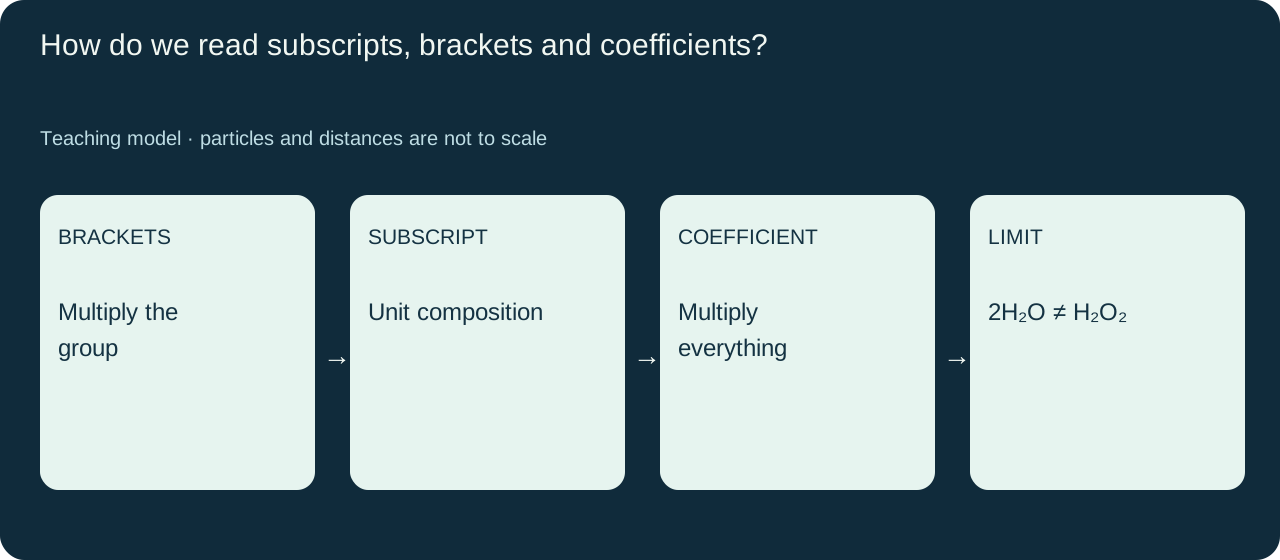
Model diagram
Teaching model · particles and distances are not to scale
Use paper and supplied data only. Do not produce gases, heat substances or use electrical equipment; do not touch, taste or smell unknown substances.
Situation and question
2H₂O and H₂O₂ differ in more than the position of a digit. The first means two water molecules; the second means one molecule of another substance. Make the counting explicit by separating “how many particles?” from “what is inside one particle?”. Work with paper and symbols, not hydrogen peroxide.
New terms, fully explained
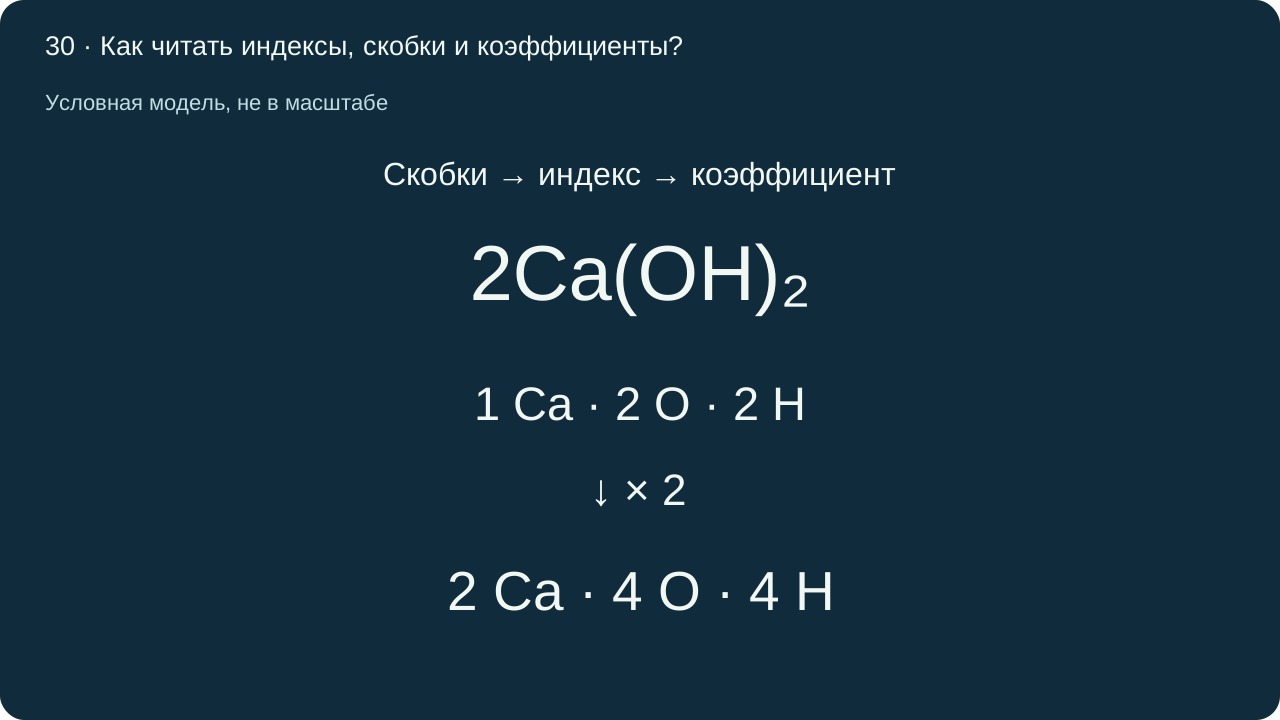
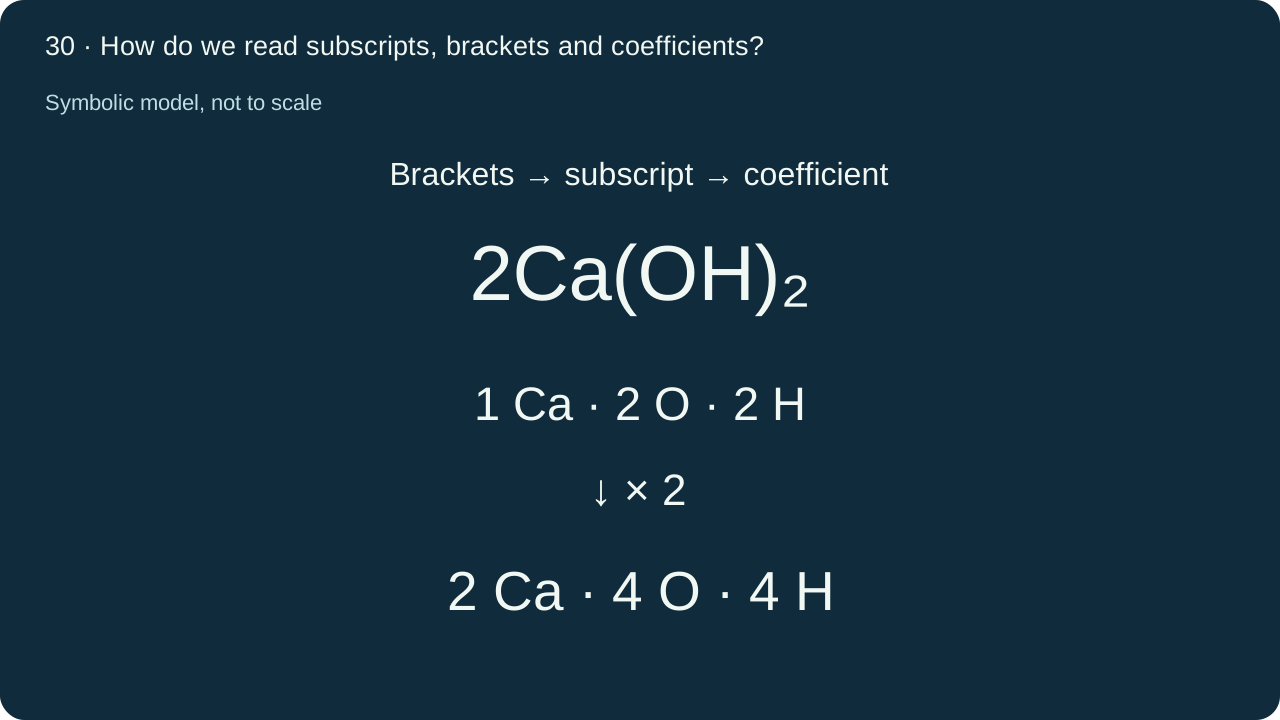
A coefficient before a formula multiplies all its atom counts or formula units. Brackets group symbols; the subscript after them multiplies everything inside. Ca(OH)₂ has one Ca, two O and two H. OH⁻ is the hydroxide ion, charge −1; this group is retained when recording its compound with Ca²⁺.
Predict first
Predict the H and O counts in 3H₂O, then Ca, O and H in 2Ca(OH)₂. Should only H be doubled because it is nearest the subscript? First write the composition of one formula unit, then apply the coefficient.
Investigate or analyse given data
Make a table with “expression — one unit — coefficient — total”. Use H₂O, 3H₂O, Ca(OH)₂, 2Ca(OH)₂ and Al₂(SO₄)₃. The last formula is supplied: SO₄²⁻ is sulfate, whose internal bonds we are not deriving here. No hydroxides or acids need to be mixed.
Worked example
3H₂O gives 6 H and 3 O. One Ca(OH)₂ unit has 1 Ca,2 O,2 H; two give 2 Ca,4 O,4 H. Al₂(SO₄)₃ contains 2 Al,3 S,12 O. Two Al³⁺ and three SO₄²⁻ charges balance. Brackets multiply both S and O but not Al outside them.
A common mistake
Mistake: changing subscripts while counting quantities. H₂O₂ is not shorthand for two H₂O molecules: the individual molecular composition differs. Count formula units, rather than invented Ca(OH)₂ molecules, for the ionic compound. For molecules, a coefficient can count particles; later it can express amounts in equations with consistent units.
Transfer to a new case
Analyse 3Mg(OH)₂ and 2Al₂(SO₄)₃ independently. Count each element’s atoms across the whole expression. Then compare 2O with O₂: is the total atom count the same, and is the grouping the same? Explain in words as well as numbers.
Answer and recall
Check: 3 Mg,6 O,6 H;4 Al,6 S,24 O. Both 2O and O₂ contain two oxygen atoms, but 2O denotes separate atoms while O₂ denotes one diatomic molecule. Recall “inner group → subscript → unit composition → coefficient”. A simple formula does not establish a substance’s safety.
Exercise
- How many O atoms are in Al₂(SO₄)₃?
- How many H atoms are in 4H₂O?
- Do 2H and H₂ denote identical particles?
Answers
Show the answers
12;8; no: two separate atoms versus one molecule. Apply group subscripts first, then coefficients to the whole formula.
Investigator’s notebook
Record your first answer before reading the explanation. For each error, identify the step: particle model, electron count, charge balance, brackets or limits of inference. Correct the explanation, invent a new example and solve it without hints.
When to revisit
Close the page and, after 10 minutes, reconstruct the map, define the terms in your own words and solve the new case. Repeat without hints after a day and a week. If an error persists, return to the worked example and write down the missing step.
Sources and limits
If you have found a mistake or a typo in this article, tell us about it
Comments (0)
Log in to leave a comment →
No comments yet. Be the first.