

Chemistry: investigate the world of substances Lesson 38 of 40
Why do some reactions warm their surroundings while others cool them?
Compare bond-breaking costs with energy released by bond formation, keeping heat distinct from temperature.
Support map
Model diagram
Use paper and supplied data only. Do not produce gases, heat substances or use electrical equipment; do not touch, taste or smell unknown substances.
Situation and question
Supplied observations describe two reactions under comparable conditions: the surroundings warm in one and cool in the other. Both rearrange bonds. How does energy explain this without claiming that every broken bond releases heat? Analyse the table rather than performing reactions at home.
New terms, fully explained
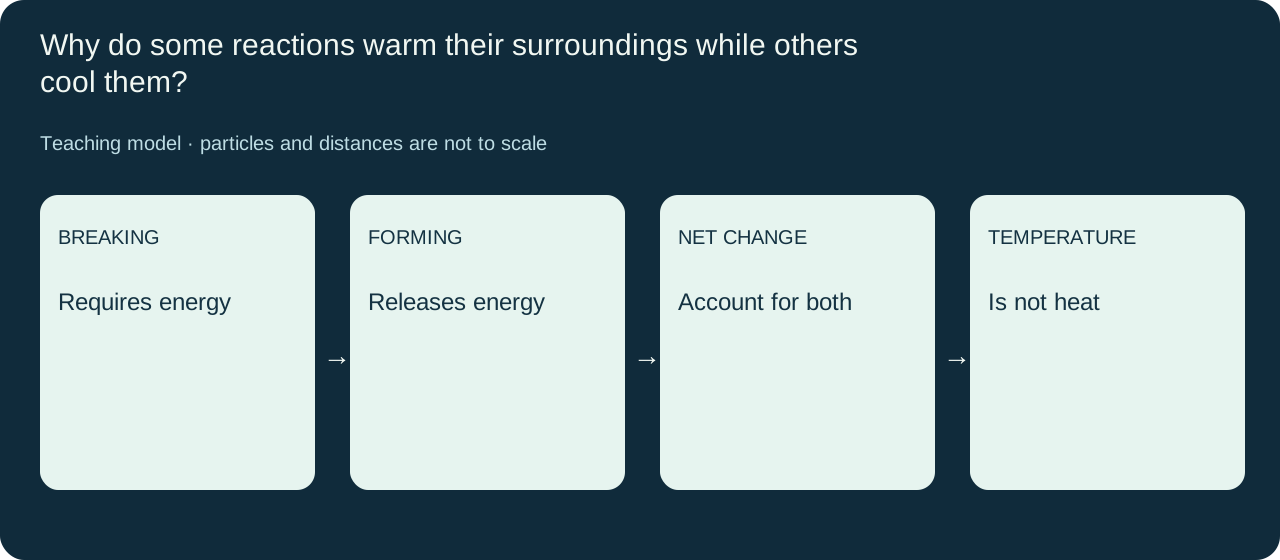
An exothermic process transfers energy as heat to its surroundings; an endothermic process takes it from them. Temperature describes thermal state; heat is energy transfer due to a temperature difference. Breaking bonds requires energy, while forming bonds releases it. Compare both contributions to determine the overall effect.
Predict first
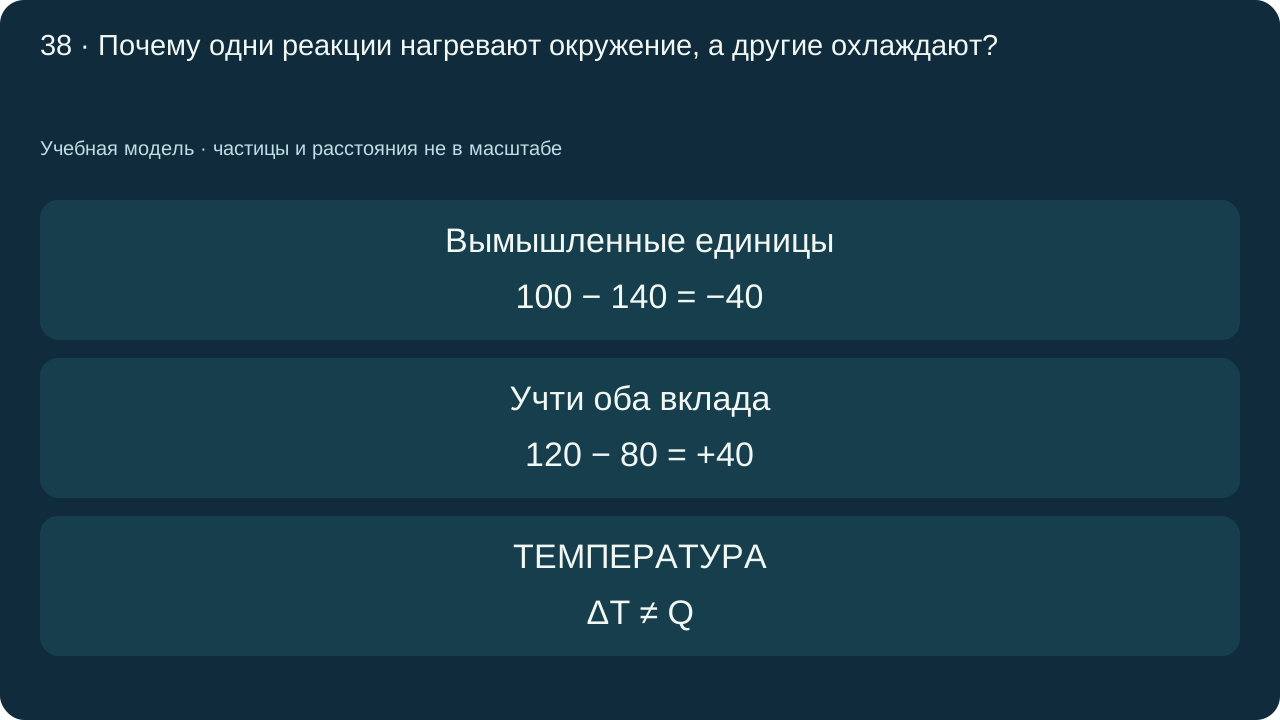
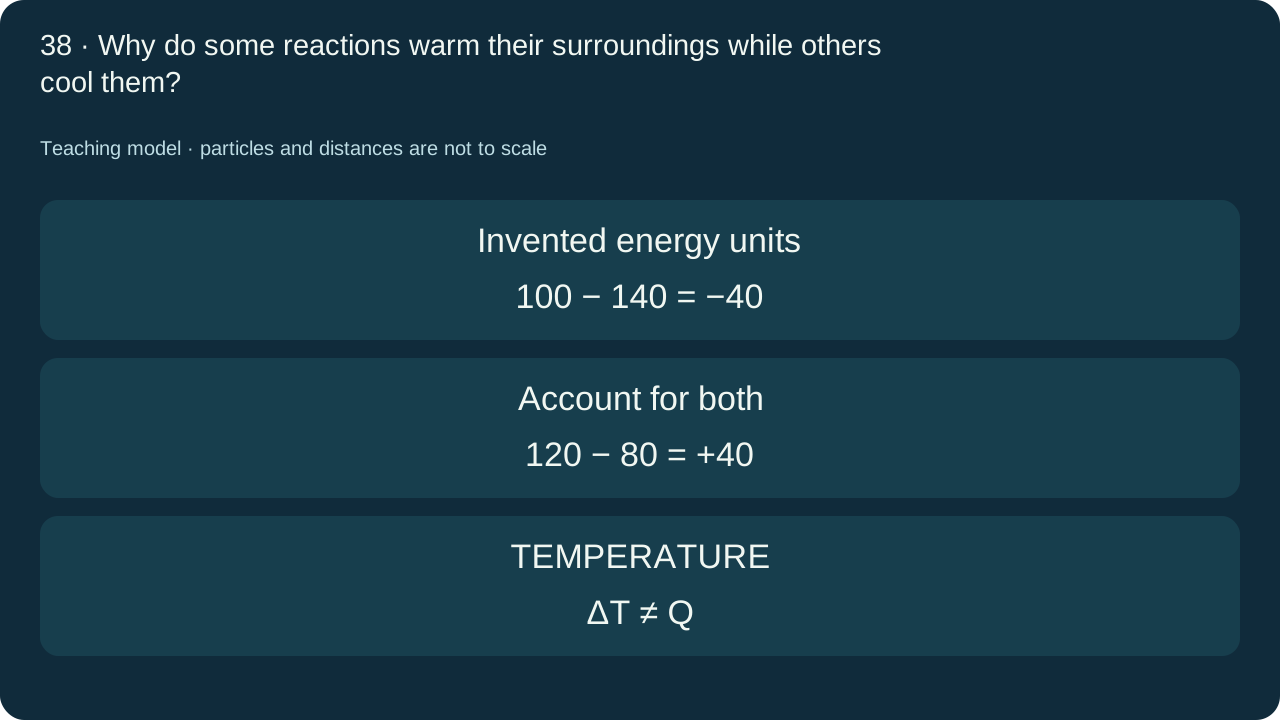
Predict the result when bond breaking requires 100 units and formation releases 140. Where do the remaining 40 go? What if 120 are required and 80 released? All values are invented teaching units, not measured bond energies for particular substances.
Investigate or analyse given data
Make columns for cost, release, difference and transfer direction. The first model gives 100−140=−40; the second 120−80=+40. Minus denotes energy leaving the reacting system for the surroundings; plus denotes energy gained from outside. This remains simplified energy bookkeeping.
Invented energy units
| Data / element | Before / left | After / right |
|---|---|---|
| A | 100 − 140 | −40 |
| B | 120 − 80 | +40 |
Worked example
The first model is exothermic, releasing 40 arbitrary units. The second is endothermic, taking in 40. Under comparable conditions, surrounding temperature helps indicate transfer direction, but a degree change alone cannot determine energy: masses, heat capacities and losses also matter.
A common mistake
Mistake: treating all warming as proof of a chemical reaction, or assuming an exothermic reaction starts on its own. Physical processes can warm surroundings; some reactions require an initial energy barrier to be overcome. Cooling during dissolution also does not prove a new substance formed. Do not test such ideas by mixing household chemicals.
Transfer to a new case
A new model requires 90 units to break bonds and releases 70 on formation. Determine the net transfer and direction. Then evaluate “a thermometer rose by 5 degrees, so 5 energy units were released”. Which information is missing? Temperature must not be substituted for energy.
Answer and recall
Check: 90−70=+20: this model takes in 20 units and is endothermic. Five degrees are not five energy units; mass, heat capacity and exchange conditions are missing. Recall “breaking costs → formation releases → compare totals → name system and surroundings”. One bond cannot determine a whole reaction’s energy balance.
Exercise
- Breaking costs 100; forming releases 140 invented units. Net change?
- 120 − 80: absorption or release?
- Does a 5 °C rise mean 5 units of heat?
Answers
Show the answers
−40: release of 40; +40: absorption of 40; no, mass, heat capacity and heat exchange conditions are needed. These energy numbers are invented.
Investigator’s notebook
For each error, identify its cause: wrong composition, changed subscript, missing atom, neglected system boundary, or confusion between heat and temperature. Correct your explanation and check another example without hints.
When to revisit
Close the page and, after 10 minutes, reconstruct the map, define the terms in your own words and solve the new case. Repeat without hints after a day and a week. If an error persists, return to the worked example and write down the missing step.
Sources and limits
Why can a balance reading change when atoms are conserved?
Why classify reactions when their formulas are already known?
If you have found a mistake or a typo in this article, tell us about it
Comments (0)
Log in to leave a comment →
No comments yet. Be the first.