

Chemistry: investigate the world of substances Lesson 39 of 40
Why classify reactions when their formulas are already known?
Recognise combination, decomposition, displacement and exchange without treating patterns as universal predictions.
Support map
Model diagram
Use paper and supplied data only. Do not produce gases, heat substances or use electrical equipment; do not touch, taste or smell unknown substances.
Situation and question
Several notebook equations show different patterns: two starting substances form one product in one, while one substance forms two products in another. Can we group the equations by structure? This classifies supplied reactions rather than authorising mixtures of unknown substances or guaranteeing results.
New terms, fully explained
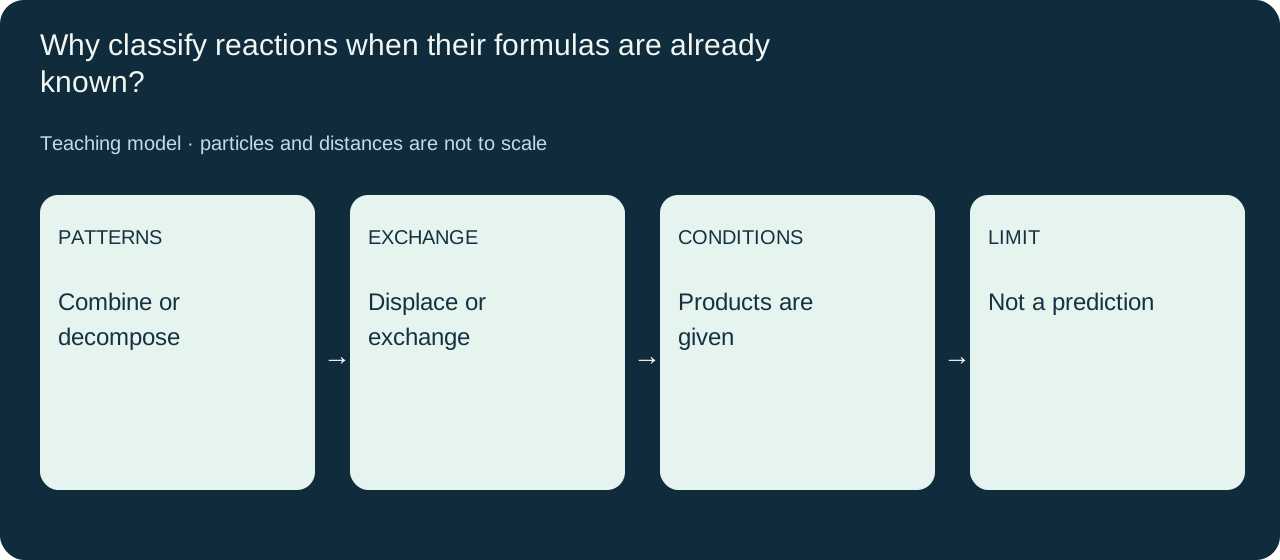
In this school classification, combination joins several reactants into one product; decomposition forms several products from one reactant. Single displacement has an elemental substance reacting with a compound to form a different elemental substance and compound. Double displacement, or exchange, swaps components between two compounds. An elemental substance contains one element; a compound contains two or more.
Predict first
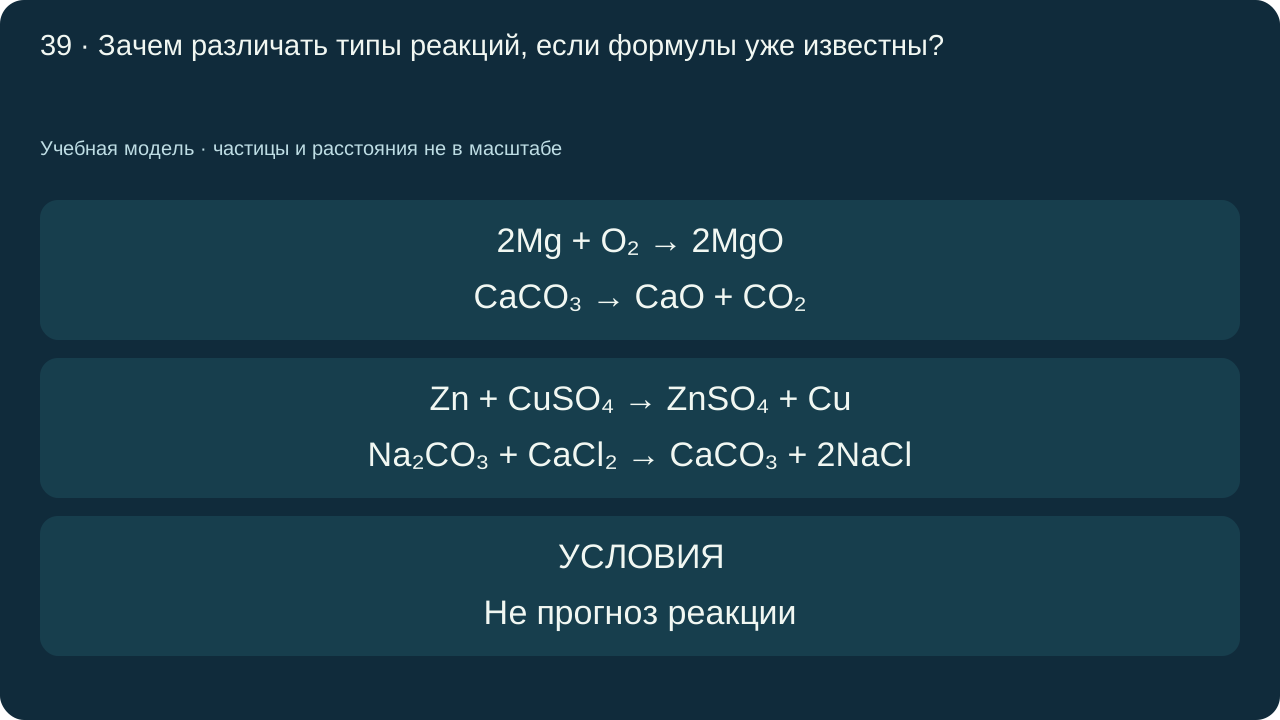
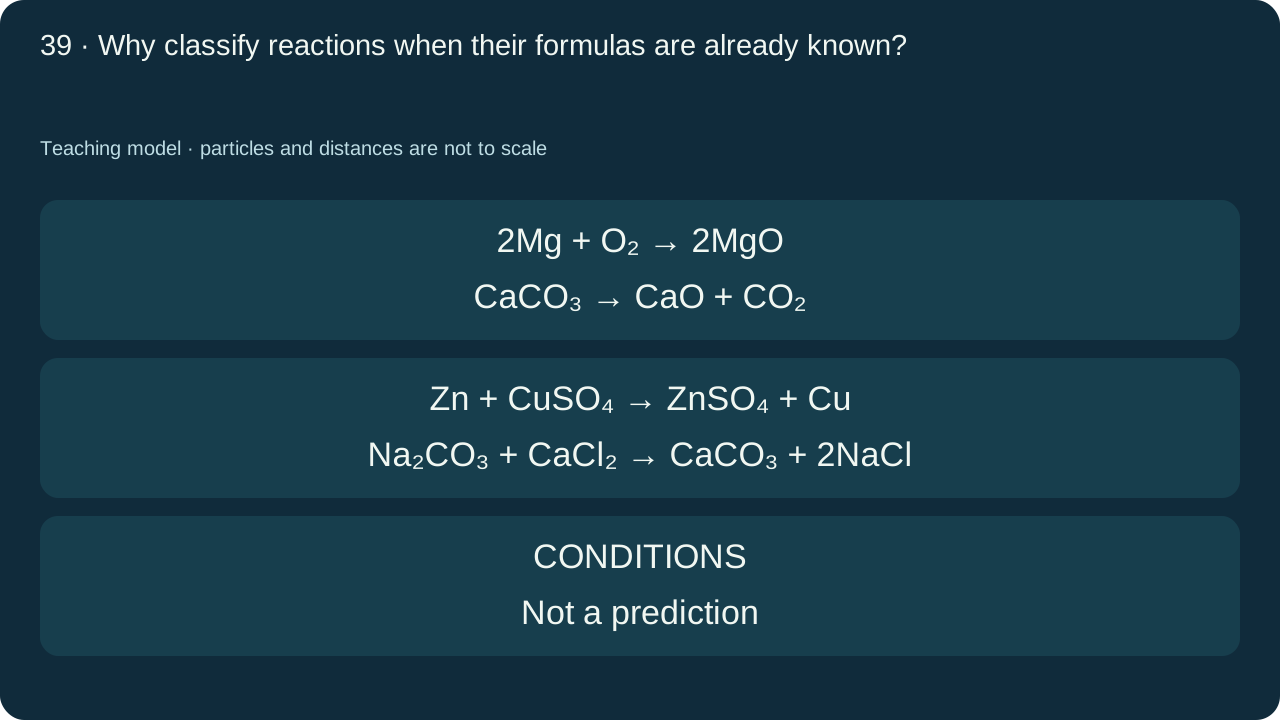
Predict the types of 2Mg + O₂ → 2MgO and CaCO₃ → CaO + CO₂. Does two before MgO mean two different substances? Count substance identities, not coefficients. Heating is a condition of the second transformation, not an experiment being assigned.
Investigate or analyse given data
Analyse two further supplied equations: Zn + CuSO₄ → ZnSO₄ + Cu; Na₂CO₃ + CaCl₂ → CaCO₃ + 2NaCl. The latter specifies aqueous conditions producing a CaCO₃ precipitate. Mark elemental substances, compare compound compositions and check balance. Do not obtain metal salts, acids or unidentified powders.
Na₂CO₃ + CaCl₂ → CaCO₃ + 2NaCl
| Data / element | Before / left | After / right |
|---|---|---|
| Na | 2 | 2 |
| C | 1 | 1 |
| O | 3 | 3 |
| Ca | 1 | 1 |
| Cl | 2 | 2 |
Worked example
The magnesium reaction is combination; calcium carbonate decomposition; zinc with copper sulfate single displacement; and the specified carbonate/chloride solutions double displacement. For the last equation each side has Na=2, C=1, O=3, Ca=1, Cl=2. All four are balanced; type and balance answer different questions.
A common mistake
Mistake: assuming every salt pair reacts observably or every metal displaces every other metal. Properties, conditions and a reason for a particular transformation matter. Classifications can overlap: a pattern and an electron-transfer description may apply to the same reaction. Electron transfer is studied separately later.
Transfer to a new case
Classify 2CO + O₂ → 2CO₂ and Ca(OH)₂ + 2HCl → CaCl₂ + 2H₂O by the stated patterns. Can the first also be called oxidation? Must one label cancel another? These equations are for reading, not for practical performance.
Answer and recall
Check: the first is combination by substance identities and also involves oxidation of CO; the second is exchange in the school-level overall notation. Different classification criteria need not conflict. Recall an example of each type, distinguish conditions from pattern and finish: “recognising a type does not prove a reaction is possible”.
Exercise
- 2Mg + O₂ → 2MgO: how many product species?
- What school pattern is Zn + CuSO₄ → ZnSO₄ + Cu?
- Does an exchange pattern prove any two solutions react?
Answers
Show the answers
One species; displacement; no. A coefficient does not create a new species, and classification does not replace checking conditions and products.
Investigator’s notebook
For each error, identify its cause: wrong composition, changed subscript, missing atom, neglected system boundary, or confusion between heat and temperature. Correct your explanation and check another example without hints.
When to revisit
Close the page and, after 10 minutes, reconstruct the map, define the terms in your own words and solve the new case. Repeat without hints after a day and a week. If an error persists, return to the worked example and write down the missing step.
Sources and limits
Why do some reactions warm their surroundings while others cool them?
The salt case: how do we check a transformation without losing matter?
If you have found a mistake or a typo in this article, tell us about it
Comments (0)
Log in to leave a comment →
No comments yet. Be the first.