

Chemistry: investigate the world of substances Lesson 32 of 40
How do we distinguish a reaction from a change of shape?
Separate an observed clue from evidence of new substances, using bubbles, melting and irreversibility.
Support map
Model diagram
Use paper and supplied data only. Do not produce gases, heat substances or use electrical equipment; do not touch, taste or smell unknown substances.
Situation and question
Four notebook cases describe melting ice, a broken glass, bubbles in heated water and rust on an iron part. Which establishes a change in composition? Do not heat or break anything: these are supplied descriptions. Record your choice and reason before reading the check.
New terms, fully explained
A physical change alters state, shape or distribution without forming new substances. A chemical reaction produces substances with a different chemical composition or structure. A clue is an observation such as colour change, gas release, a precipitate or temperature change. A clue alone does not establish its cause; conditions and composition evidence matter.
Predict first
Predict whether every bubble proves a reaction and whether every irreversible change is chemical. Offer an alternative explanation for each claim. The aim is to identify evidence that would distinguish explanations, rather than guess a label. Never propose tasting or smelling an unidentified substance.
Investigate or analyse given data
Make a table for the four cases. The supplied evidence says ice and water are both H₂O, the fragments retain the glass composition, boiling bubbles contain water vapour, and rust contains iron–oxygen compounds different from the metal. Those facts are given, not established by appearance alone.
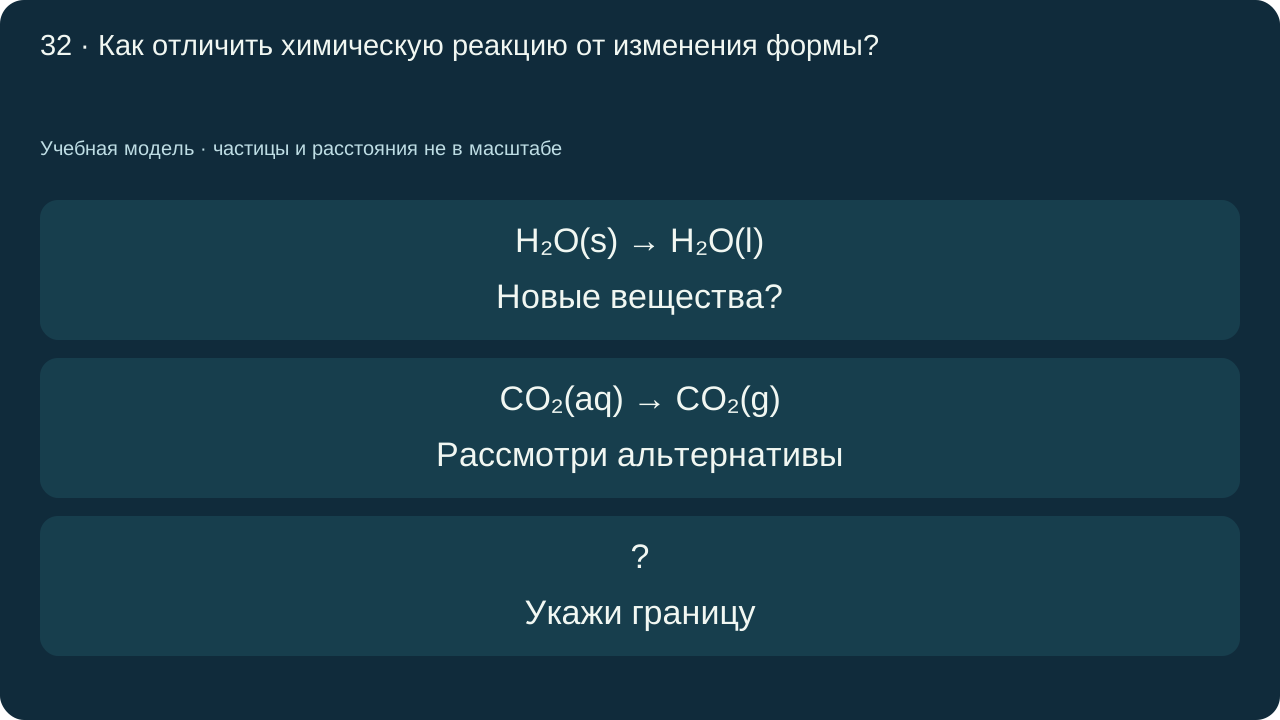
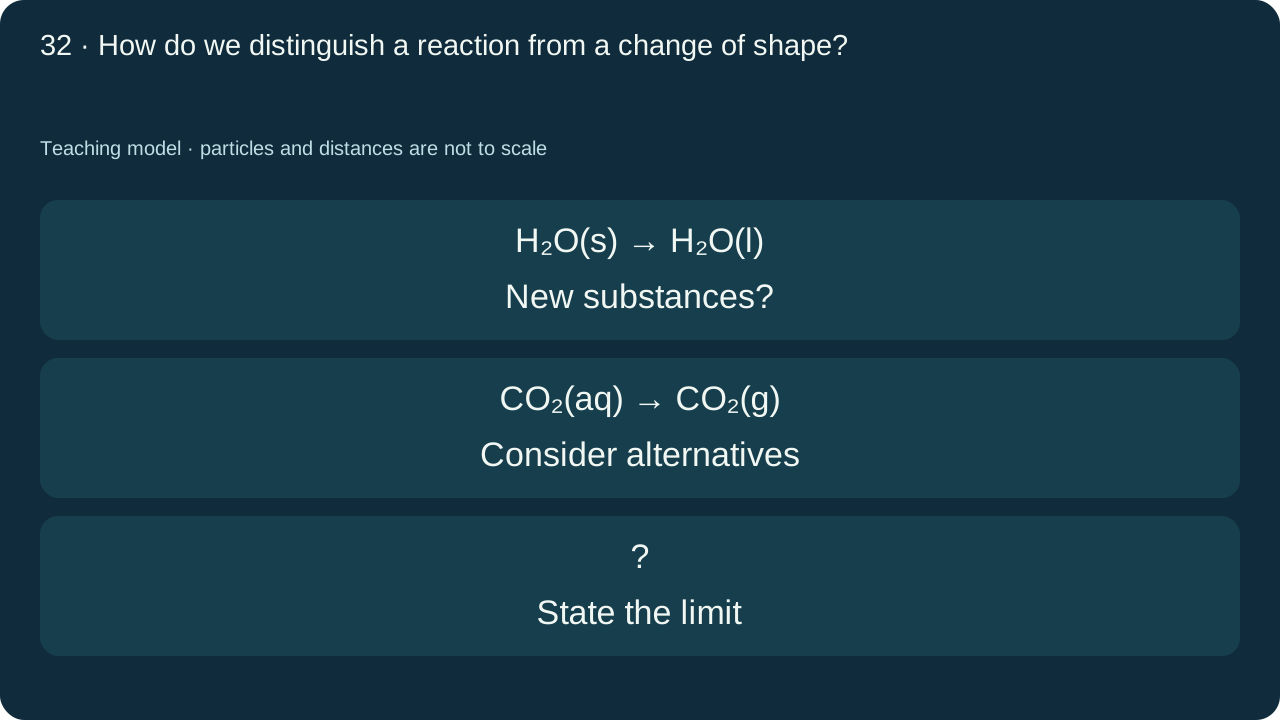
H₂O(s) / H₂O(l) / H₂O(g)
| Data / element | Before / left | After / right |
|---|---|---|
| H₂O | H₂O(s) | H₂O(l) |
| H₂O | H₂O(l) | H₂O(g) |
Worked example
Melting, breaking glass and boiling are physical changes in these cases: chemical identity remains. Rust formation is chemical. Rust need not have one simple formula because its composition depends on conditions. Do not label all rust as pure Fe₂O₃ without further evidence.
A common mistake
Mistake: “the glass cannot easily be rebuilt, so it reacted” or “bubbles always mean a new substance”. Reversibility does not define chemical change. Mixing coloured solutions can alter the observed shade simply by mixing colours. Several clues help, but identifying products needs appropriate evidence.
Transfer to a new case
A new case describes bubbles when a chilled fizzy-water container is opened. The gas is specified as previously dissolved CO₂, with no new substance detected. Compare a second case in which analysis confirms new CO₂ formed from reactants. Can similar visible clues accompany different processes?
Answer and recall
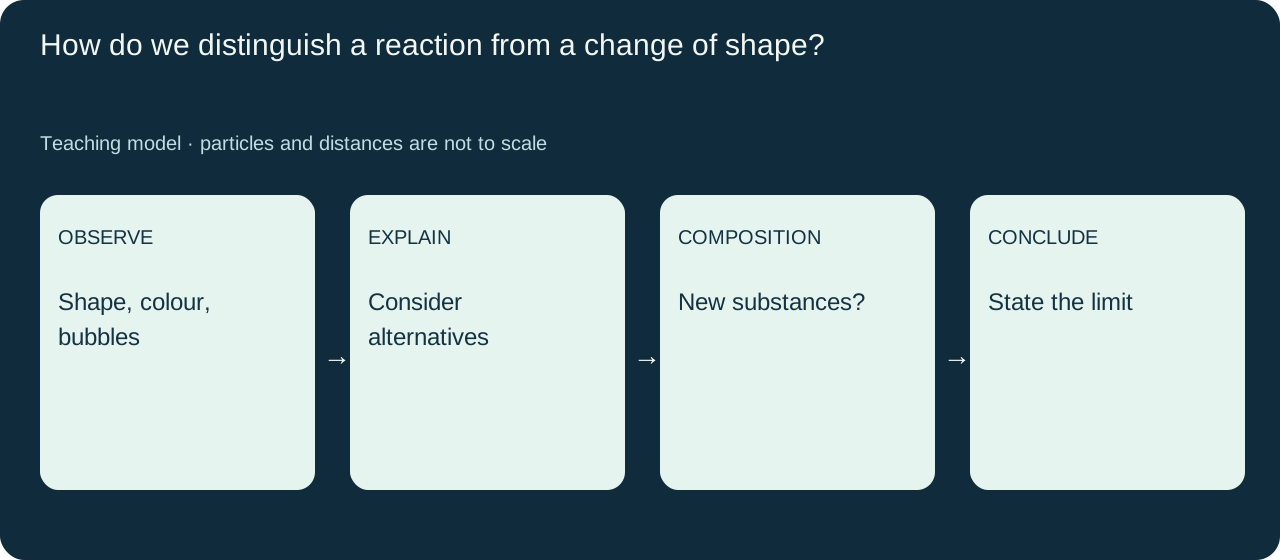
Check: release of previously dissolved CO₂ can be a physical process; formation of new CO₂ through a transformation is chemical. Similar bubbles have different origins. Reconstruct “observation → possible explanations → composition evidence → limited conclusion”. Leave an unidentified sample unresolved when evidence is insufficient.
Exercise
- Do bubbles alone prove a reaction?
- Why is broken glass not necessarily a reaction product?
- What distinguishes boiling from formation of a new gas?
Answers
Show the answers
No; glass composition may be unchanged; conditions and evidence of gas identity and origin are needed. Irreversibility and appearance do not replace that evidence.
Investigator’s notebook
For each error, identify its cause: wrong composition, changed subscript, missing atom, neglected system boundary, or confusion between heat and temperature. Correct your explanation and check another example without hints.
When to revisit
Close the page and, after 10 minutes, reconstruct the map, define the terms in your own words and solve the new case. Repeat without hints after a day and a week. If an error persists, return to the worked example and write down the missing step.
Sources and limits
If you have found a mistake or a typo in this article, tell us about it
Comments (0)
Log in to leave a comment →
No comments yet. Be the first.