

Chemistry: investigate the world of substances Lesson 29 of 40
How does valency differ from an ion’s charge?
Count bonds in simple molecules without assigning charge signs to valency.
Support map
Model diagram
Teaching model · particles and distances are not to scale
Use paper and supplied data only. Do not produce gases, heat substances or use electrical equipment; do not touch, taste or smell unknown substances.
Situation and question
Water is drawn H—O—H. Oxygen has two lines but is not labelled O²⁻. Why do two bonds not turn it into a separate ion with charge −2? Compare the molecule model with the previous lesson’s ion cards. Both involve the number two, but the numbers answer different questions.
New terms, fully explained
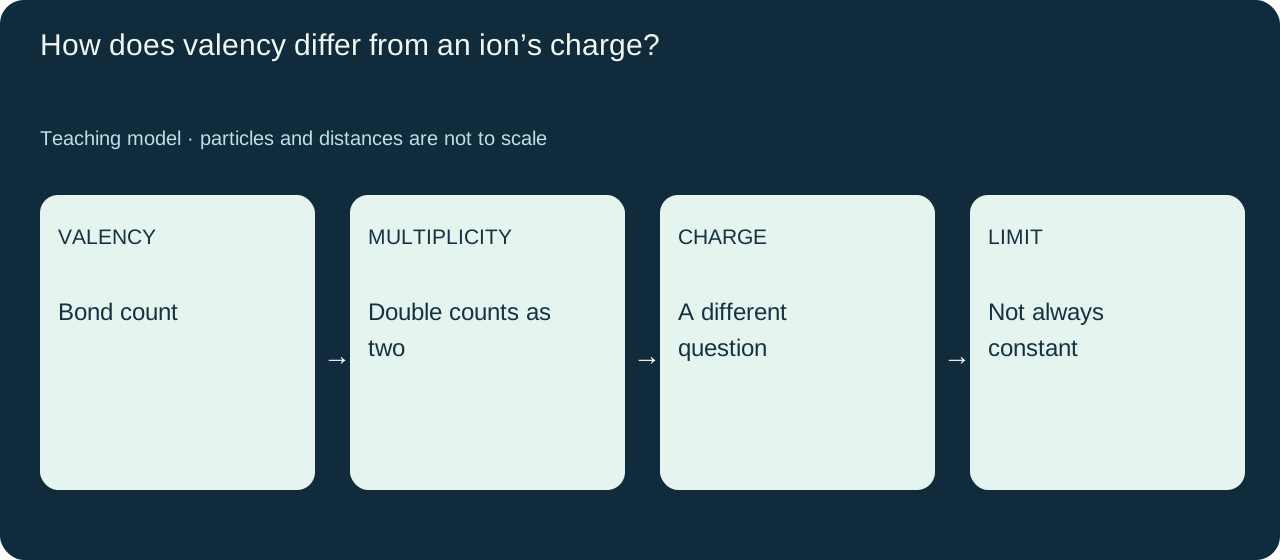
In the school model used here, valency counts bonds with their multiplicity included. H has valency I and O has II in H₂O; C has IV in CH₄. Write valency as a Roman numeral without a plus or minus sign. Ion charge describes excess or missing electrons in a whole particle. Oxidation state is another bookkeeping system, outside this lesson.
Predict first
Predict O’s valency in O=O if a double bond counts as two. Must an element have the same valency in every compound? We have specified structures: check those rather than turning one memorised number into a universal rule.
Investigate or analyse given data
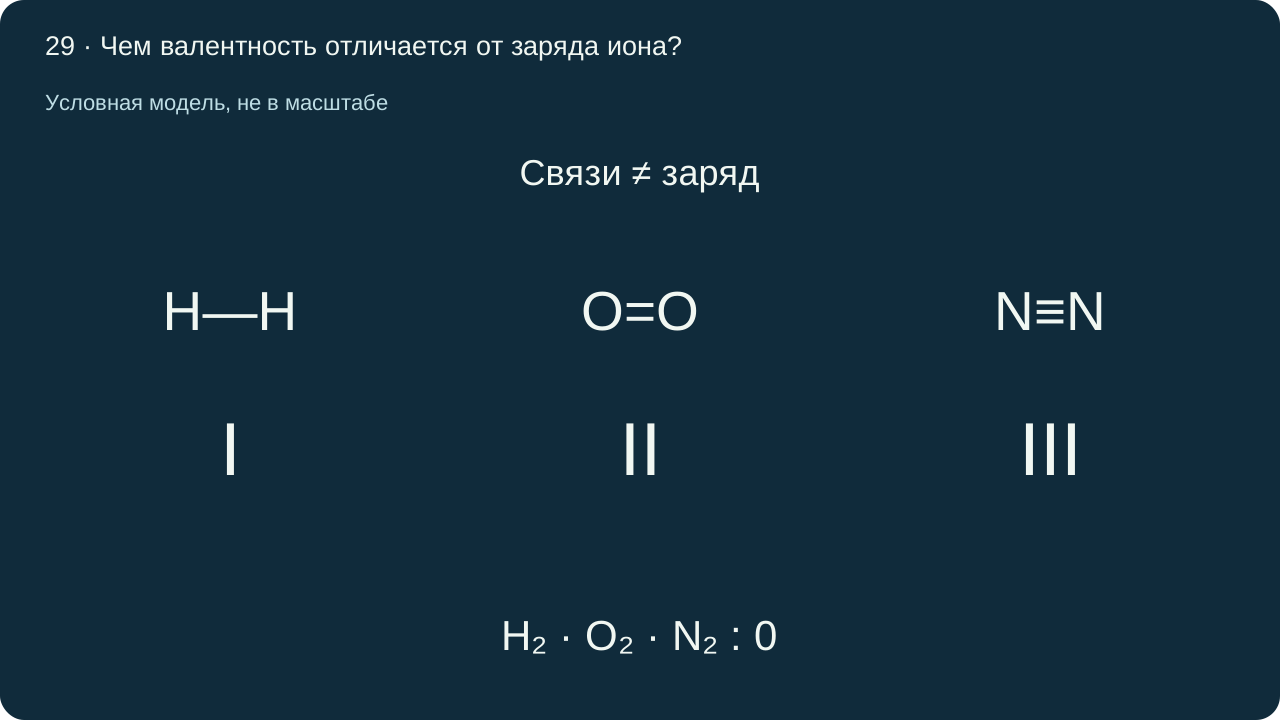
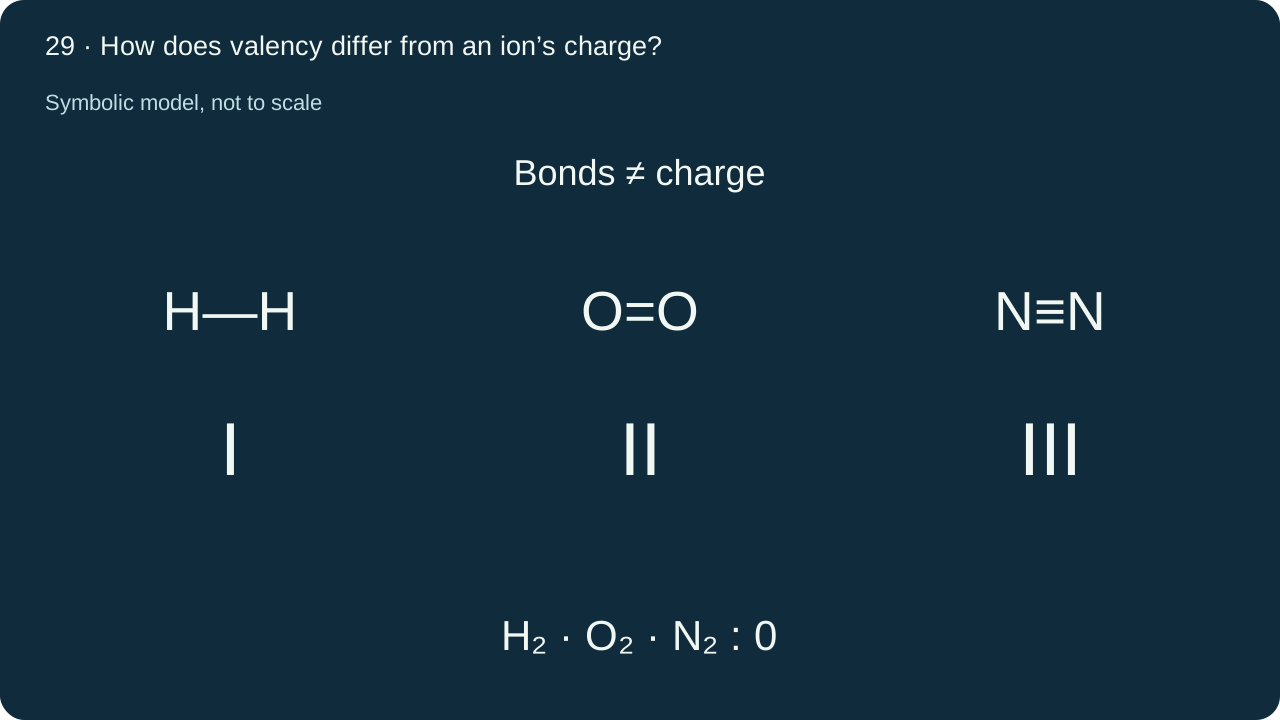
Draw H—H, H—O—H, O=O and CH₄ with four single C—H bonds. Count each single line as one and each double line as two for each atom. Distinguish the number of neighbouring atoms from bond count with multiplicity. A flat cross does not show methane’s actual three-dimensional geometry.
Worked example
Each O in O₂ has one neighbour but a double bond and valency II. Oxygen in water has two neighbours and two single bonds, also II. Carbon in methane has four single bonds and valency IV. This does not mean CH₄ contains C⁴⁺: the covalent model uses shared pairs.
A common mistake
Mistake: saying “oxygen’s valency is −2” or “one neighbour always means I”. The minus sign belongs to another accounting system, while a double bond refutes the second claim. This simple count does not cover all bonding types and exceptions; complex compounds need a fuller model. A formula without a structure does not always reveal every bond.
Transfer to a new case
New diagrams are H—Cl and N≡N. A triple bond represents three shared pairs. Find Cl’s and each N’s valency, the number of neighbours of each N and the total shared pairs in N₂. Does the numeral III imply that a free N₂ molecule has charge +3?
Answer and recall
Check: Cl is I and each N is III; each N has one neighbour, with three shared pairs between them. N₂ is neutral; valency is not its charge. Make two columns: “how many bonds?” and “what particle charge?”. Give an example where equal numbers have different physical meanings.
Exercise
- What is O’s valency in double-bonded O₂?
- How many neighbours does each N have in N₂?
- Does IV for C in CH₄ imply charge +4?
Answers
Show the answers
II; one; no. A triple bond has three shared pairs; valency is not charge.
Investigator’s notebook
Record your first answer before reading the explanation. For each error, identify the step: particle model, electron count, charge balance, brackets or limits of inference. Correct the explanation, invent a new example and solve it without hints.
When to revisit
Close the page and, after 10 minutes, reconstruct the map, define the terms in your own words and solve the new case. Repeat without hints after a day and a week. If an error persists, return to the worked example and write down the missing step.
Sources and limits
If you have found a mistake or a typo in this article, tell us about it
Comments (0)
Log in to leave a comment →
No comments yet. Be the first.