

Chemistry: investigate the world of substances Lesson 33 of 40
How do we record reactants and products?
Read word equations, formulas and state symbols, distinguishing a reaction scheme from a balanced equation.
Support map
Model diagram
Use paper and supplied data only. Do not produce gases, heat substances or use electrical equipment; do not touch, taste or smell unknown substances.
Situation and question
A teaching report says magnesium reacted with oxygen to form magnesium oxide. The substance names are supplied. How can we write this concisely without substituting our own guess about the product? Use text and cards only; do not burn magnesium or produce oxygen.
New terms, fully explained
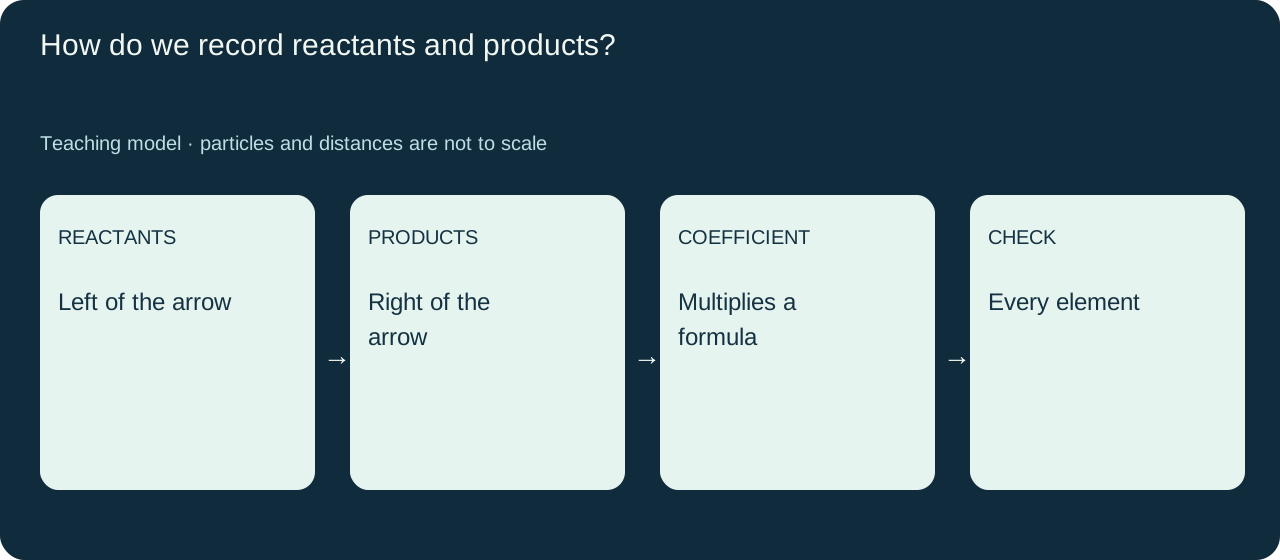
Reactants are starting substances participating in a reaction, written on the left. Products are substances formed, written on the right. The arrow gives the direction of the transformation being considered. Plus signs separate different substances. A reaction scheme lists formulas; a balanced equation also reconciles each element’s atom count.
Predict first
Predict the sides for magnesium, oxygen and MgO. Should ordinary molecular oxygen be O or O₂? Could you choose any product formula and claim it is correct merely because coefficients can be found?
Investigate or analyse given data
Write “magnesium + oxygen → magnesium oxide”. With the supplied formulas this becomes Mg + O₂ → MgO. Count atoms in two columns: left Mg=1, O=2; right Mg=1, O=1. This scheme is not balanced. Note that MgO’s identity and properties were supplied, not deduced from a plus sign and arrow.
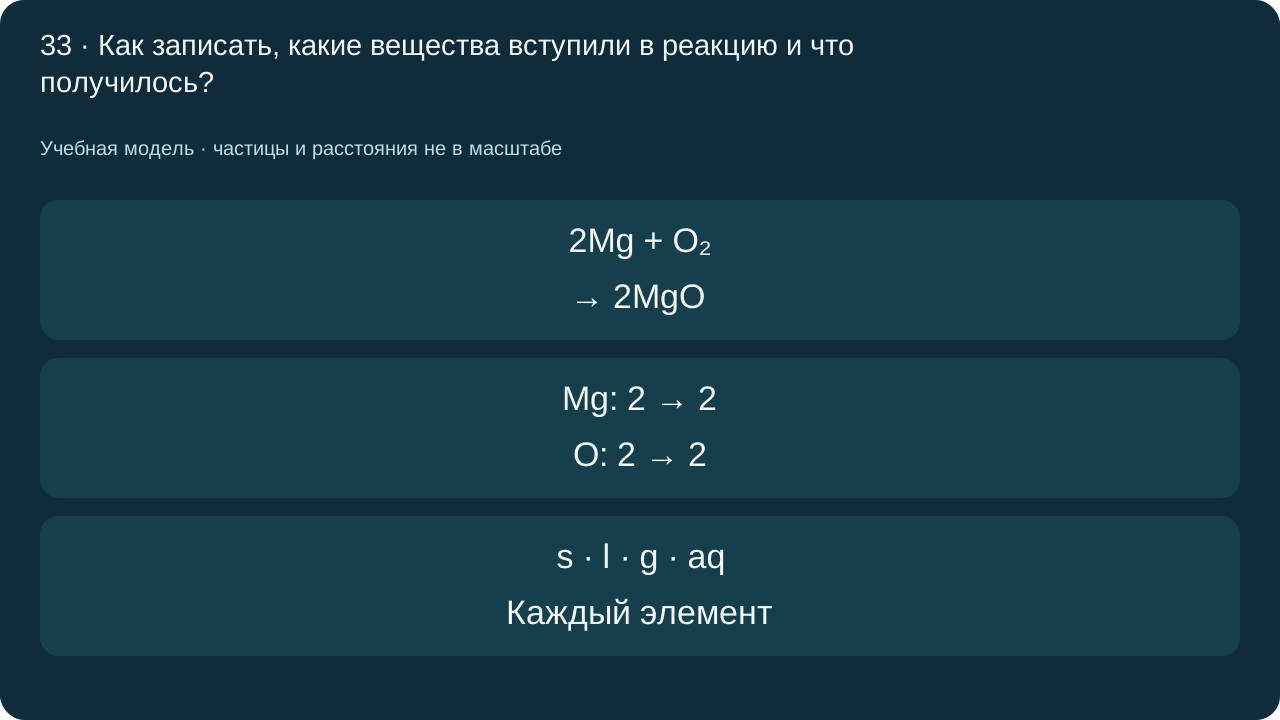
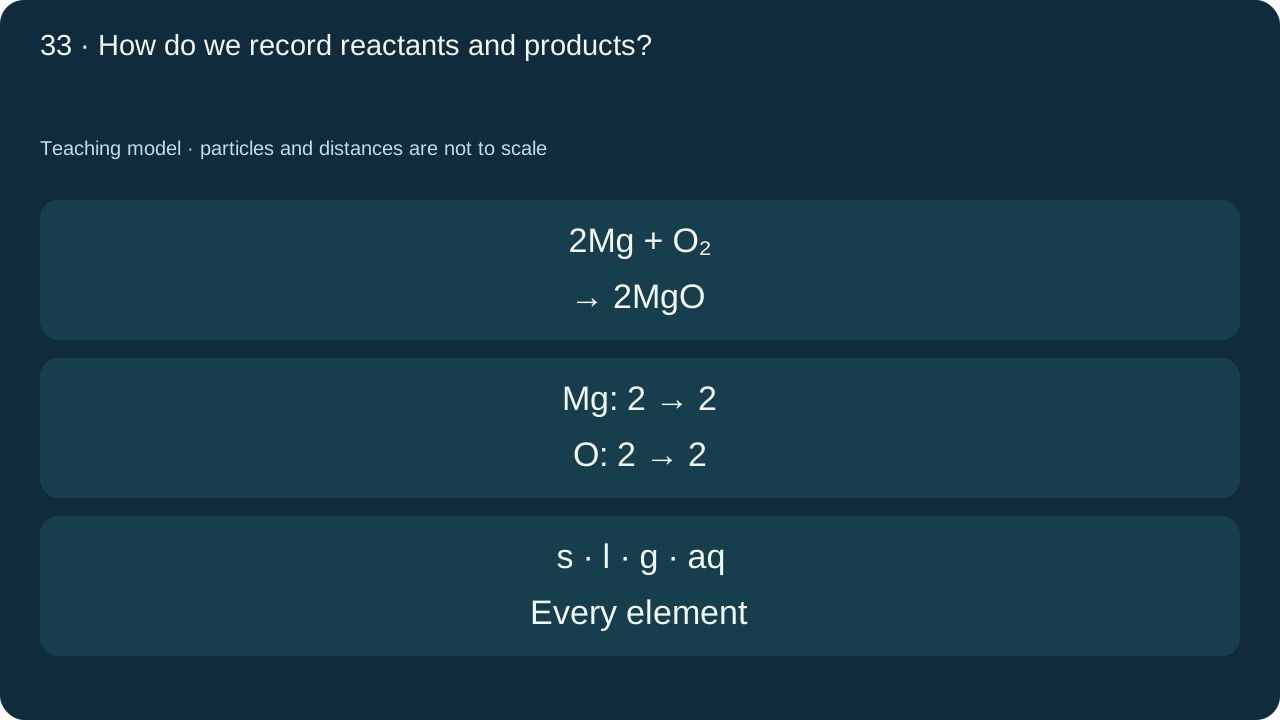
2Mg + O₂ → 2MgO
| Data / element | Before / left | After / right |
|---|---|---|
| Mg | 2 | 2 |
| O | 2 | 2 |
Worked example
The balanced equation for these substances is 2Mg(s) + O₂(g) → 2MgO(s). Here s denotes solid and g denotes gas. Other examples use l for liquid and aq for aqueous solution. State symbols are neither extra elements nor subscripts. The equation does not display every intermediate step.
A common mistake
Mistake: reading plus as “a mixture is formed” or the arrow as equality between the masses of individual substances. Plus lists reactants or products; one reactant’s mass need not equal each product’s mass. Atom balance alone does not prove a reaction occurs under every condition.
Transfer to a new case
A new description says heated calcium carbonate forms calcium oxide and carbon dioxide. Given formulas are CaCO₃, CaO and CO₂. Place them on the correct sides, check atoms and explain that the heating condition describes the reaction rather than authorising a home experiment.
Answer and recall
Check: CaCO₃(s) → CaO(s) + CO₂(g), with Ca=1, C=1, O=3 on each side. Heating is a condition, not an additional reactant with a formula “heat”. Close the page and explain reactants, products, coefficients and states. For unfamiliar substances, first request evidence about products and conditions.
Exercise
- Name the reactants in 2Mg + O₂ → 2MgO.
- How many O atoms are in 2MgO?
- What does (g) mean?
Answers
Show the answers
Mg and O₂; two O atoms in this set; gas state. Subscripts describe composition, coefficients count units; (g) is not an element.
Investigator’s notebook
For each error, identify its cause: wrong composition, changed subscript, missing atom, neglected system boundary, or confusion between heat and temperature. Correct your explanation and check another example without hints.
When to revisit
Close the page and, after 10 minutes, reconstruct the map, define the terms in your own words and solve the new case. Repeat without hints after a day and a week. If an error persists, return to the worked example and write down the missing step.
Sources and limits
If you have found a mistake or a typo in this article, tell us about it
Comments (0)
Log in to leave a comment →
No comments yet. Be the first.