

Chemistry: investigate the world of substances Lesson 24 of 40
How does a shared electron pair connect atoms?
Model H₂, Cl₂ and HCl and count bonding and lone pairs.
Support map
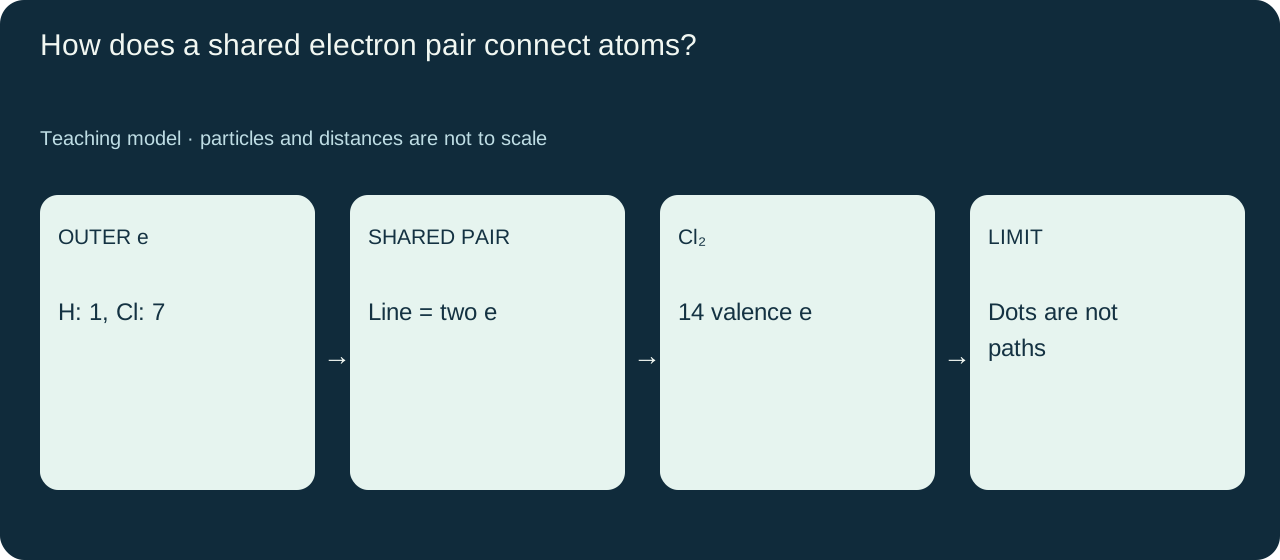
Model diagram
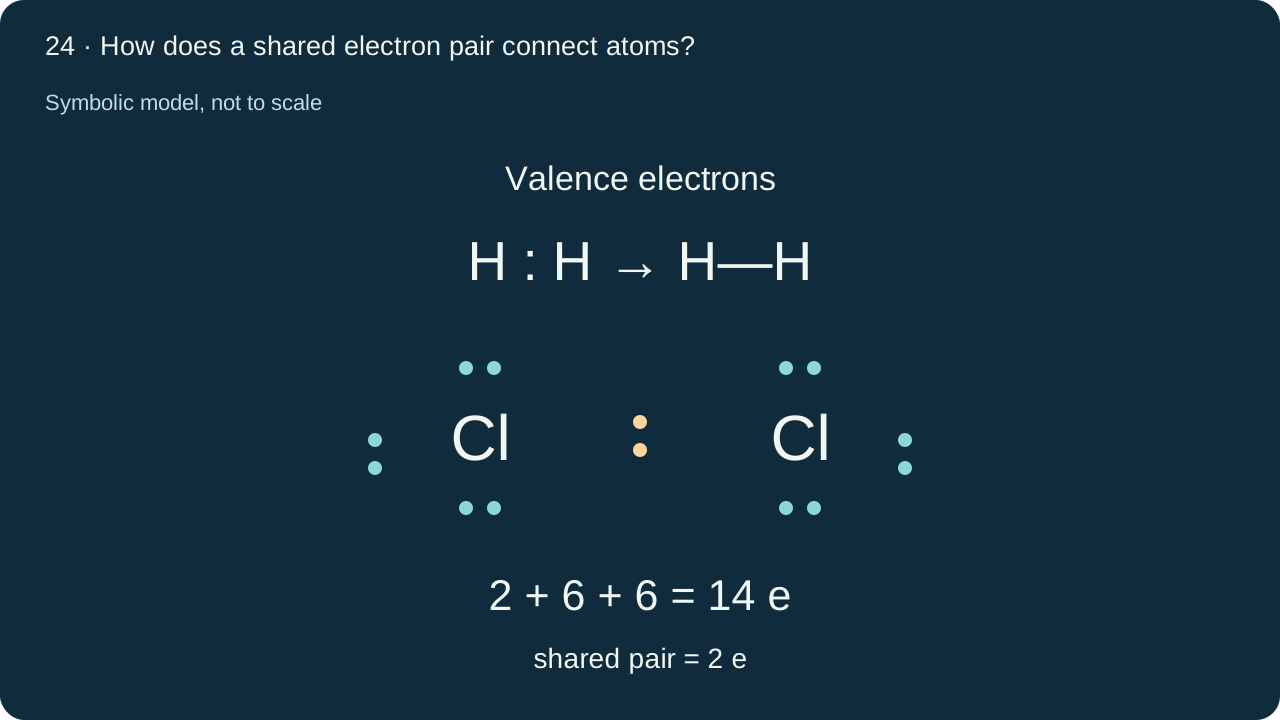
Teaching model · particles and distances are not to scale
Use paper and supplied data only. Do not produce gases, heat substances or use electrical equipment; do not touch, taste or smell unknown substances.
Situation and question
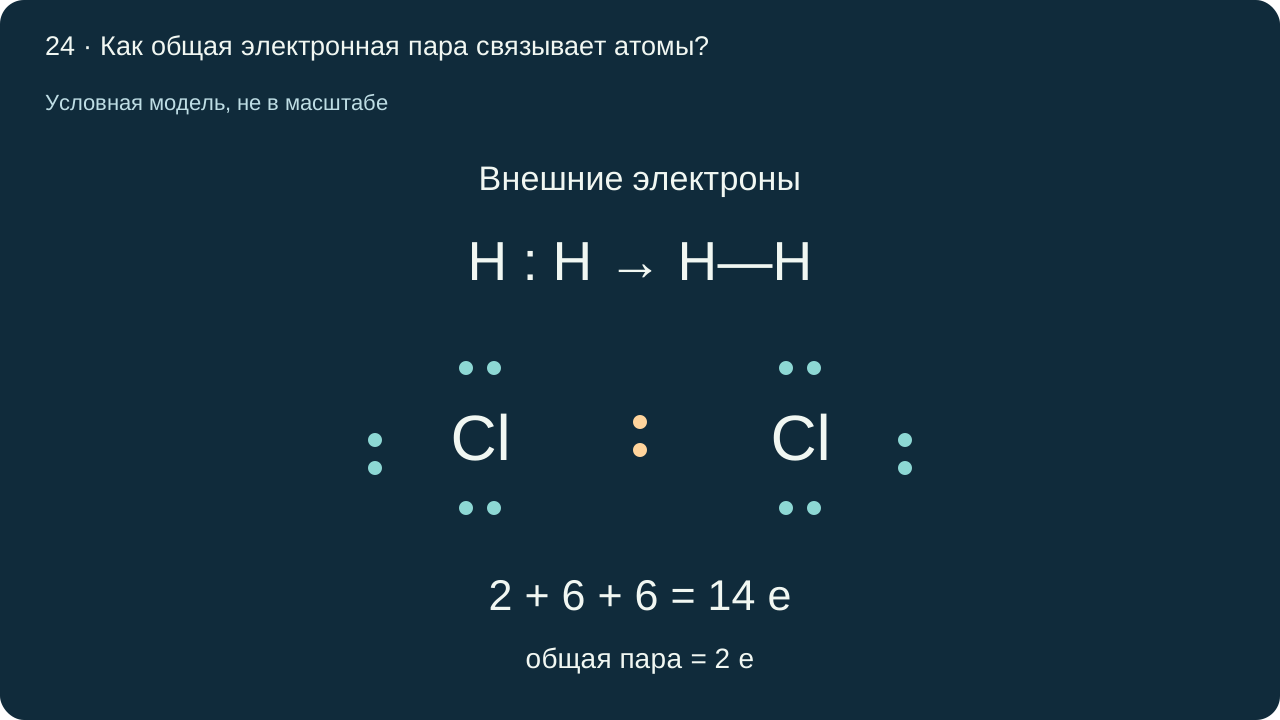
H—H and Cl—Cl each show one line. Does that mean each molecule contains just two electrons? Recall that neutral H has one electron, whereas Cl has seventeen, seven in its outer shell. We are focusing on outer electrons rather than every charge inside an atom. No gas samples are needed.
New terms, fully explained
A covalent bond involves a shared electron pair interacting with both nuclei. In our simple examples, valence electrons are outer-shell electrons. A Lewis diagram uses dots for these electrons and a line for a shared pair. A lone pair occupies the region of one atom and is not a connecting line. The diagram models electron distribution, not electron paths.
Predict first
Predict the number of outer electrons in H₂ and Cl₂. Should electrons outside the shared pair disappear when a bond forms? Write electron counts separately from pair counts. Do not replace hydrogen’s filled shell of two electrons with a requirement for eight.
Investigate or analyse given data
On paper, place one dot by H and seven by Cl. Connect two H atoms with one shared pair. For two Cl atoms, mark the shared pair and arrange the remaining dots in pairs around the atoms. Do not use wires, electrical supplies or chemicals: the drawing checks bookkeeping rather than producing a substance.
Worked example
H₂ has 1+1=2 valence electrons, one shared pair. Cl₂ has 7+7=14: one shared pair and three lone pairs on each Cl. Each Cl counts eight surrounding electrons in this model, but the shared pair must not be added twice to the total of fourteen. Inner electrons are not drawn here.
A common mistake
Mistake: treating a line as one electron, or assuming all Cl₂ electrons belong to its bond. For identical atoms, do not assign permanent ownership of the shared pair to one atom. The drawing gives neither molecular dimensions nor electron speeds nor gas safety. H—Cl also does not require transfer of a whole electron.
Transfer to a new case
Try HCl: H contributes one outer electron to the total and Cl contributes seven. Find the total, the number of shared pairs and the number of lone pairs on Cl in a simple diagram. Compare molecular HCl with ionic Na⁺Cl⁻: do these notations describe the particles in the same way?
Answer and recall
Check: eight valence electrons, one shared pair and three lone pairs on Cl. HCl denotes a molecule; Na⁺Cl⁻ indicates ions in a 1:1 ratio. The next lesson examines an ionic lattice. Draw H₂ and then Cl₂ from memory, checking that no dot has been lost.
Exercise
- How many shared pairs are in H₂?
- How many lone pairs are on each Cl in Cl₂?
- How many valence electrons are in HCl in total?
Answers
Show the answers
One; three on each; eight. A line represents two electrons, not the complete electron content of the atoms.
Investigator’s notebook
Record your first answer before reading the explanation. For each error, identify the step: particle model, electron count, charge balance, brackets or limits of inference. Correct the explanation, invent a new example and solve it without hints.
When to revisit
Close the page and, after 10 minutes, reconstruct the map, define the terms in your own words and solve the new case. Repeat without hints after a day and a week. If an error persists, return to the worked example and write down the missing step.
Sources and limits
If you have found a mistake or a typo in this article, tell us about it
Comments (0)
Log in to leave a comment →
No comments yet. Be the first.