

Chemistry: investigate the world of substances Lesson 36 of 40
How do we balance bracketed formulas without losing atoms?
Analyse Ca(OH)₂ and Fe₂(SO₄)₃, preserving formulas and distinguishing aqueous notation from individual molecules.
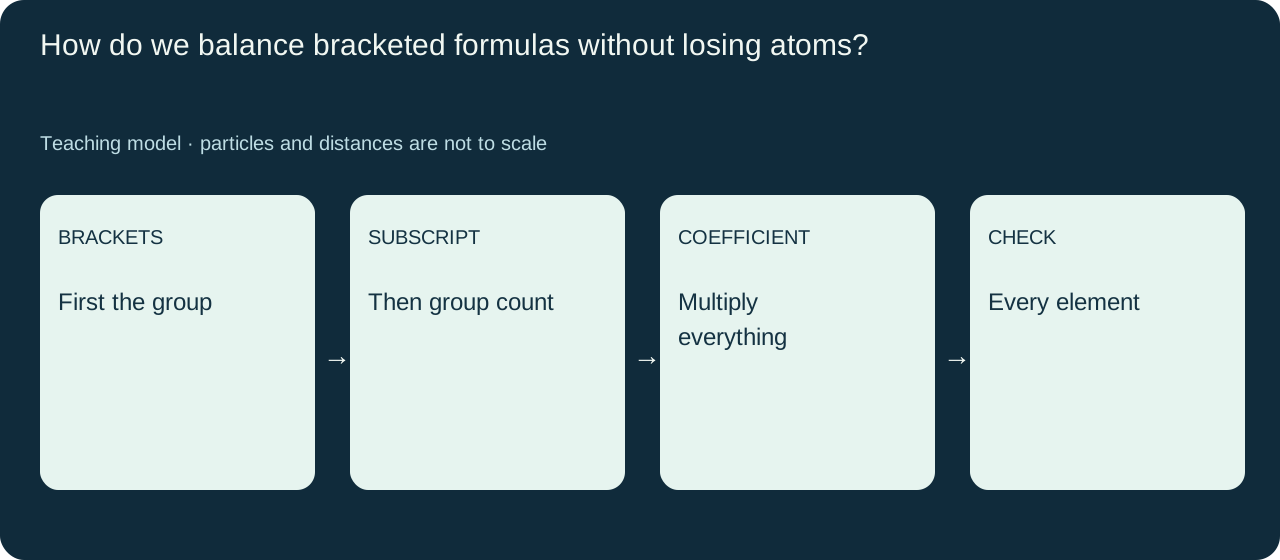
Support map
Model diagram
Use paper and supplied data only. Do not produce gases, heat substances or use electrical equipment; do not touch, taste or smell unknown substances.
Situation and question
Ca(OH)₂ + HCl → CaCl₂ + H₂O contains familiar brackets. If we place two before water, what happens to H and O counts? Do not mix substances: this is a data exercise. Reagent names do not invite you to obtain acids or hydroxides at home.
New terms, fully explained
First expand brackets to find the composition of one formula unit. Then apply the coefficient to the whole formula. Ca(OH)₂ contains Ca=1, O=2, H=2. You may temporarily count a group as a unit only when it appears unchanged on both sides; individual elements must still be checked afterwards.
Predict first
Predict whether OH can be treated as unchanged when the product is H₂O. What does aq after HCl mean? Aqueous particles may be ions: a conventional molecular equation does not prove that separate molecules of every listed salt exist in solution.
Investigate or analyse given data
Start with Ca and Cl. One CaCl₂ requires two HCl. The left now has H=2+2=4, O=2, requiring two H₂O on the right. Make Ca, H, O, Cl rows and total both sides. State symbols s, l, g, aq do not enter atom arithmetic.
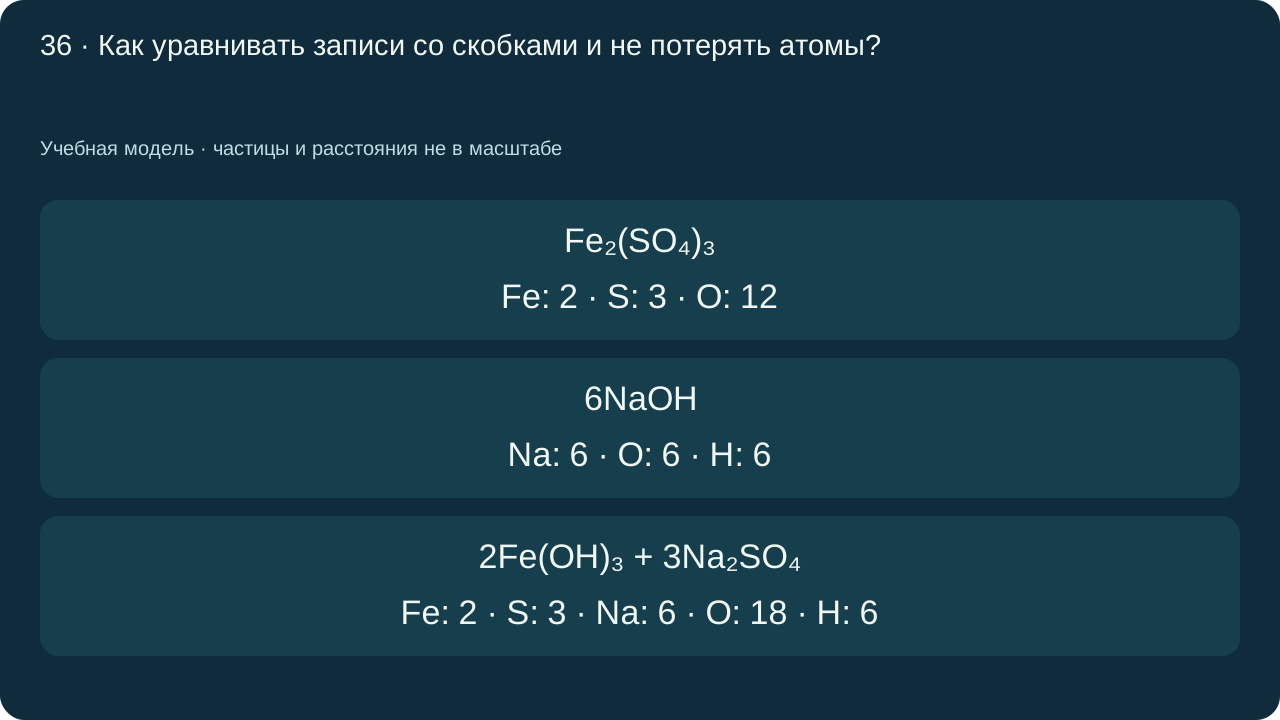
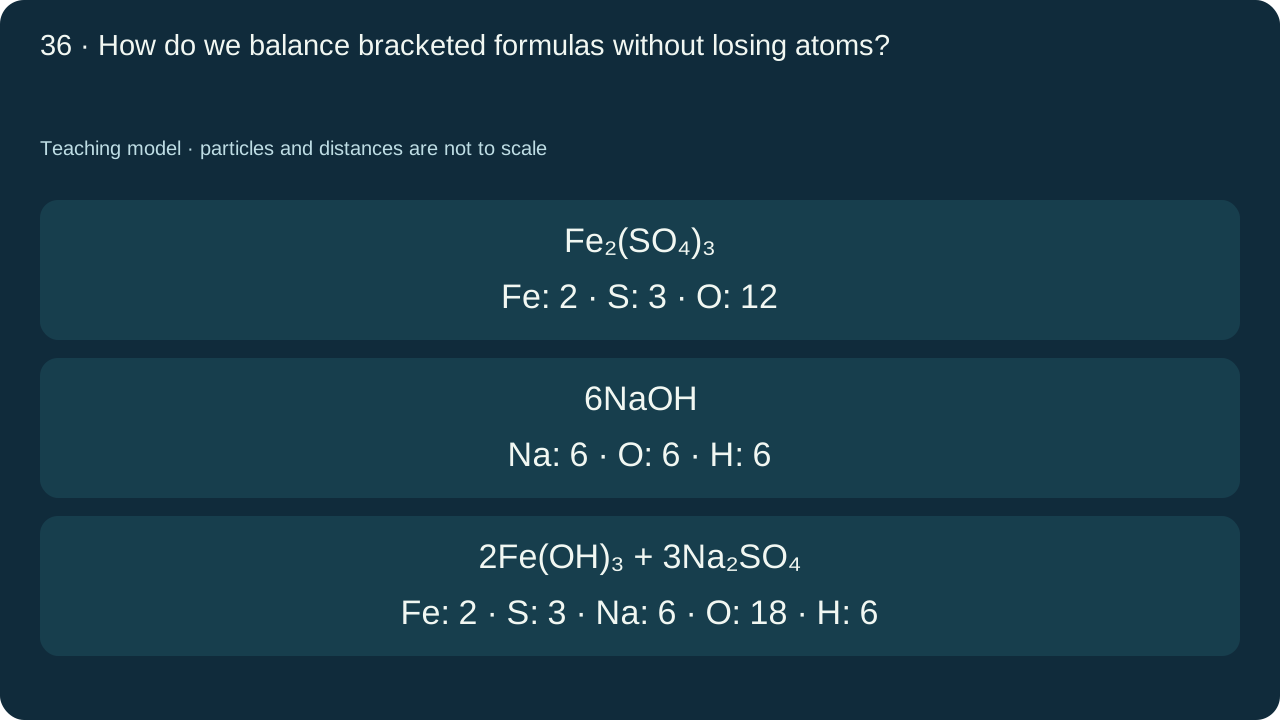
Fe₂(SO₄)₃ + 6NaOH → 2Fe(OH)₃ + 3Na₂SO₄
| Data / element | Before / left | After / right |
|---|---|---|
| Fe | 2 | 2 |
| S | 3 | 3 |
| Na | 6 | 6 |
| O | 18 | 18 |
| H | 6 | 6 |
Worked example
The result is Ca(OH)₂ + 2HCl → CaCl₂ + 2H₂O. Each side has Ca=1, H=4, O=2, Cl=2. OH was not retained as a ready-made block: its atoms entered water. Two before HCl multiplies both H and Cl. This is a school-level overall equation for supplied products, not a description of every solution particle.
A common mistake
Mistake: multiplying only the final bracketed symbol, adding rather than multiplying a subscript, or changing water to H₂O₂ to obtain balance. States and reaction conditions are separate information. A precipitate is a solid phase formed; writing s does not prove precipitation at every dilution.
Transfer to a new case
A new scheme supplies Fe₂(SO₄)₃ + NaOH → Fe(OH)₃ + Na₂SO₄, with Fe(OH)₃ precipitation specified. Try unchanged SO₄ groups first, then Fe and Na; finally expand brackets and check O and H. Use paper only.
Answer and recall
Check: Fe₂(SO₄)₃ + 6NaOH → 2Fe(OH)₃ + 3Na₂SO₄. Both sides have Fe=2, S=3, Na=6, O=18, H=6. The equation is not an instruction to make a precipitate. Explain why SO₄ can be counted as a group here, whereas OH in the first example must be recounted when its atoms enter water.
Exercise
- How many O atoms are in Fe₂(SO₄)₃?
- How many H atoms are in 6NaOH?
- Does OH remain intact in the products of Ca(OH)₂ + 2HCl?
Answers
Show the answers
12; 6; no, the products are CaCl₂ and 2H₂O. Count elements rather than carrying a group unchanged when its form changes.
Investigator’s notebook
For each error, identify its cause: wrong composition, changed subscript, missing atom, neglected system boundary, or confusion between heat and temperature. Correct your explanation and check another example without hints.
When to revisit
Close the page and, after 10 minutes, reconstruct the map, define the terms in your own words and solve the new case. Repeat without hints after a day and a week. If an error persists, return to the worked example and write down the missing step.
Sources and limits
If you have found a mistake or a typo in this article, tell us about it
Comments (0)
Log in to leave a comment →
No comments yet. Be the first.