

Chemistry: investigate the world of substances Lesson 63 of 67
What changes in neutralisation, and which ions remain?
Connect molecular, complete ionic and net ionic equations.
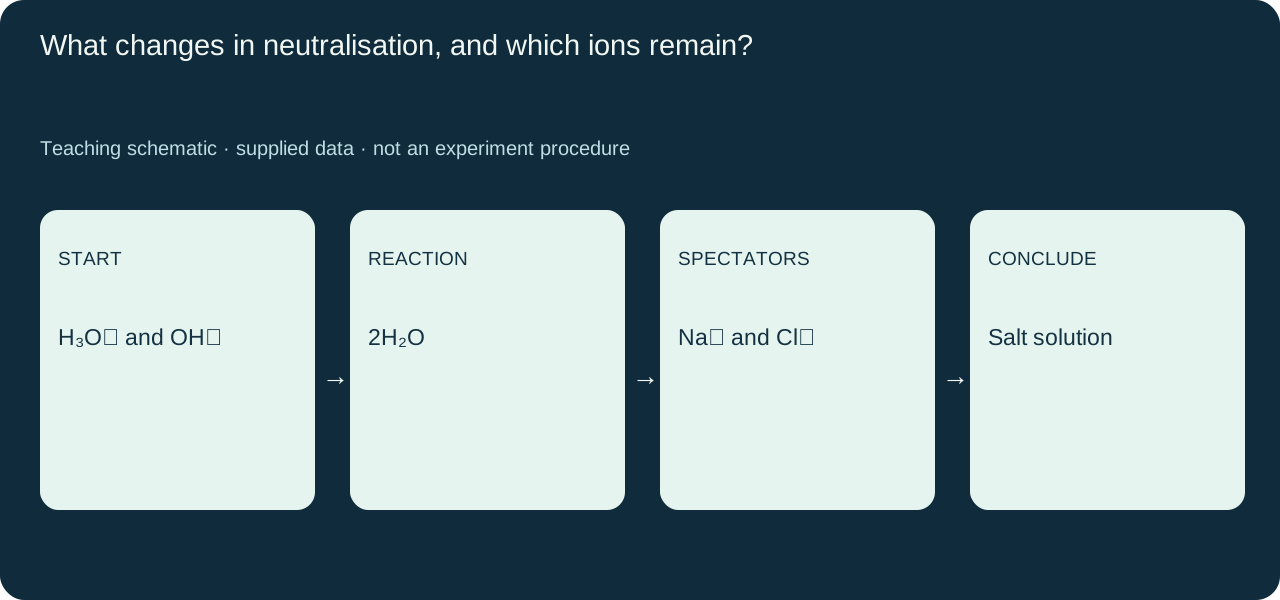
Support map
Model diagram
Use paper, a calculator and supplied data only. Do not taste, smell, mix or heat chemicals; do not open household products or unknown containers. Neutral pH does not establish safety. Do not apply teaching neutralisation to skin, eyes, spills or unknown mixtures.
Situation and question
The notebook claims: “The acid and alkali disappeared, leaving pure water.” Where did Na and Cl go? Compare the solution formula with its particle contents. Consider a calculation model of strong monoprotic HCl reacting with aqueous NaOH only; no experiment is assigned.
New terms, fully explained
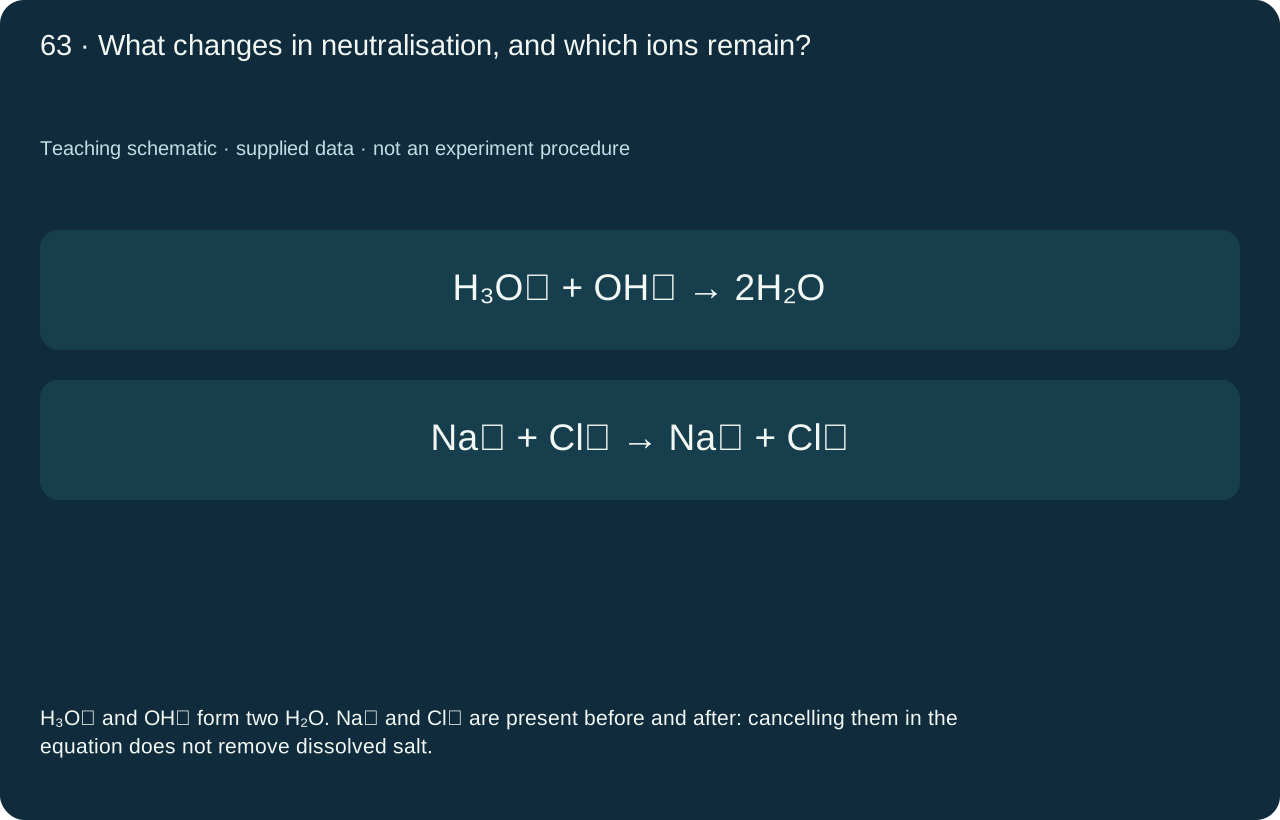
In this case, neutralisation consumes H₃O⁺ and OH⁻ to form water. Spectator ions remain in the same form before and after reaction. They cancel from an equation, not from the solution’s contents. Complete neutralisation does not give pH 7 for every acid and base combination.
Predict first
Predict the products of HCl(aq) + NaOH(aq) → NaCl(aq) + H₂O(l). Which species remain in solution? If Na⁺ and Cl⁻ are omitted from the net equation, have their atoms vanished? Answer before reading on. NaCl(aq) does not represent separate salt molecules in this model.
Investigate or analyse given data
With water represented explicitly, write H₃O⁺ + Cl⁻ + Na⁺ + OH⁻ → Na⁺ + Cl⁻ + 2H₂O. Cancel identical spectator ions. Count H and O in the remaining equation, then total charges. Two waters are appropriate for the hydronium representation, rather than the shorthand H⁺ equation.
| Object / step | Given / calculation | Conclusion |
|---|---|---|
| H₃O⁺ + OH⁻ | → | 2H₂O |
| Na⁺, Cl⁻ | before and after | spectators |
| K⁺, NO₃⁻ | before and after | spectators |
Worked example
The net equation H₃O⁺ + OH⁻ → 2H₂O has four H and two O on each side, with total charge zero on both. Na⁺ and Cl⁻ remain hydrated. Exact equivalent amounts of strong acid and alkali give approximately pH 7 in an ideal dilute model at 25 °C—but a salt solution, not pure water.
A common mistake
Mistake: saying “all ions were neutralised”, or transferring pH≈7 to salts of weak acids and bases. More generally, acid–base equilibria can alter pH. An indicator colour does not demonstrate the disappearance of all solutes. This theory is not a method for making unknown household mixtures safe.
Transfer to a new case
Transfer case: HNO₃(aq) + KOH(aq) → KNO₃(aq) + H₂O(l). Identify the spectators and reconstruct the hydronium net equation. Explain why a reading near pH 7 under the model’s conditions still does not make the product distilled water.
Answer and recall
Check: K⁺ and NO₃⁻ are spectators; the net equation is again H₃O⁺ + OH⁻ → 2H₂O. Salt ions remain. Neutrality concerns acid–base state, whereas purity concerns composition. Reconstruct all three representations, checking atoms and charge separately.
Exercise
Identify the spectator ions for HCl and NaOH. Do they disappear from solution?
Answers
Show the answers
Na⁺ and Cl⁻; no. H₃O⁺ + OH⁻ → 2H₂O does not remove them from the contents.
When to revisit
Close the page and, after 10 minutes, reconstruct the map, define the terms in your own words and solve the new case. Repeat without hints after a day and a week. If an error persists, return to the worked example and write down the missing step.
Sources and limits
If you have found a mistake or a typo in this article, tell us about it
Comments (0)
Log in to leave a comment →
No comments yet. Be the first.