

Chemistry: investigate the world of substances Lesson 55 of 58
How do we find component masses from a target fraction?
Plan solution composition on paper and verify it by working backward.
Support map
Model diagram
Use paper, a calculator and supplied data only. Do not heat, taste or smell samples, mix household chemicals or perform electrical experiments. Clarity and ordinary filtration do not establish drinking safety.
Situation and question
Describe 250 g of sugar solution containing 8% sugar by mass. This is a composition problem, not a home laboratory recipe. The denominator is total solution mass. Which two component masses must add to 250 g?
New terms, fully explained
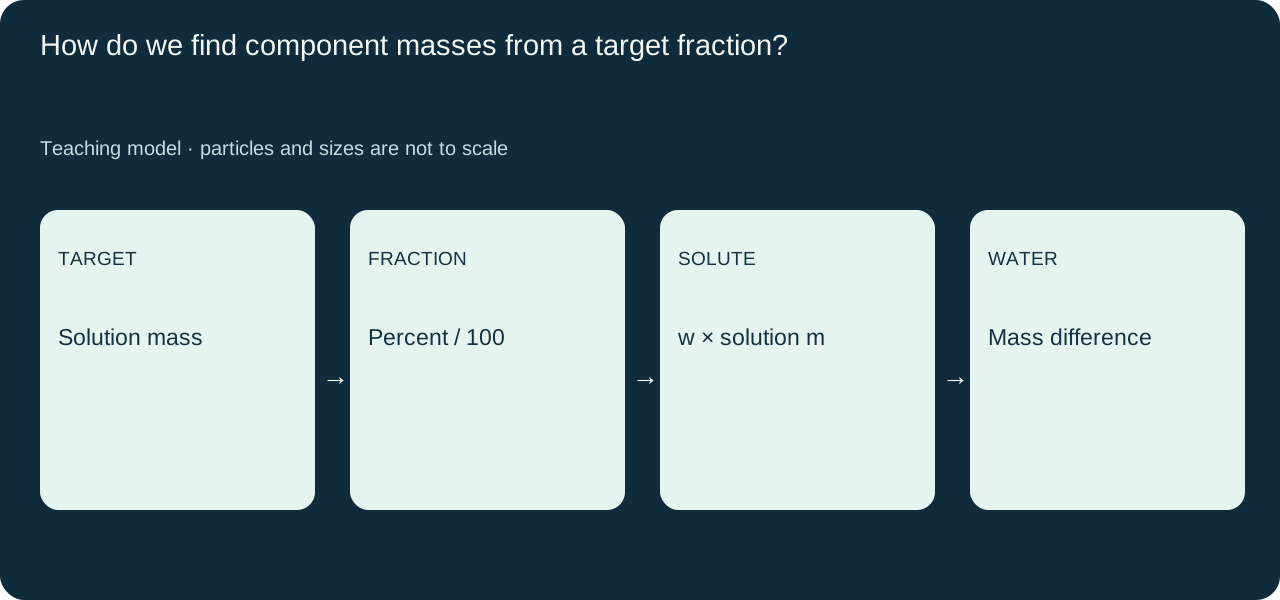
From w=m(solute)/m(solution), obtain m(solute)=w×m(solution). In a two-component system, water mass equals solution mass minus solute mass. A reverse check substitutes the masses into the original definition, detecting an incorrect denominator or percentage conversion.
Predict first
Predict whether an 8% solute mass can exceed half the solution mass. Compare plans for 100 g and 250 g of the same composition. Does multiplying both component masses by 2.5 preserve the fraction?
Investigate or analyse given data
Write the target 250 g and w=0.08. Build a solute–water–total table. Assume pure components, complete dissolution and no losses. Without these conditions the composition can change; arithmetic does not establish actual preparation accuracy.
| Object / step | Given / calculation | Result |
|---|---|---|
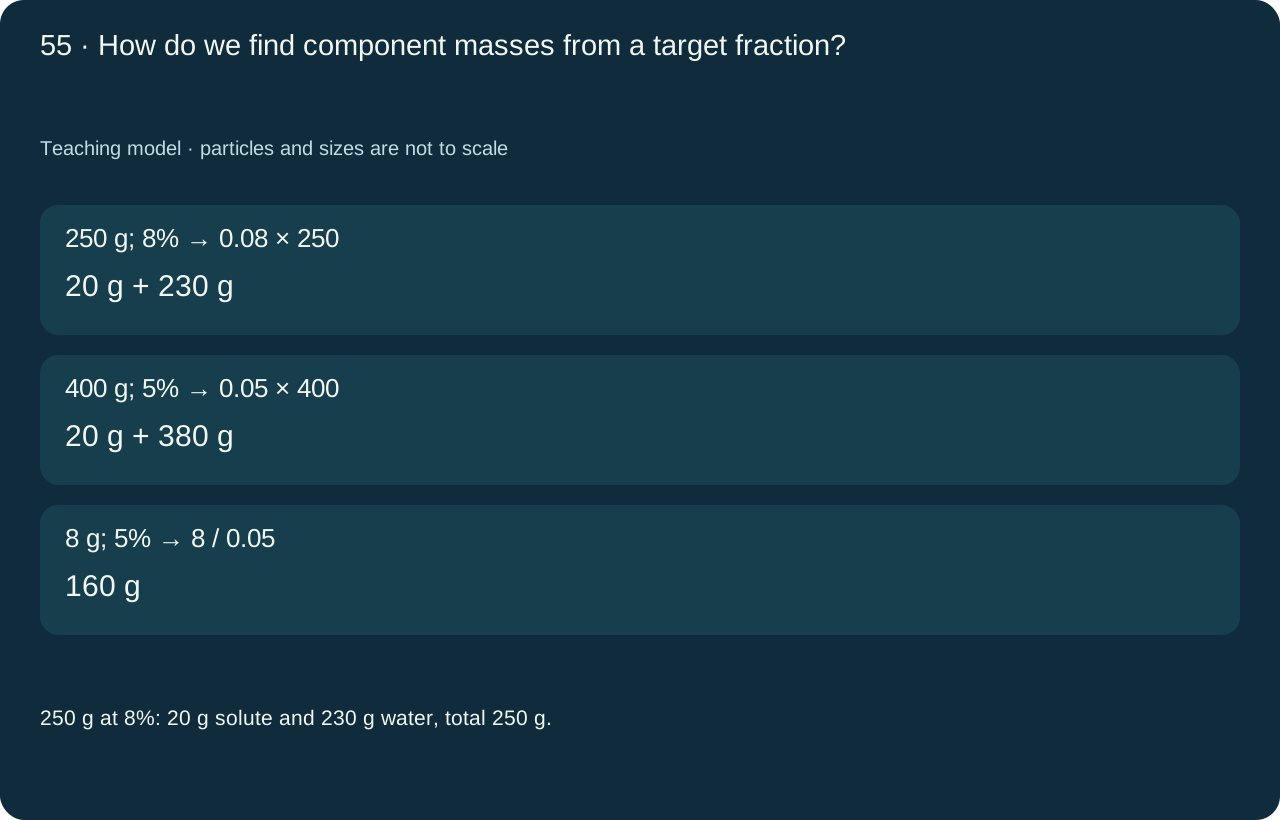
| 250 g; 8% | 0.08 × 250 | 20 g + 230 g |
| 400 g; 5% | 0.05 × 400 | 20 g + 380 g |
| 8 g; 5% | 8 / 0.05 | 160 g |
Worked example
Sugar mass is 0.08×250=20 g and water mass 250−20=230 g. Check 20+230=250 g and 20/250=0.08. Combining 20 g of sugar with 250 g of water instead gives 270 g at about 7.41%, not 8%.
A common mistake
Mistake: treating “250 g of solution” as “250 g of solvent”. For an impure reagent, total reagent mass cannot silently replace pure solute mass. Here purity is supplied; impurity problems need another balance and do not instruct learners to handle unknown materials.
Transfer to a new case
Transfer: plan 400 g of a 5% sugar solution on paper. Find both masses, check their sum and ratio, then find the solution mass at the same fraction containing 8 g of sugar. Include units.
Answer and recall
Check: 20 g of sugar and 380 g of water; 20/400=0.05. With 8 g of sugar, solution mass is 8/0.05=160 g, containing 152 g of water. Equal sugar masses can belong to different compositions; specify the fraction and total mass.
Exercise
Find component masses for 300 g of 4% sugar solution and check.
Answers
Show the answers
12 g of sugar and 288 g of water; 12/300=0.04.
When to revisit
Close the page and, after 10 minutes, reconstruct the map, define the terms in your own words and solve the new case. Repeat without hints after a day and a week. If an error persists, return to the worked example and write down the missing step.
Sources and limits
If you have found a mistake or a typo in this article, tell us about it
Comments (0)
Log in to leave a comment →
No comments yet. Be the first.