

Chemistry: investigate the world of substances Lesson 42 of 49
Why do equal mole amounts have different masses?
Calculate molar mass from a formula and distinguish it from relative formula mass.
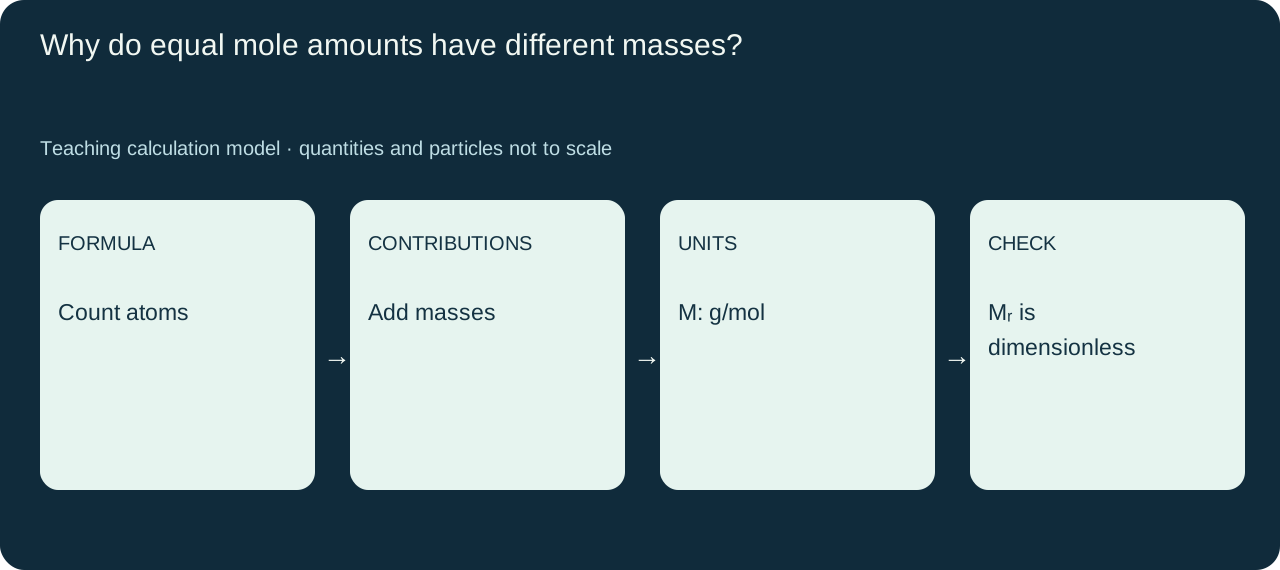
Support map
Model diagram
Use only paper, a calculator and supplied data. Do not carry out reactions, generate gases, heat substances or mix household chemicals.
Situation and question
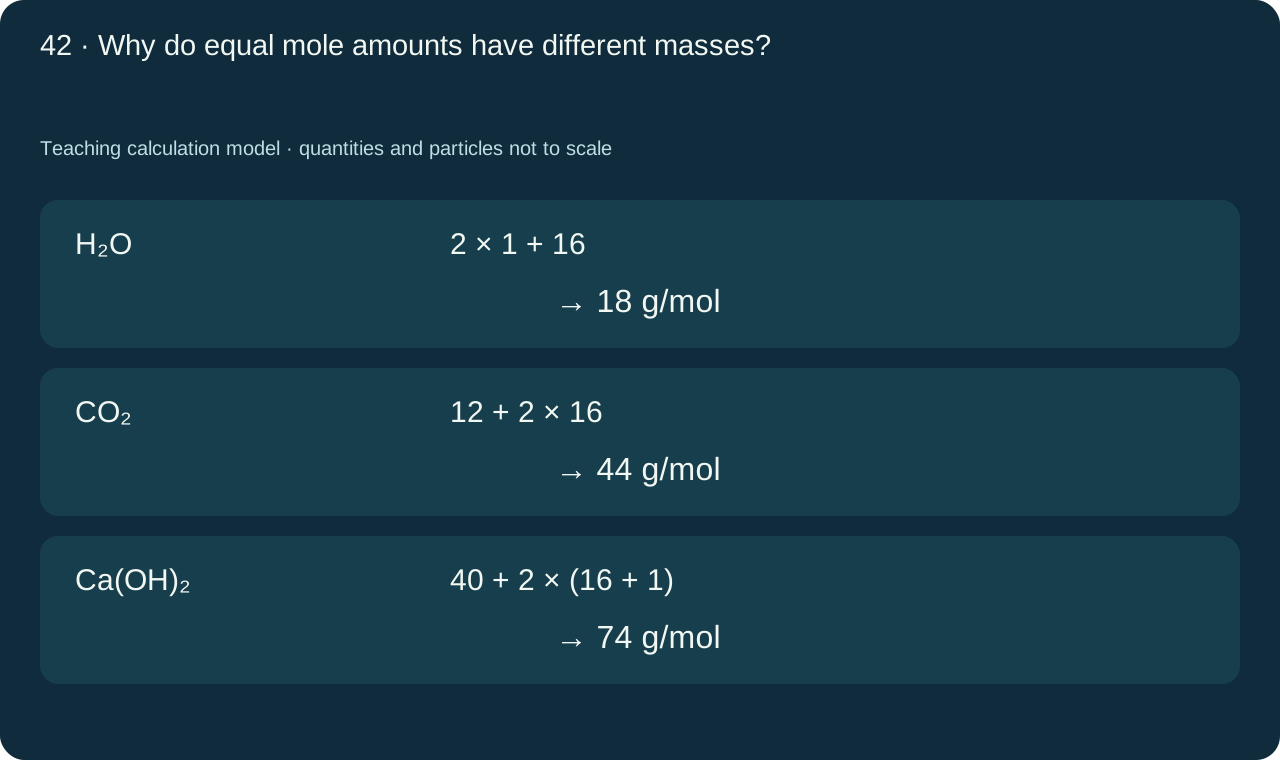
Two report entries each specify 1 mol: H₂O and CO₂. Their molecule counts match, but their masses are 18 g and 44 g in the supplied rounded model. Where does the difference come from? Return to the composition and atomic masses in each molecule.
New terms, fully explained
Molar mass M is mass divided by amount: M = m/n. We use g/mol; its SI unit is kg/mol. Relative formula mass Mᵣ is a dimensionless sum of relative atomic masses according to a formula. At school precision, we use its numerical value for M in g/mol; quantities with different units are not identical.
Predict first
Predict whether 1 mol of O atoms or 1 mol of O₂ molecules is heavier. Then decide how to account for the subscript outside the brackets in Ca(OH)₂. Explain the composition in words before adding any masses.
Investigate or analyse given data
Use these supplied rounded Aᵣ values throughout this block: H=1, C=12, O=16, Na=23, Cl=35.5, Ca=40. For Ca(OH)₂, count one Ca, two O and two H. A coefficient before a formula does not enter the molar mass of that substance.
| Entity / step | Given / calculation | Result |
|---|---|---|
| H₂O | 2 × 1 + 16 | 18 g/mol |
| CO₂ | 12 + 2 × 16 | 44 g/mol |
| Ca(OH)₂ | 40 + 2 × (16 + 1) | 74 g/mol |
Worked example
M(H₂O) ≈ 2×1+16 = 18 g/mol; M(CO₂) ≈ 12+2×16 = 44 g/mol. For Ca(OH)₂, 40+2×(16+1) = 74 g/mol. NaCl gives 58.5 g/mol and describes formula units of an ionic substance. These are calculation approximations rather than claims about measurement precision.
A common mistake
Mistake: writing M(2H₂O)=36 g/mol as a property of water. Doubling a portion doubles mass and amount equally, leaving m/n unchanged. Another mistake is assigning g/mol to Mᵣ. Separate the quantity symbol, numerical value and unit.
Transfer to a new case
Calculate M(CaCO₃), M(O₂) and M(H₂) using the supplied values. Find the mass of 1 mol of each. Explain why a formula alone cannot give the mass of an arbitrary sample without knowing its amount.
Answer and recall
Check: approximately 100, 32 and 2 g/mol; 1 mol has masses 100, 32 and 2 g respectively in this model. Count atoms before adding. Precise work needs consistent reference masses and isotope information; these exercises use school-level rounding.
Exercise
Find M(Na₂O) and M(CaCl₂) from the supplied data. Does doubling a water portion change M?
Answers
Show the answers
62 and 111 g/mol; no. A coefficient changes amount, not composition.
When to revisit
Close the page and, after 10 minutes, reconstruct the map, define the terms in your own words and solve the new case. Repeat without hints after a day and a week. If an error persists, return to the worked example and write down the missing step.
Sources and limits
How can we count particles too numerous to count one by one?
How do we move from mass to particle count without confusion?
If you have found a mistake or a typo in this article, tell us about it
Comments (0)
Log in to leave a comment →
No comments yet. Be the first.