

Chemistry: investigate the world of substances Lesson 44 of 49
Why are atom fractions and mass fractions different answers?
Find an element’s mass fraction in a known pure compound and check that the fractions add up.
Support map
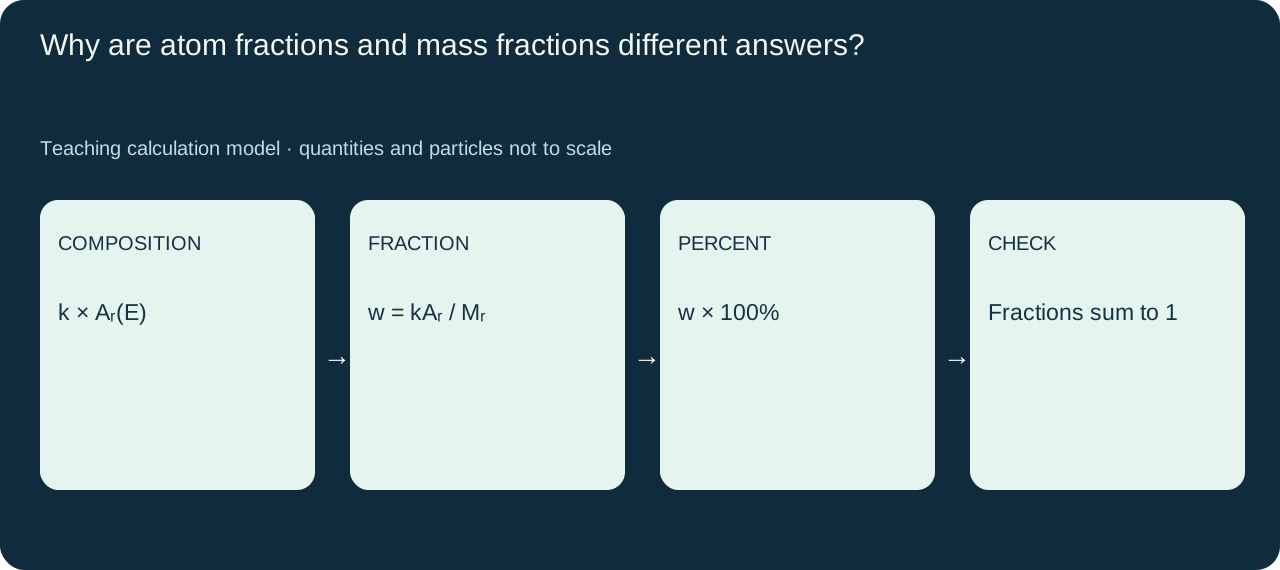
Model diagram
Use only paper, a calculator and supplied data. Do not carry out reactions, generate gases, heat substances or mix household chemicals.
Situation and question
A water molecule contains two H atoms and one O atom. A learner concludes that hydrogen contributes two thirds of the mass. Is that correct? Compare atom counts with mass contributions using H=1 and O=16 in the supplied teaching model.
New terms, fully explained
An element’s mass fraction w is its mass in a compound divided by the mass of the compound. For a known formula, w(E) = kAᵣ(E)/Mᵣ, where k counts E atoms in the formula. The fraction is dimensionless; multiply by 100% for a percentage. This describes a pure compound’s composition, not solution concentration.
Predict first
Predict which element contributes most of the mass of H₂O. Would the mass fraction change between 18 g and 36 g of pure water with the same composition? Explain the difference between a constant fraction and an increasing mass of an element.
Investigate or analyse given data
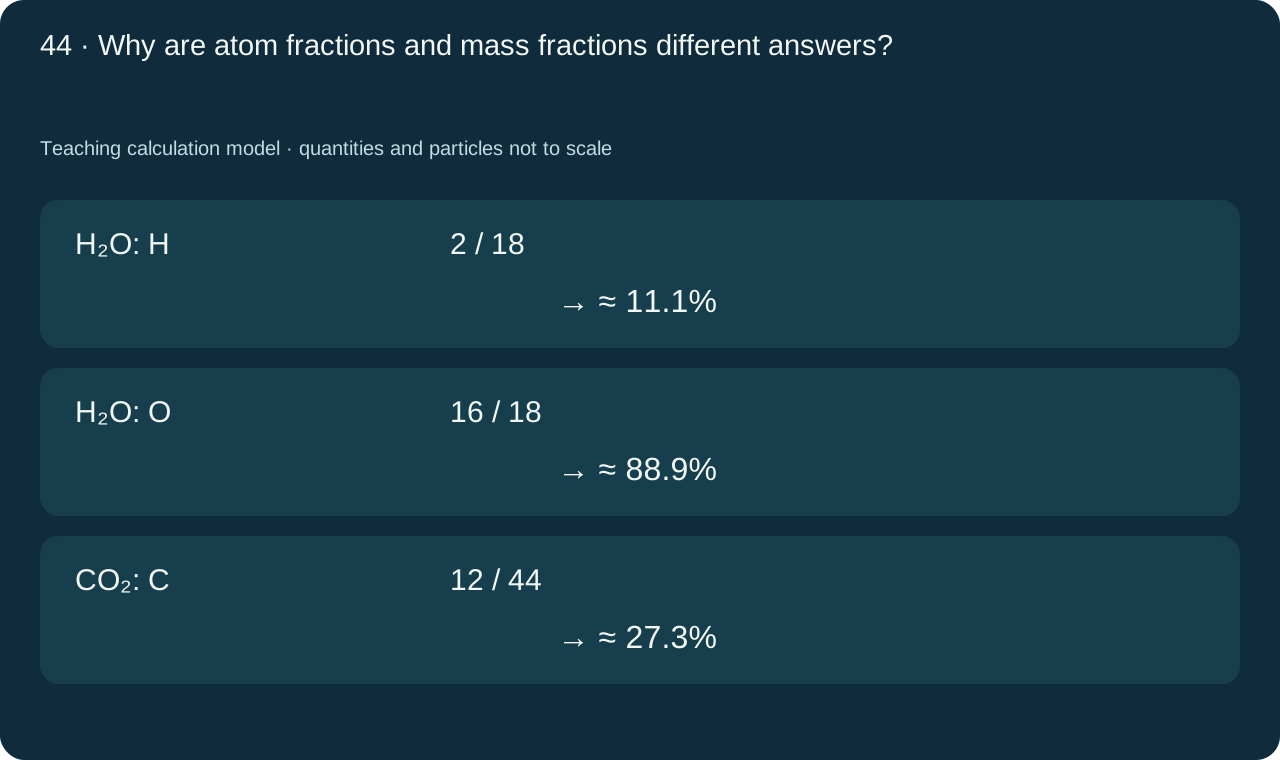
For water, list the contributions: H contributes 2×1=2, O contributes 16, total 18. For CO₂, C contributes 12 and O contributes 32, total 44. Find fractions first and percentages second. Rounding may make the percentages add to slightly more or less than 100%.
| Entity / step | Given / calculation | Result |
|---|---|---|
| H₂O: H | 2 / 18 | ≈ 11.1% |
| H₂O: O | 16 / 18 | ≈ 88.9% |
| CO₂: C | 12 / 44 | ≈ 27.3% |
Worked example
In water, w(H)=2/18≈0.111, or 11.1%, and w(O)=16/18≈88.9%. In 36 g of water, the hydrogen mass represented by its composition is 36×2/18=4 g. This is a composition calculation, not an instruction to extract hydrogen from water.
A common mistake
Mistake: using atom counts instead of mass contributions, or confusing 11.1% with 11.1. To multiply by a mass, use 0.111… or divide the percentage by 100. Oxygen mass in water does not mean free O₂ gas is present inside it.
Transfer to a new case
Find the mass fractions of C and O in CO₂. Then find the carbon mass corresponding to 22 g of pure CO₂. As an additional case, find the Ca fraction in CaCO₃ with Mᵣ≈100 and Aᵣ(Ca)=40.
Answer and recall
Check: CO₂ contains approximately 27.3% C and 72.7% O by mass; 22 g corresponds to 6 g of C in its composition. The Ca fraction in CaCO₃ is about 40%. Check the fraction sum and label whether you describe composition or the whole sample mass.
Exercise
What is the O mass fraction in CaCO₃? What O mass corresponds to 25 g CaCO₃?
Answers
Show the answers
48%; 12 g. This is element mass in the compound, not free O₂.
When to revisit
Close the page and, after 10 minutes, reconstruct the map, define the terms in your own words and solve the new case. Repeat without hints after a day and a week. If an error persists, return to the worked example and write down the missing step.
Sources and limits
How do we move from mass to particle count without confusion?
If you have found a mistake or a typo in this article, tell us about it
Comments (0)
Log in to leave a comment →
No comments yet. Be the first.