

Chemistry: investigate the world of substances Lesson 47 of 49
How do we identify the reactant that runs out first?
Compare amounts with coefficients to find theoretical product and excess remaining.
Support map
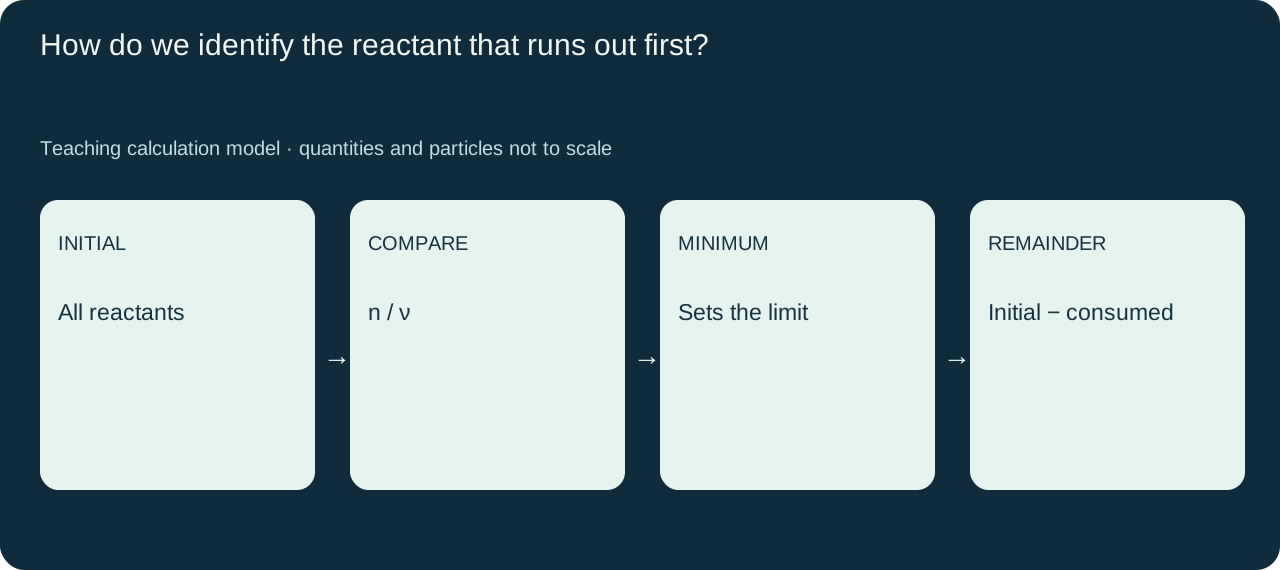
Model diagram
Use only paper, a calculator and supplied data. Do not carry out reactions, generate gases, heat substances or mix household chemicals.
Situation and question
A paper model for 2H₂ + O₂ → 2H₂O supplies 3 mol of H₂ and 2 mol of O₂. Both numbers are positive: will everything run out together? Group cards in a 2:1 ratio and see which supply ends first. Do not use actual gases.
New terms, fully explained
The limiting reactant sets the maximum product amount in this complete-conversion model. An excess is the portion of another reactant left afterward. For one specified reaction, compare n/ν for each reactant, where ν is its positive coefficient. The smallest ratio sets the limit. Equal ratios describe a stoichiometric mixture.
Predict first
Can the limiting reactant be selected from the smaller mass or smaller mole number alone? For 3 mol of H₂ and 2 mol of O₂, compare 3/2 with 2/1, not simply 3 with 2. Explain why division by the coefficient is needed.
Investigate or analyse given data
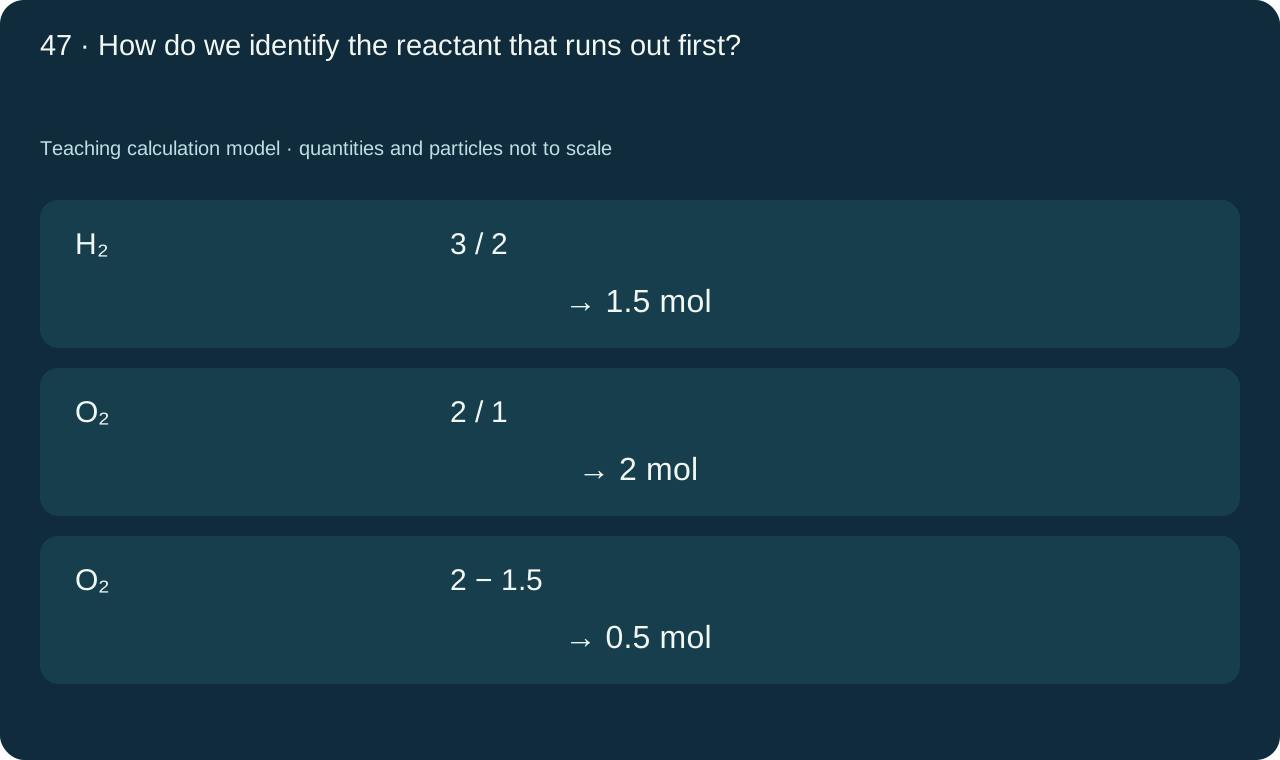
Write initial amount, consumption and remainder on separate rows. H₂ has coefficient 2 and O₂ coefficient 1. The ratios 1.5 mol and 2 mol normalize each supply to the same reaction basis. The number 1.5 is not automatically the amount of every product; its coefficient must also be used.
| Entity / step | Given / calculation | Result |
|---|---|---|
| H₂ | 3 / 2 | 1.5 mol |
| O₂ | 2 / 1 | 2 mol |
| O₂ | 2 − 1.5 | 0.5 mol |
Worked example
The minimum n/ν is 1.5 mol, so H₂ limits the reaction. It consumes 3 mol of H₂ and 1.5 mol of O₂ and forms 3 mol of H₂O. Oxygen remaining is 2−1.5=0.5 mol. That remainder is not added to the amount of water.
A common mistake
Mistake: choosing O₂ because 2 is smaller than 3, or converting all the initial O₂ into product. Both reactant supplies constrain the outcome. A negative remainder signals a calculation or model error. We assume one reaction and complete conversion of the limiting reactant.
Transfer to a new case
Transfer: the same model now supplies 4 mol of H₂ and 1 mol of O₂. Find the limiting reactant, H₂O formed and H₂ left. Then check 2 mol of H₂ with 1 mol of O₂: is any excess left in the ideal model?
Answer and recall
Check: O₂ limits the first case; 2 mol of H₂O forms and 2 mol of H₂ remains. The second mixture is stoichiometric, with no excess. Check atoms in the remaining reactants as well as in the products: leftovers are part of the final system.
Exercise
For 2H₂ + O₂ → 2H₂O, we have 1 mol H₂ and 1 mol O₂. Which limits? How much O₂ remains?
Answers
Show the answers
H₂ limits; 0.50 mol O₂ remains and 1 mol H₂O forms.
When to revisit
Close the page and, after 10 minutes, reconstruct the map, define the terms in your own words and solve the new case. Repeat without hints after a day and a week. If an error persists, return to the worked example and write down the missing step.
Sources and limits
If you have found a mistake or a typo in this article, tell us about it
Comments (0)
Log in to leave a comment →
No comments yet. Be the first.