

Chemistry: investigate the world of substances Lesson 43 of 49
How do we move from mass to particle count without confusion?
Connect m, n and N through molar mass, checking units at every step.
Support map
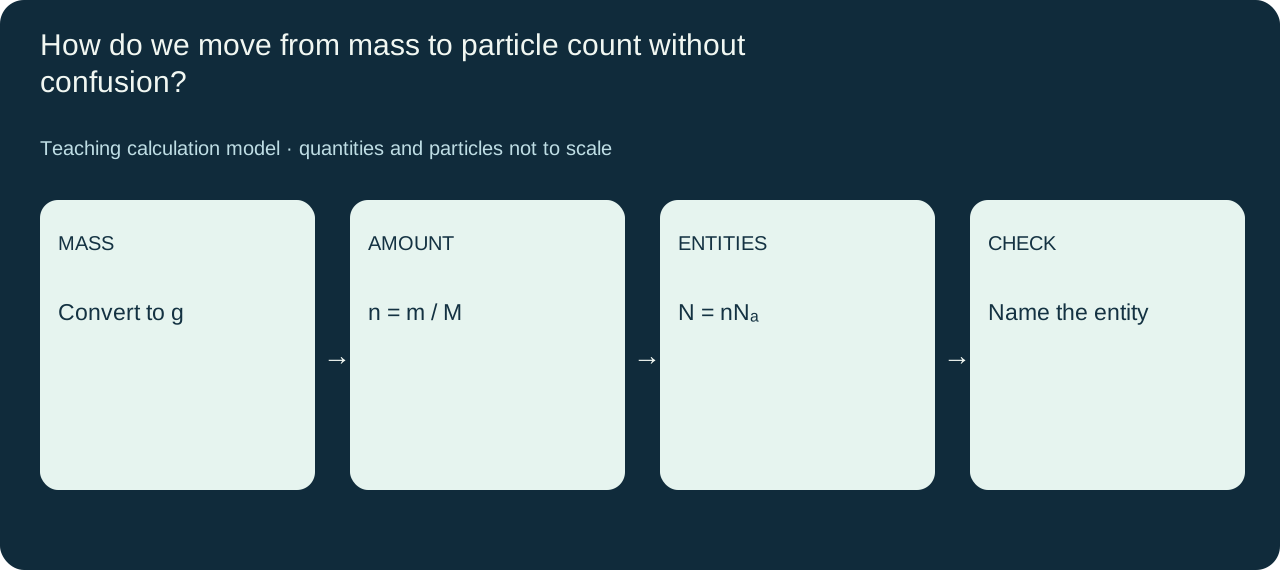
Model diagram
Use only paper, a calculator and supplied data. Do not carry out reactions, generate gases, heat substances or mix household chemicals.
Situation and question
A problem supplies 9.0 g of pure water and M(H₂O)=18 g/mol and asks for the molecule count. Why can we not simply multiply 9 by the Avogadro constant? Draw two arrows: mass → amount → number of molecules.
New terms, fully explained
Mass and amount are connected by n = m/M, or m = nM in reverse. Amount and entity count use N = nNₐ and n = N/Nₐ. A dimensional check cancels units: g ÷ (g/mol) = mol. Only then does mol × mol⁻¹ give a dimensionless entity count.
Predict first
Predict whether 18 g of water contains twice as many or half as many molecules as 9 g. If a mass is given in mg, can its number be divided directly by M in g/mol? Convert the units to a consistent system first.
Investigate or analyse given data
Use three entries: 9.0 g of H₂O; 11 g of CO₂ with M=44 g/mol; and 500 mg of H₂O. Convert 500 mg to 0.500 g. List m, M, n, N and the entity type for each. Use Nₐ ≈ 6.02 × 10²³ mol⁻¹.
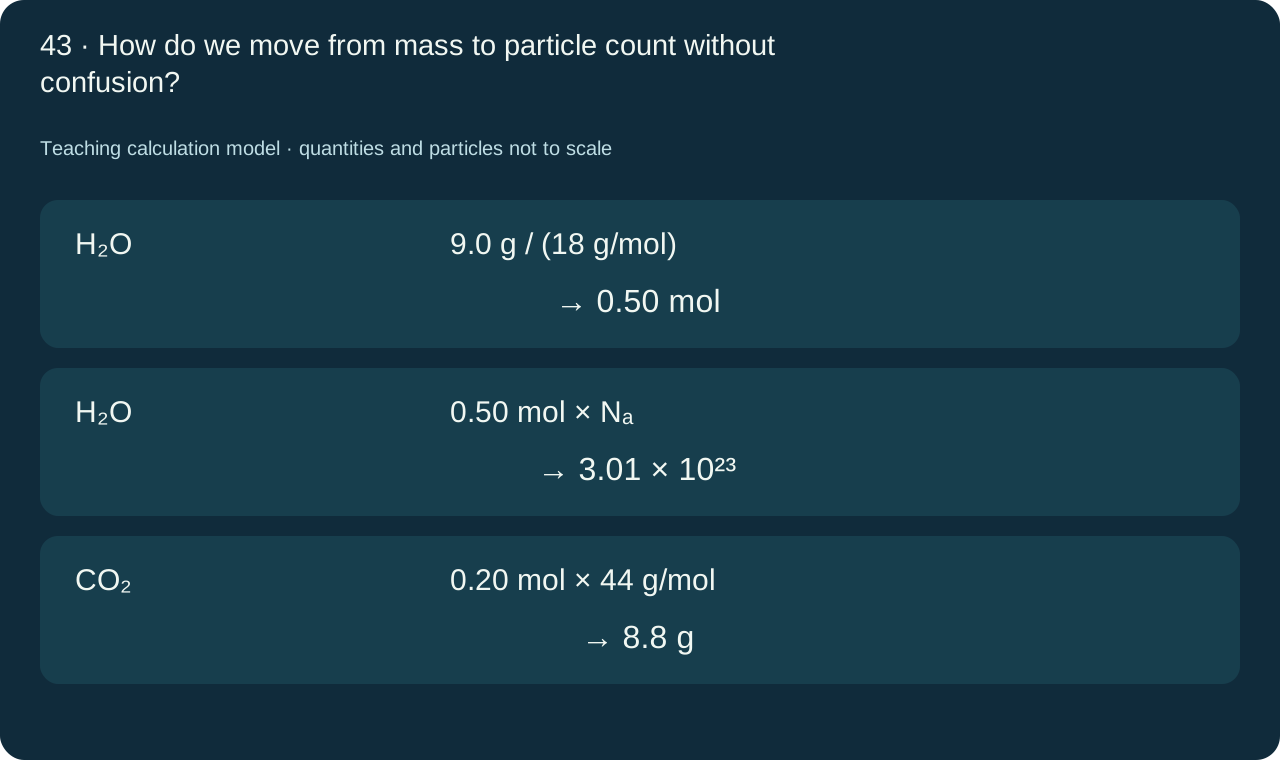
| Entity / step | Given / calculation | Result |
|---|---|---|
| H₂O | 9.0 g / (18 g/mol) | 0.50 mol |
| H₂O | 0.50 mol × Nₐ | 3.01 × 10²³ |
| CO₂ | 0.20 mol × 44 g/mol | 8.8 g |
Worked example
For 9.0 g of water, n = 9.0/18 = 0.50 mol and N ≈ 3.01 × 10²³ molecules. For 11 g of CO₂, n = 0.25 mol and N ≈ 1.51 × 10²³ molecules. Halving the mass of the same pure substance halves its particle count, provided its composition stays unchanged.
A common mistake
Mistake: dividing the mass of water by 6.02 × 10²³ and calling the answer moles. The constant converts entity counts to amounts; mass requires M. Also check purity: the total mass of a mixture is not the mass of the selected component.
Transfer to a new case
Find the mass of 0.20 mol of CO₂ and the amount of 1.204 × 10²³ H₂O molecules. Estimate the molecule count in 500 mg of water. Before calculating, say which result should be smaller than the count for 9.0 g of water.
Answer and recall
Check: m(CO₂)=8.8 g; n(H₂O)=0.20 mol using the chosen rounded Nₐ. For 0.500 g of water, n≈0.0278 mol and N≈1.67 × 10²² molecules. Return to the two arrows and explain which conversion factor belongs to each.
Exercise
Find n for 4.4 g CO₂ and m for 0.25 mol H₂O. How do we convert mg to g?
Answers
Show the answers
0.10 mol; 4.5 g; divide the milligram number by 1000.
When to revisit
Close the page and, after 10 minutes, reconstruct the map, define the terms in your own words and solve the new case. Repeat without hints after a day and a week. If an error persists, return to the worked example and write down the missing step.
Sources and limits
Why do equal mole amounts have different masses?
Why are atom fractions and mass fractions different answers?
If you have found a mistake or a typo in this article, tell us about it
Comments (0)
Log in to leave a comment →
No comments yet. Be the first.