

Chemistry: investigate the world of substances Lesson 45 of 49
How do equation coefficients connect amounts of substances?
Read coefficients as mole ratios while keeping moles distinct from grams.
Support map
Model diagram
Use only paper, a calculator and supplied data. Do not carry out reactions, generate gases, heat substances or mix household chemicals.
Situation and question
The verified reaction is 2H₂ + O₂ → 2H₂O. A learner thinks 2 g of hydrogen requires 1 g of oxygen. What do the numbers 2:1:2 actually compare? This is a paper problem: do not generate, mix or ignite gases.
New terms, fully explained
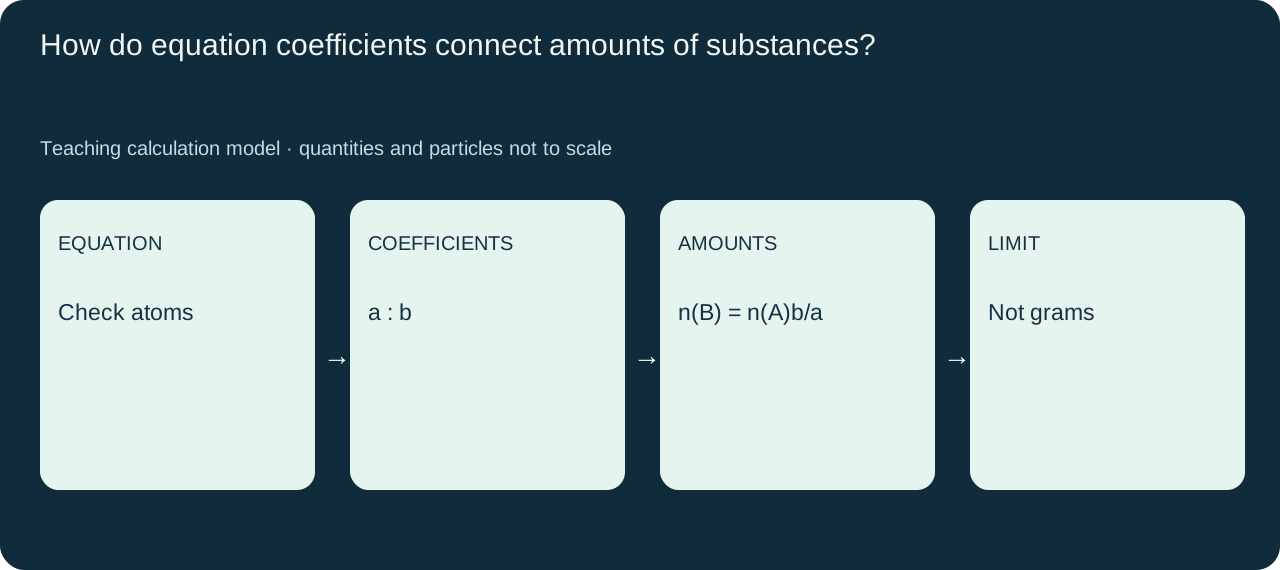
A stoichiometric ratio relates amounts using balanced equation coefficients. For aA → bB, n(B)/n(A)=b/a for A consumed and B formed in that reaction. Subscripts specify composition; coefficients specify amount ratios. The calculation assumes that the stated reaction takes place.
Predict first
Predict the O₂ consumed by 4 mol of H₂ when oxygen is sufficient and hydrogen reacts completely. Would 4 mol of O₂ be needed? Decide whether doubling every coefficient changes the ratio, and reduce it to its simplest form.
Investigate or analyse given data
Complete rows for 2, 4 and 0.5 mol of H₂ consumed: how much O₂ is consumed and H₂O formed? Distinguish initial quantities from consumed quantities. An initial oxygen excess does not have to participate completely.
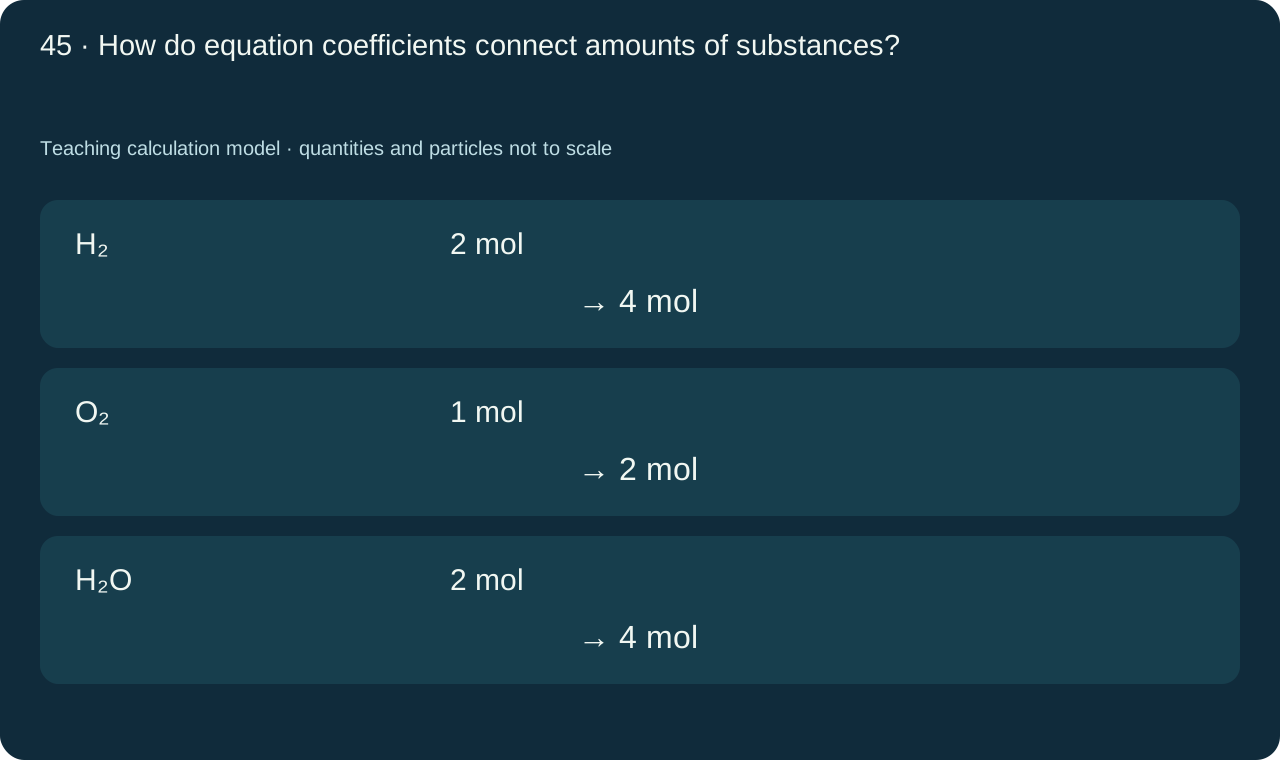
| Substance | Ratio: example A | Doubled: example B |
|---|---|---|
| H₂ | 2 mol | 4 mol |
| O₂ | 1 mol | 2 mol |
| H₂O | 2 mol | 4 mol |
Worked example
For 4 mol of H₂, n(O₂)=4×1/2=2 mol is required and n(H₂O)=4×2/2=4 mol forms with complete conversion. In the supplied mass model, 8 g of H₂ and 64 g of O₂ give 72 g of H₂O. The mass ratio is 1:8:9, not 2:1:2.
A common mistake
Mistake: applying coefficients directly to grams or using an unbalanced equation. Check atom balance first and convert mass to moles. Coefficients do not establish that a reaction proceeds spontaneously or goes to completion; those are separate conditions.
Transfer to a new case
For 2CO + O₂ → 2CO₂, find O₂ consumption and CO₂ formation when 0.60 mol of CO reacts. Then find the CO₂ amount from complete conversion of 0.20 mol of CaCO₃ in CaCO₃ → CaO + CO₂. These are calculations only, without experiments.
Answer and recall
Check: 0.30 mol of O₂ is consumed and 0.60 mol of CO₂ forms in the first case. The carbonate case gives 0.20 mol of CO₂. Write each coefficient fraction and label the given substance, target substance, consumed quantities and what remains unknown.
Exercise
For 2H₂ + O₂ → 2H₂O, how much O₂ is needed for 0.80 mol H₂? What do coefficients compare?
Answers
Show the answers
0.40 mol; mole amounts or corresponding entity counts, not masses in grams.
When to revisit
Close the page and, after 10 minutes, reconstruct the map, define the terms in your own words and solve the new case. Repeat without hints after a day and a week. If an error persists, return to the worked example and write down the missing step.
Sources and limits
Why are atom fractions and mass fractions different answers?
If you have found a mistake or a typo in this article, tell us about it
Comments (0)
Log in to leave a comment →
No comments yet. Be the first.