

Chemistry: investigate the world of substances Lesson 46 of 49
How can we calculate product mass from a reaction equation?
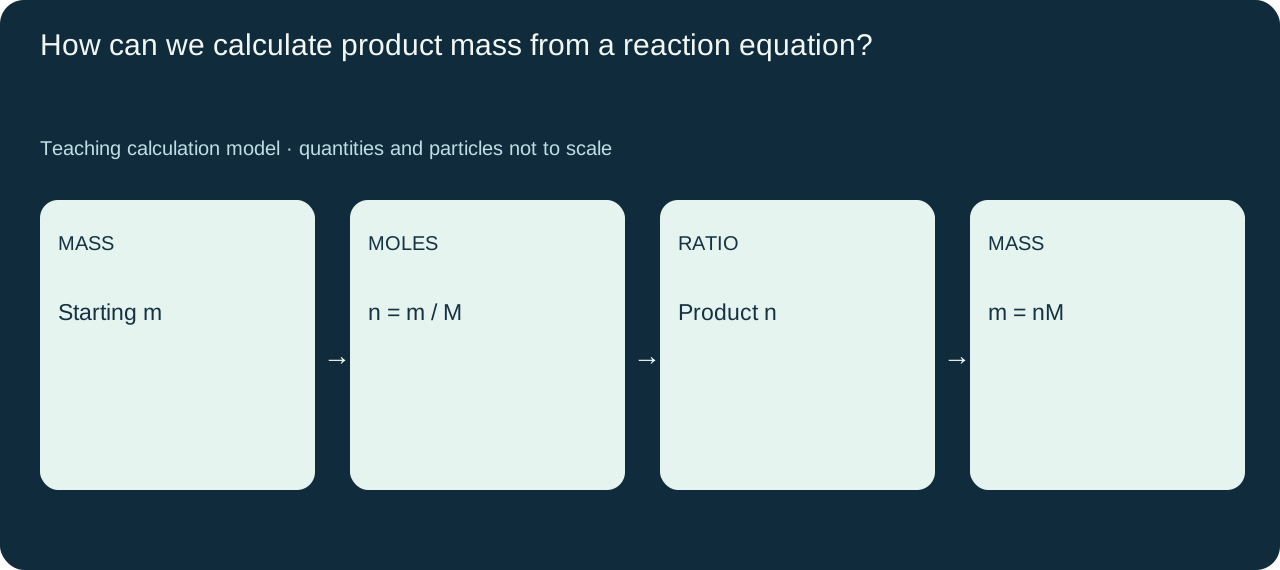
Follow mass → moles → coefficient ratio → moles → mass.
Support map
Model diagram
Use only paper, a calculator and supplied data. Do not carry out reactions, generate gases, heat substances or mix household chemicals.
Situation and question
A calculation model states that 10.0 g of pure CaCO₃ converts completely by CaCO₃ → CaO + CO₂. Find the CO₂ mass. The conversion is supplied as a condition; no carbonate heating or gas generation at home is required.
New terms, fully explained
A theoretical product mass is calculated from an equation for the given composition and complete conversion of the limiting reactant. First n(start)=m/M, then n(product)=n(start)×b/a, finally m(product)=nM. An assumption is a model condition to state explicitly: purity, selected reaction and degree of conversion.
Predict first
Predict whether 10 g of CaCO₃ could give 44 g of CO₂ merely because M(CO₂)=44 g/mol. Compare this product’s mass with the starting mass for this particular reaction. Decide which portion of the mass remains in CaO.
Investigate or analyse given data
Use M(CaCO₃)=100, M(CaO)=56 and M(CO₂)=44 g/mol. The coefficients are 1:1:1. Write units for all three conversions, and separately check 100=56+44 for one mole. These data do not determine reaction duration or energy consumption.
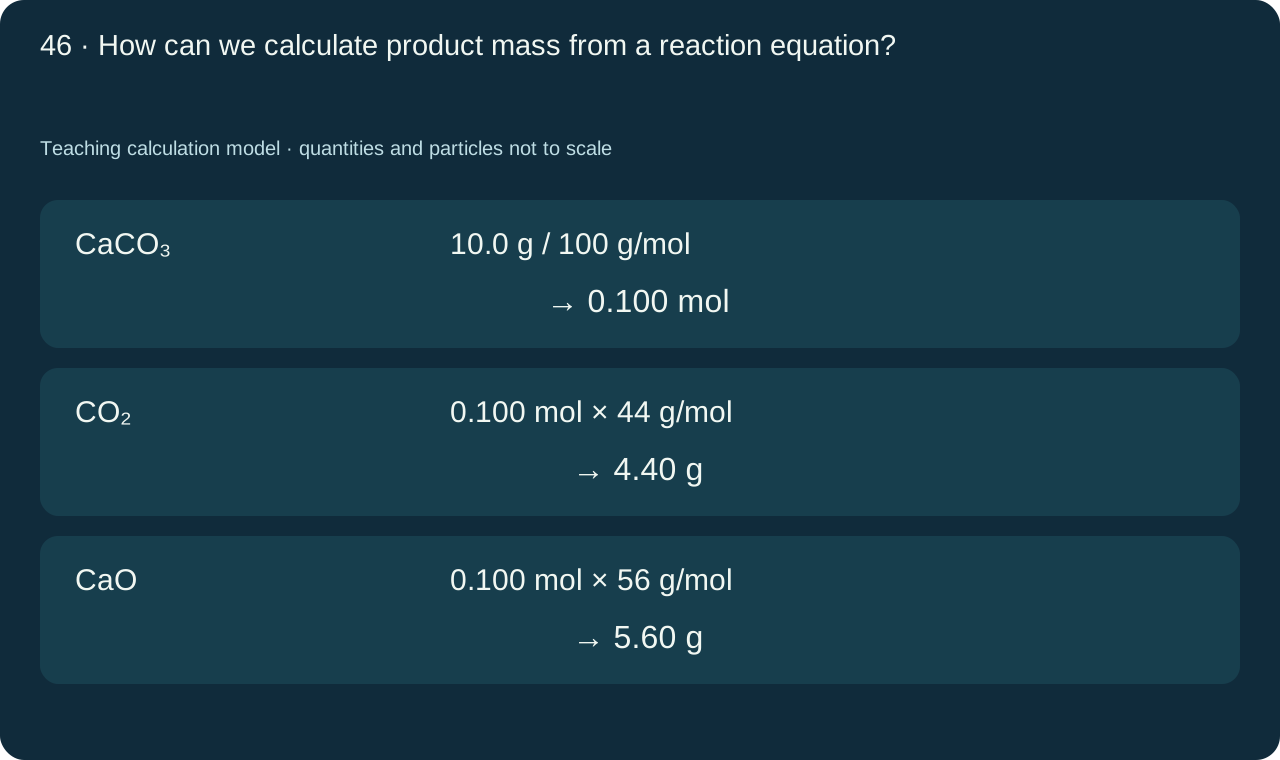
| Entity / step | Given / calculation | Result |
|---|---|---|
| CaCO₃ | 10.0 g / 100 g/mol | 0.100 mol |
| CO₂ | 0.100 mol × 44 g/mol | 4.40 g |
| CaO | 0.100 mol × 56 g/mol | 5.60 g |
Worked example
n(CaCO₃)=10.0/100=0.100 mol, so n(CO₂)=0.100 mol and m(CO₂)=0.100×44=4.40 g. CaO has mass 0.100×56=5.60 g. Product masses total 4.40+5.60=10.00 g, consistent with conservation in the model.
A common mistake
Mistake: stopping at 0.100 and labelling it grams when the calculated unit is mol. Another mistake is treating the full mass of an impure sample as pure CaCO₃. For a mixture, first find the reacting substance’s mass and account separately for the other components.
Transfer to a new case
Transfer: 5.30 g of pure Na₂CO₃ reacts completely with sufficient HCl: Na₂CO₃ + 2HCl → 2NaCl + H₂O + CO₂. Use M(Na₂CO₃)=106 and M(NaCl)=58.5 g/mol. Find the theoretical NaCl mass. No gas collection is needed.
Answer and recall
Check: n(Na₂CO₃)=0.0500 mol, n(NaCl)=0.100 mol and m(NaCl)=5.85 g. The salt mass exceeds the carbonate mass because some of its composition comes from HCl. Include all reactants in a total mass check, not just the first substance listed.
Exercise
What CO₂ mass theoretically forms from complete conversion of 25 g CaCO₃? What CaO mass remains?
Answers
Show the answers
11 g CO₂ and 14 g CaO; 25=11+14 in this model.
When to revisit
Close the page and, after 10 minutes, reconstruct the map, define the terms in your own words and solve the new case. Repeat without hints after a day and a week. If an error persists, return to the worked example and write down the missing step.
Sources and limits
If you have found a mistake or a typo in this article, tell us about it
Comments (0)
Log in to leave a comment →
No comments yet. Be the first.