

Chemistry: investigate the world of substances Lesson 51 of 58
How can we distinguish a solution from a suspension?
Identify solution components and explain what ordinary filtration can establish.
Support map
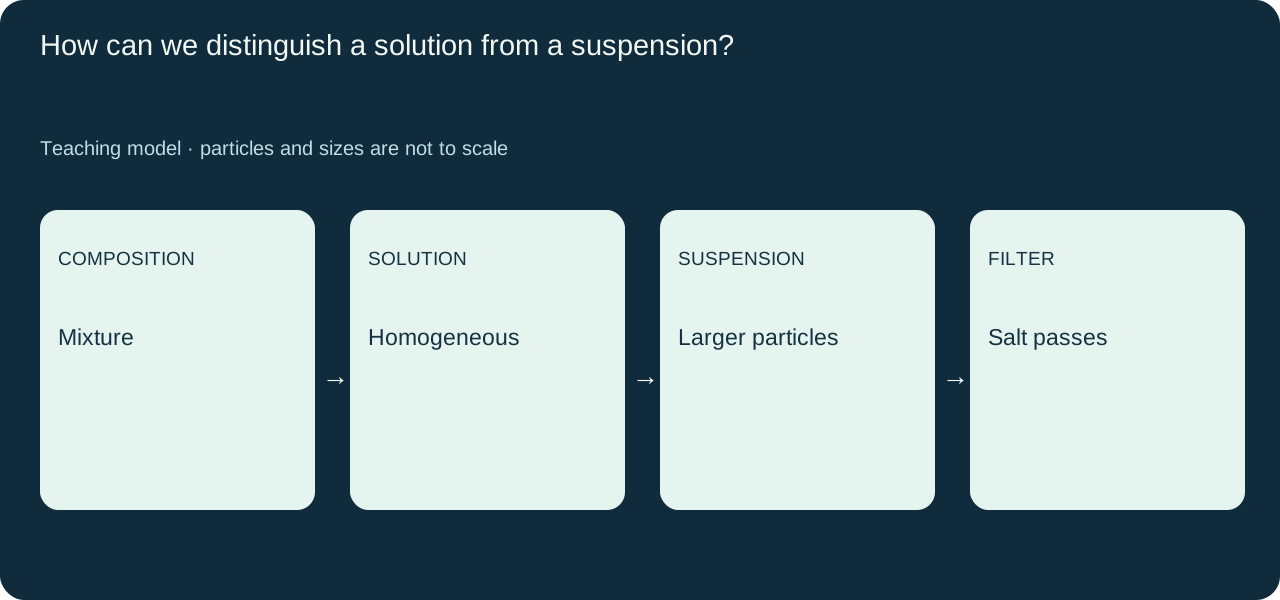
Model diagram
Use paper, a calculator and supplied data only. Do not heat, taste or smell samples, mix household chemicals or perform electrical experiments. Clarity and ordinary filtration do not establish drinking safety.
Situation and question
Three glasses contain pure water, water with salt completely dissolved, and water mixed with sand. Appearance alone cannot always establish composition. Recall the first salt investigation: invisible grains do not imply vanished matter. Build an explanation that does not require tasting samples.
New terms, fully explained
A solution is a homogeneous mixture whose components are distributed at molecular or ionic scale. The solvent provides the medium; a solute is dissolved in it. Here water is the solvent. A suspension is heterogeneous and contains relatively large dispersed particles. Solutions need not be aqueous or liquid.
Predict first
Predict whether ordinary filter paper retains sand particles or dissolved salt. Must a clear filtrate be pure drinking water? Write separate claims about particle separation and drinking safety.
Investigate or analyse given data
Analyse supplied observations: some sand settled and was caught by the filter, whereas salt solution passed through. Ordinary filtration removes suitable suspended particles but not dissolved ions. In the school model a well-mixed solution has the same composition in different portions if conditions remain unchanged.
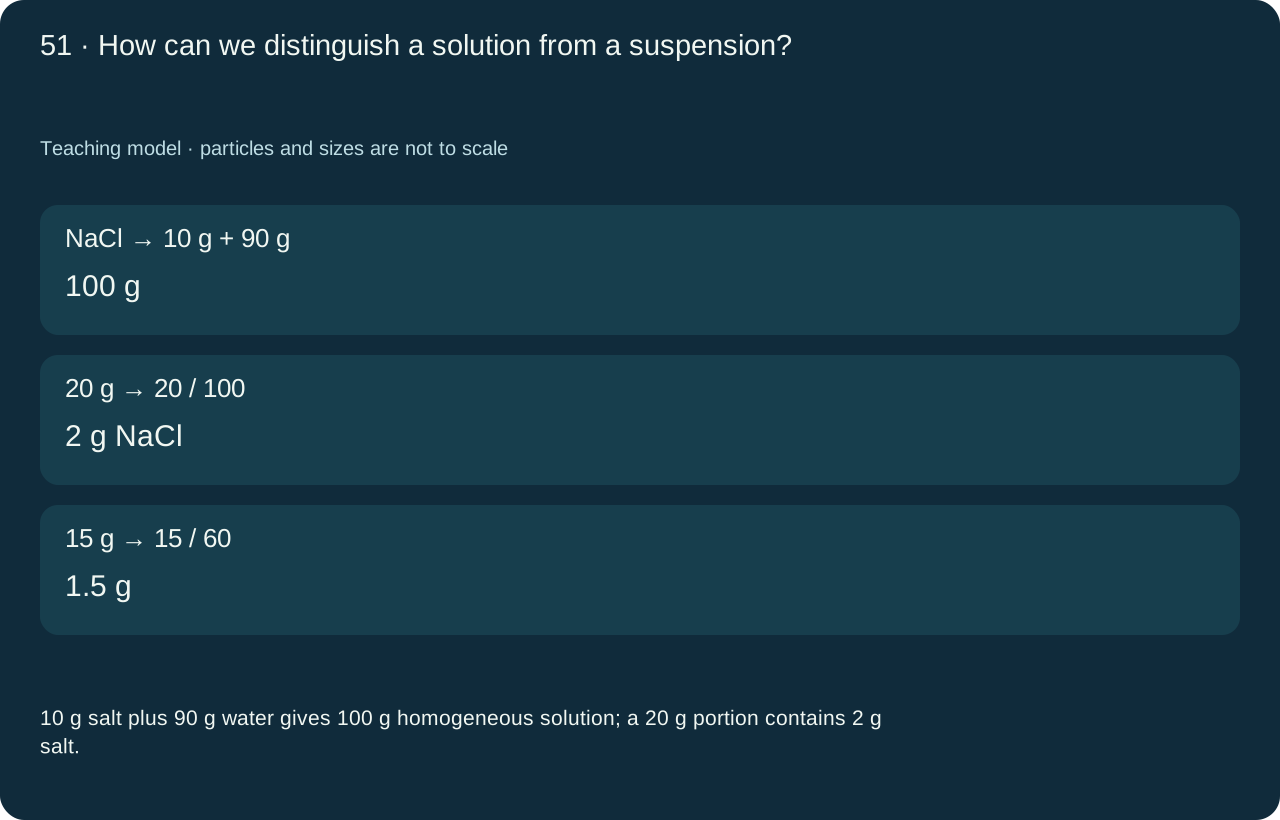
| Object / step | Given / calculation | Result |
|---|---|---|
| NaCl | 10 g + 90 g | 100 g |
| 20 g | 20 / 100 | 2 g NaCl |
| 15 g | 15 / 60 | 1.5 g |
Worked example
10 g of salt completely dissolves in 90 g of water without losses. Solution mass is 100 g. A 20 g portion contains 2 g of salt because it is one fifth of the homogeneous solution. This follows from supplied composition, not visual measurement. It does not determine the volume change on mixing.
A common mistake
Mistake: assuming every clear sample is a pure substance, or adding volumes as if they were masses. A clear solution remains a mixture. Component masses add in a mass balance; exact final solution volume requires measurement or density information.
Transfer to a new case
Transfer: 6 g of sugar completely dissolves in 54 g of water. Identify the components, total mass and sugar mass in a 15 g portion. Explain why uniform composition is required. Use supplied data; no home observation is necessary.
Answer and recall
Check: water is solvent, sugar is solute, total mass is 60 g, and one quarter contains 1.5 g of sugar. Dissolved contaminants may remain in the filtrate. Reconstruct “appearance → uniformity → composition → separation method”, without claiming that the water is safe to drink.
Exercise
A solution contains 10 g of salt per 100 g of solution. How much is in 30 g? Does paper filtration remove it?
Answers
Show the answers
3 g; ordinary filter paper does not remove dissolved salt.
When to revisit
Close the page and, after 10 minutes, reconstruct the map, define the terms in your own words and solve the new case. Repeat without hints after a day and a week. If an error persists, return to the worked example and write down the missing step.
Sources and limits
If you have found a mistake or a typo in this article, tell us about it
Comments (0)
Log in to leave a comment →
No comments yet. Be the first.