

Chemistry: investigate the world of substances Lesson 52 of 58
Which particles remain in a solution?
Compare sucrose molecules and hydrated salt ions while conserving mass and charge.
Support map
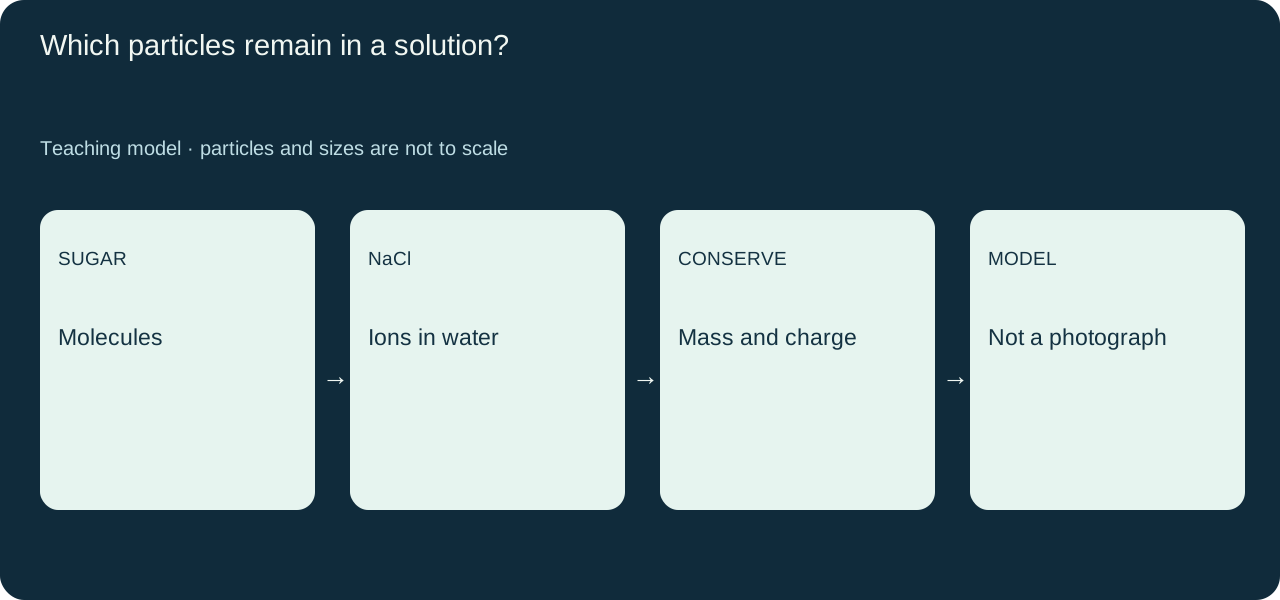
Model diagram
Use paper, a calculator and supplied data only. Do not heat, taste or smell samples, mix household chemicals or perform electrical experiments. Clarity and ordinary filtration do not establish drinking safety.
Situation and question
After sugar and salt dissolve, individual grains are no longer visible. Does that mean both mixtures contain identical particles? Similar appearance cannot establish this. Use the molecular structure of sucrose and ionic structure of NaCl from earlier lessons.
New terms, fully explained
Dissolution distributes a component through a solvent. In ordinary dissolution, sucrose C₁₂H₂₂O₁₁ remains as sucrose molecules. NaCl is an ionic crystal; dissolving it in water gives hydrated Na⁺ and Cl⁻ ions. Dissociation here means separation of ions previously held within the crystal lattice.
Predict first
Predict whether a drawing of separate NaCl molecules in water represents ordinary salt solution. What about a drawing in which atoms spontaneously vanish from sucrose? Identify the restrictions imposed by conservation of atoms and electric charge.
Investigate or analyse given data
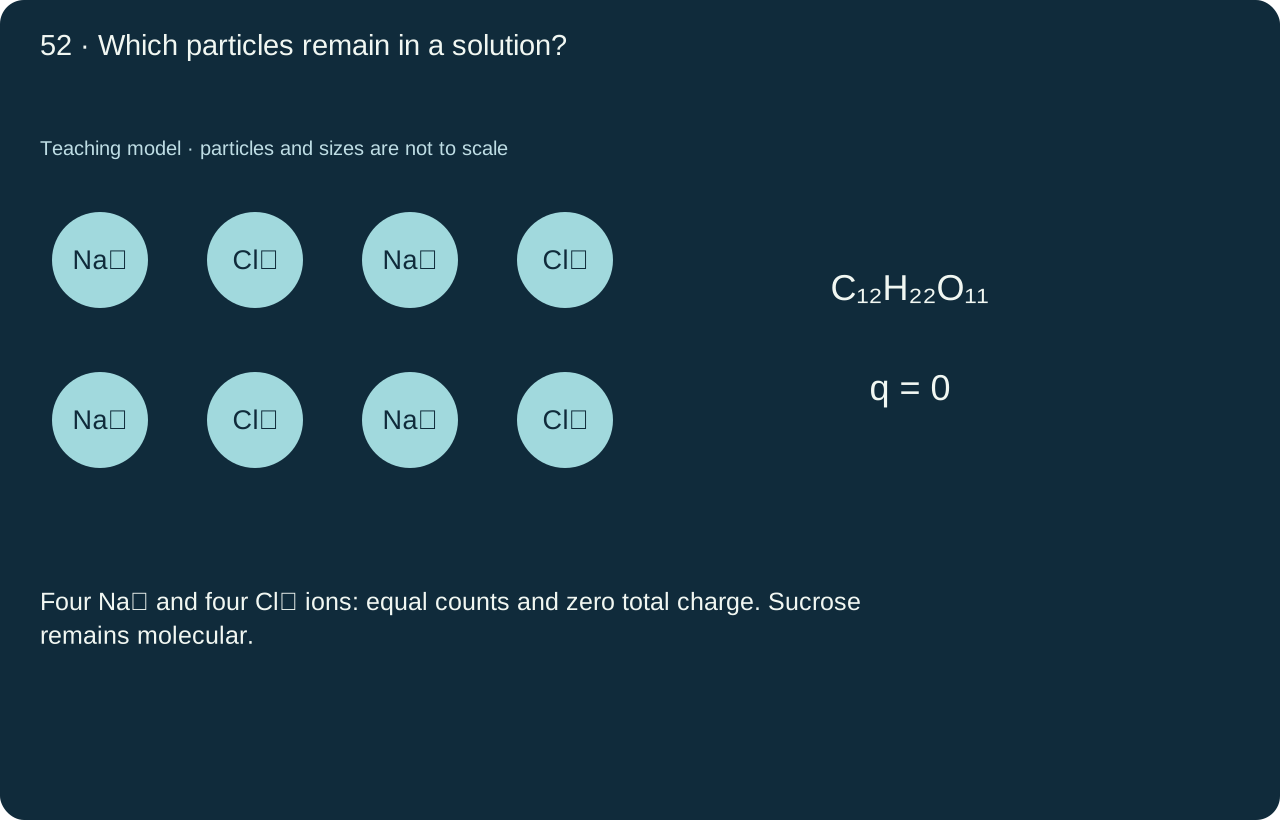
Write NaCl(s) → Na⁺(aq) + Cl⁻(aq). The label s denotes a solid and aq denotes an aqueous environment. Draw four Na⁺ and four Cl⁻ ions: total charge is zero. Separately show four intact sucrose molecules using one labelled card for each molecule.
| Object / step | Given / calculation | Result |
|---|---|---|
| NaCl | 0.10 mol | 0.10 mol Na⁺ + 0.10 mol Cl⁻ |
| NaCl | 0.20 mol | 0.40 mol ions |
| 5 g + 95 g | 100 g | q = 0 |
Worked example
5 g of salt dissolves completely in 95 g of water without losses: solution mass is 100 g. In the complete-dissociation model, 0.10 mol of NaCl formula units corresponds to 0.10 mol of Na⁺ and 0.10 mol of Cl⁻. Ion amounts do not specify the amount of water molecules.
A common mistake
Mistake: “invisible means gone”, or “every solute turns into ions”. Molecular and ionic structures differ. Dissolution is not always a chemical reaction; other substances may react with water, so the sugar model cannot apply universally.
Transfer to a new case
Transfer: 0.20 mol of NaCl is completely dissolved in sufficient water. Find the amount of each ion and their total. Explain why doubling the count of specified entities does not violate mass conservation. No experiment or electrical measurement is required.
Answer and recall
Check: 0.20 mol of Na⁺ and 0.20 mol of Cl⁻ gives 0.40 mol of ions altogether. Grouping of the specified entities changes while atoms and charge are conserved. Reconstruct the contrast with sucrose, the meaning of aq and the limits of the model.
Exercise
For complete dissociation of 0.30 mol of NaCl, find both ion amounts and total charge.
Answers
Show the answers
0.30 mol of each ion, 0.60 mol of ions total; total charge is zero.
When to revisit
Close the page and, after 10 minutes, reconstruct the map, define the terms in your own words and solve the new case. Repeat without hints after a day and a week. If an error persists, return to the worked example and write down the missing step.
Sources and limits
If you have found a mistake or a typo in this article, tell us about it
Comments (0)
Log in to leave a comment →
No comments yet. Be the first.