

Chemistry: investigate the world of substances Lesson 57 of 58
What is conserved when a solution is diluted?
Use a solute balance and avoid adding volumes without a stated assumption.
Support map
Model diagram
Use paper, a calculator and supplied data only. Do not heat, taste or smell samples, mix household chemicals or perform electrical experiments. Clarity and ordinary filtration do not establish drinking safety.
Situation and question
Water is added to a solution. Salt amount remains the same but concentration changes. Which quantity is conserved? Compare dilution to a specified final volume with mixing solutions by mass. Work on paper only.
New terms, fully explained
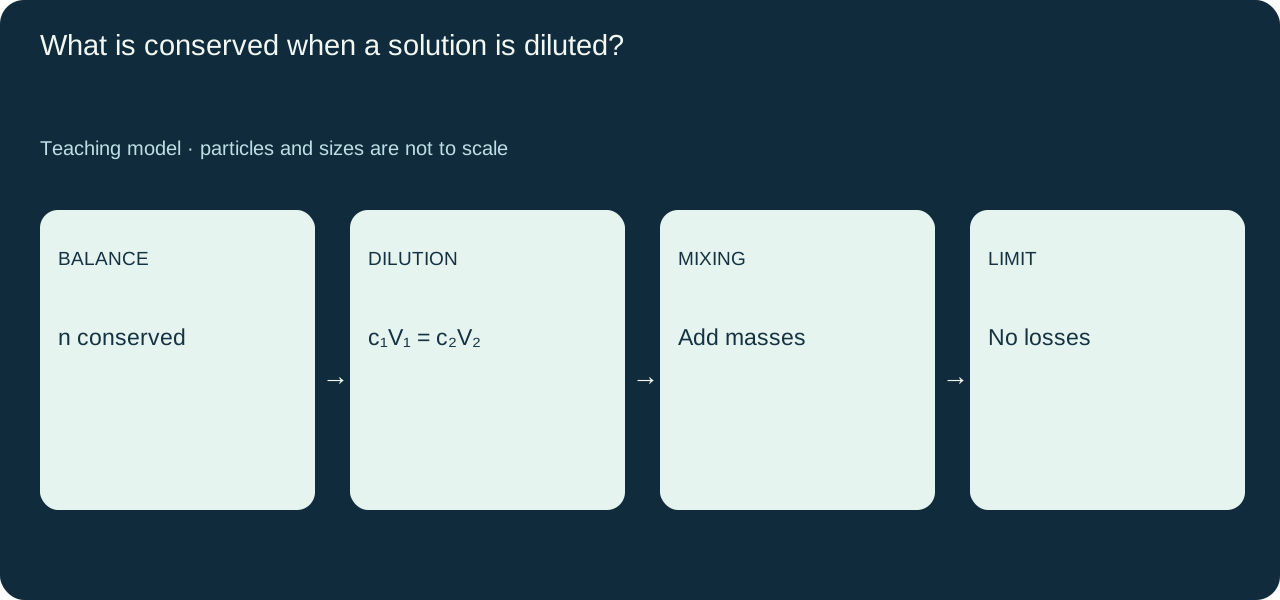
Dilution adds solvent. If solute is neither lost nor reacting, n₁=n₂. Since n=cV, c₁V₁=c₂V₂. V₂ is final solution volume. For mass fractions, solute mass is conserved under the same restrictions: w₁m₁=w₂m₂.
Predict first
Predict whether c increases on adding pure water. Must final volume equal the exact sum of starting solution and added water volumes? Concentration uses a solute balance; exact volume needs measurement or an explicit assumption.
Investigate or analyse given data
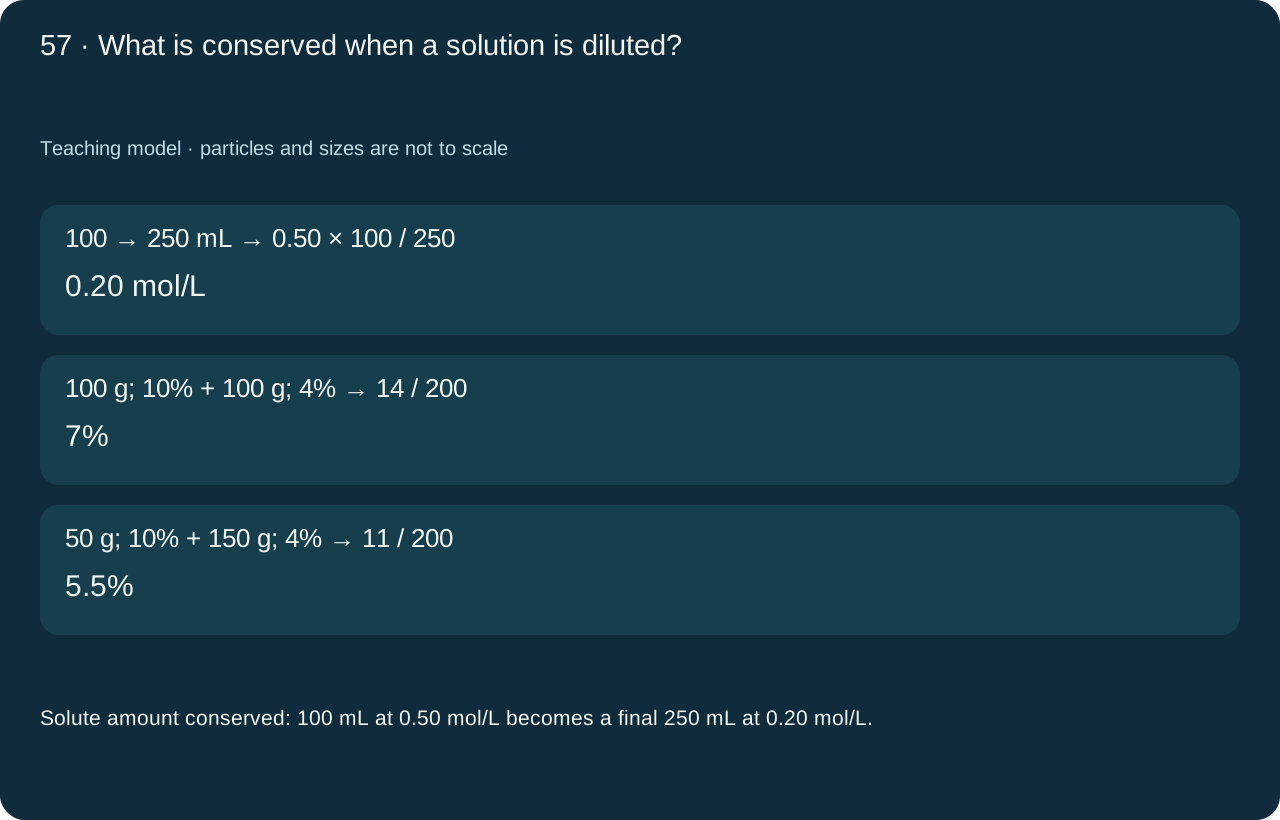
Start with 100 mL at c₁=0.50 mol/L and final V₂=250 mL. Convert volumes to litres and find n before and after. Separately consider mixing 100 g of 10% and 100 g of 4% solutions of the same solute without reaction or losses.
| Object / step | Given / calculation | Result |
|---|---|---|
| 100 → 250 mL | 0.50 × 100 / 250 | 0.20 mol/L |
| 100 g; 10% + 100 g; 4% | 14 / 200 | 7% |
| 50 g; 10% + 150 g; 4% | 11 / 200 | 5.5% |
Worked example
In the first case n=0.50×0.100=0.050 mol, and c₂=0.050/0.250=0.20 mol/L. In the second, solute mass is 10+4=14 g in 200 g total, so w=0.07=7%. Averaging percentages works here because solution masses are equal.
A common mistake
Mistake: averaging percentages for any masses, or treating V₂ as added water volume. Mixing 50 g at 10% with 150 g at 4% gives solute masses 5 and 6 g, hence 11/200=5.5%, not 7%. Balance first, divide second.
Transfer to a new case
Transfer: dilute 40 mL at 0.75 mol/L to a final 120 mL. Find n and c₂. Separately add 40 g of water to 80 g of a 15% solution. Find the final mass fraction without losses.
Answer and recall
Check: n=0.030 mol and c₂=0.25 mol/L. The mass case gives 12 g of solute in 120 g of solution, or 10%. Do not apply dilution equations to reaction or precipitation without a new balance. Recall: same component, no losses, correct final volume or mass.
Exercise
Add 100 g of water to 50 g of a 12% solution. Find mass fraction and the conserved quantity.
Answers
Show the answers
6 g of component in 150 g gives 4%; component mass is conserved without losses or reaction.
When to revisit
Close the page and, after 10 minutes, reconstruct the map, define the terms in your own words and solve the new case. Repeat without hints after a day and a week. If an error persists, return to the worked example and write down the missing step.
Sources and limits
If you have found a mistake or a typo in this article, tell us about it
Comments (0)
Log in to leave a comment →
No comments yet. Be the first.