

Chemistry: investigate the world of substances Lesson 50 of 58
Why is a water molecule polar?
Connect the bent shape of H₂O with partial charges and a model of ion hydration.
Support map
Model diagram
Use paper, a calculator and supplied data only. Do not heat, taste or smell samples, mix household chemicals or perform electrical experiments. Clarity and ordinary filtration do not establish drinking safety.
Situation and question
Water in a glass looks similar in every direction. Can that reveal the charge distribution within one molecule? Recall lesson 26: bond polarity and molecular polarity are related but distinct questions. Work with drawings and supplied information, without handling chemical samples.
New terms, fully explained
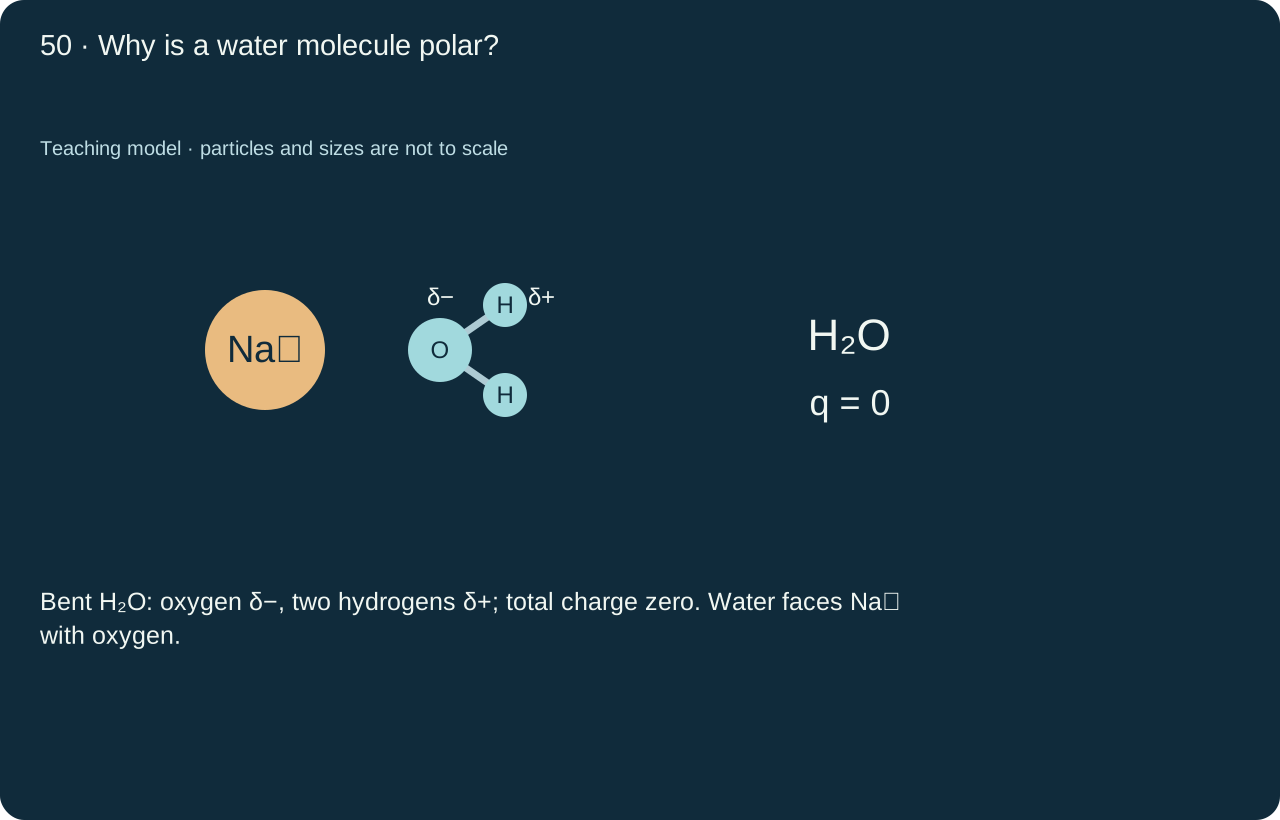
A polar bond has an uneven distribution of electron density. In O–H it is shifted toward oxygen. The labels δ− on O and δ+ on H denote partial charges, not full ionic charges. H₂O is electrically neutral overall, but its bent shape gives a nonzero molecular dipole: it is polar.
Predict first
Draw bent H₂O and linear CO₂. Both contain polar bonds. Predict which geometry allows the opposite contributions of identical bonds to cancel. Give a reason before reading the explanation; listing the elements alone cannot answer the question.
Investigate or analyse given data
Draw Na⁺ and Cl⁻ on paper. Around Na⁺ orient water molecules with their oxygen ends facing inward; around Cl⁻ use their hydrogen ends. Hydration means interaction with surrounding water. Real molecules move; the drawing represents a simplified orientation. Colours and distances are not measurements.
| Object / step | Given / calculation | Result |
|---|---|---|
| H₂O | δ−: O; δ+: H | q = 0 |
| CO₂ | O=C=O | μ = 0 |
| Na⁺ / Cl⁻ | H₂O | δ− / δ+ |
Worked example
The two bond contributions do not cancel in bent H₂O, whereas they cancel in symmetric linear CO₂. The model places δ− toward Na⁺ and δ+ toward Cl⁻. Turning a molecule does not turn water into an ion or change its formula.
A common mistake
Mistake: “water is positively charged”, or “a polar bond always makes a polar molecule”. A neutral molecule has zero total charge. Shape matters alongside bond polarity. Water polarity does not prove that every substance dissolves in it; interactions among all components also matter.
Transfer to a new case
Transfer: a hypothetical linear X–Y–X molecule has two identical polar bonds with opposite contributions. Could the molecule be nonpolar? Explain without relying on colour. Change the drawing to a bent shape and reconsider cancellation.
Answer and recall
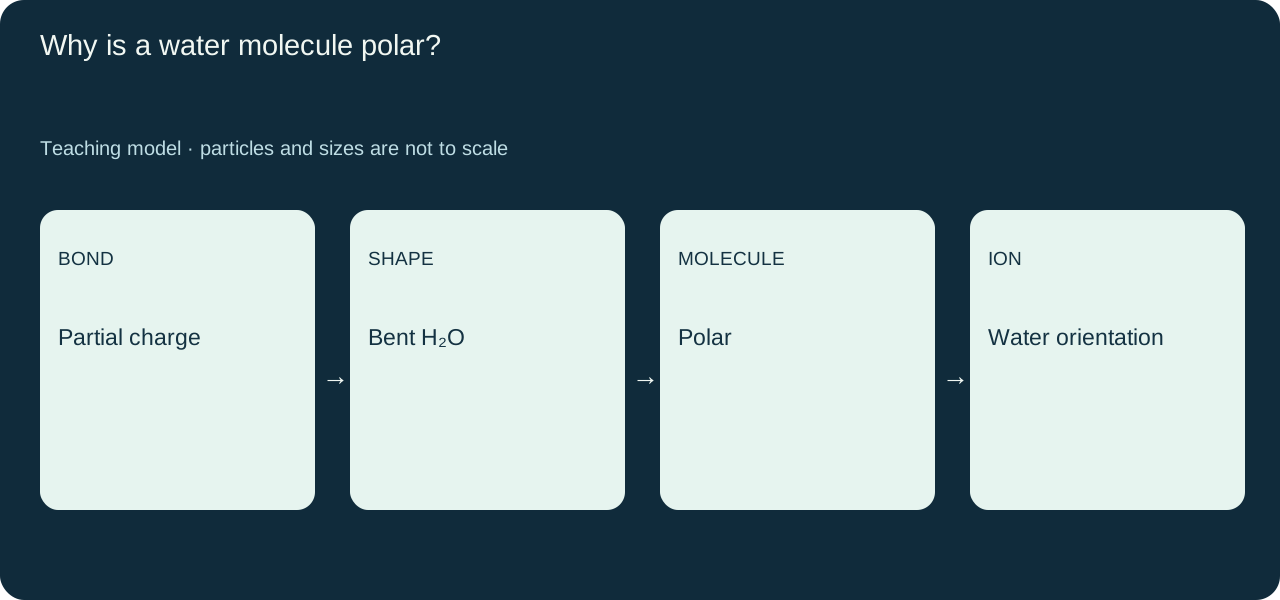
Check: symmetric linear geometry allows cancellation and a nonpolar molecule despite polar bonds. Two equal nonzero contributions do not cancel in the bent model. Reconstruct “bond → shape → molecule → orientation near an ion”. Distinguish an explanatory particle model from direct observation.
Exercise
Do polar bonds prove molecular polarity? Which end of H₂O faces Na⁺?
Answers
Show the answers
No; shape matters. The oxygen end with δ− faces Na⁺. Water is neutral overall.
When to revisit
Close the page and, after 10 minutes, reconstruct the map, define the terms in your own words and solve the new case. Repeat without hints after a day and a week. If an error persists, return to the worked example and write down the missing step.
Sources and limits
The salt case: how can we check the entire calculation chain?
If you have found a mistake or a typo in this article, tell us about it
Comments (0)
Log in to leave a comment →
No comments yet. Be the first.