

Chemistry: investigate the world of substances Lesson 56 of 58
How does molar concentration differ from mass fraction?
Calculate amount per litre of final solution and check every unit.
Support map
Model diagram
Use paper, a calculator and supplied data only. Do not heat, taste or smell samples, mix household chemicals or perform electrical experiments. Clarity and ordinary filtration do not establish drinking safety.
Situation and question
Two portions contain equal salt masses but different final solution volumes. Are their concentrations equal? Lessons 41–49 established conversion from mass to moles. Add volume while naming exactly which object it describes.
New terms, fully explained
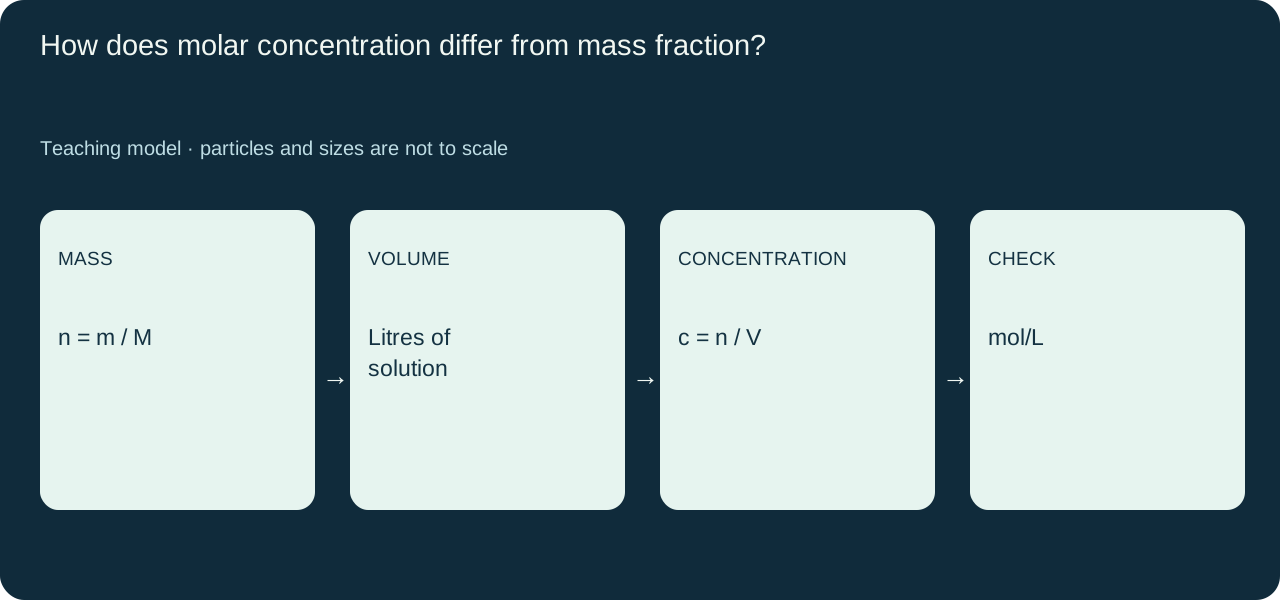
Molar concentration c is solute amount divided by solution volume: c=n/V. We use mol/L and 1000 mL=1 L. Some sources use M for molarity units; in our course M denotes molar mass in g/mol. Write c and mol/L explicitly to avoid ambiguity.
Predict first
Predict whether 0.10 mol in 0.50 L is more concentrated than the same amount in 1.00 L. Can solution volume be replaced by water volume if the volume change on mixing is unknown?
Investigate or analyse given data
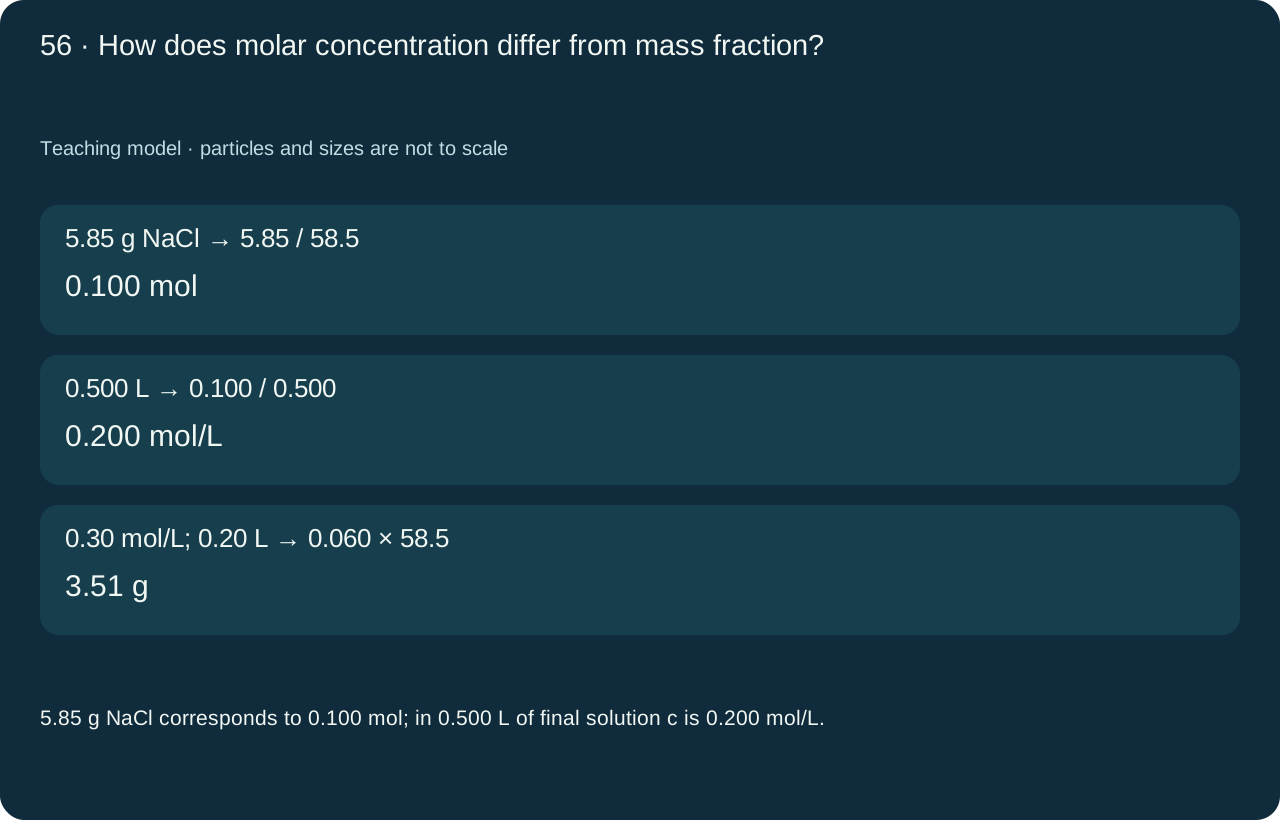
Use supplied M(NaCl)=58.5 g/mol and 5.85 g of pure salt. Two final solution volumes are given: 500 mL and 1000 mL. Build the route m → n → V in litres → c. Do not add solute volume to an already specified final volume.
| Object / step | Given / calculation | Result |
|---|---|---|
| 5.85 g NaCl | 5.85 / 58.5 | 0.100 mol |
| 0.500 L | 0.100 / 0.500 | 0.200 mol/L |
| 0.30 mol/L; 0.20 L | 0.060 × 58.5 | 3.51 g |
Worked example
n=5.85/58.5=0.100 mol. For 0.500 L, c=0.100/0.500=0.200 mol/L; for 1.000 L it is 0.100 mol/L. Unit check: g divided by g/mol gives mol, then division by litres gives mol/L. Doubling volume at fixed solute amount halves concentration.
A common mistake
Mistake: dividing 0.100 by 500 and labelling the result mol/L when 500 is millilitres. Another is equating NaCl concentration with total ion concentration. Count ions separately using composition and the complete-dissociation model; the solute concentration describes solution composition.
Transfer to a new case
Transfer: 2.925 g of NaCl is present in 250 mL of final solution. Find n and c. For a different solution with c=0.30 mol/L and V=0.20 L, find amount and NaCl mass. These are calculations, not preparation instructions.
Answer and recall
Check: n=0.0500 mol and c=0.200 mol/L; the second contains 0.060 mol or 3.51 g using the supplied molar mass. Mass fraction alone does not determine c without final volume or suitable density data. Explain each unit while reconstructing the route.
Exercise
Find c for 0.040 mol in 200 mL of final solution. Would knowing water mass alone suffice?
Answers
Show the answers
0.20 mol/L; no, final solution volume or additional information is needed.
When to revisit
Close the page and, after 10 minutes, reconstruct the map, define the terms in your own words and solve the new case. Repeat without hints after a day and a week. If an error persists, return to the worked example and write down the missing step.
Sources and limits
If you have found a mistake or a typo in this article, tell us about it
Comments (0)
Log in to leave a comment →
No comments yet. Be the first.