

Chemistry: investigate the world of substances Lesson 53 of 58
Why does a substance stop dissolving?
Distinguish dissolution rate from solubility and interpret saturation data.
Support map
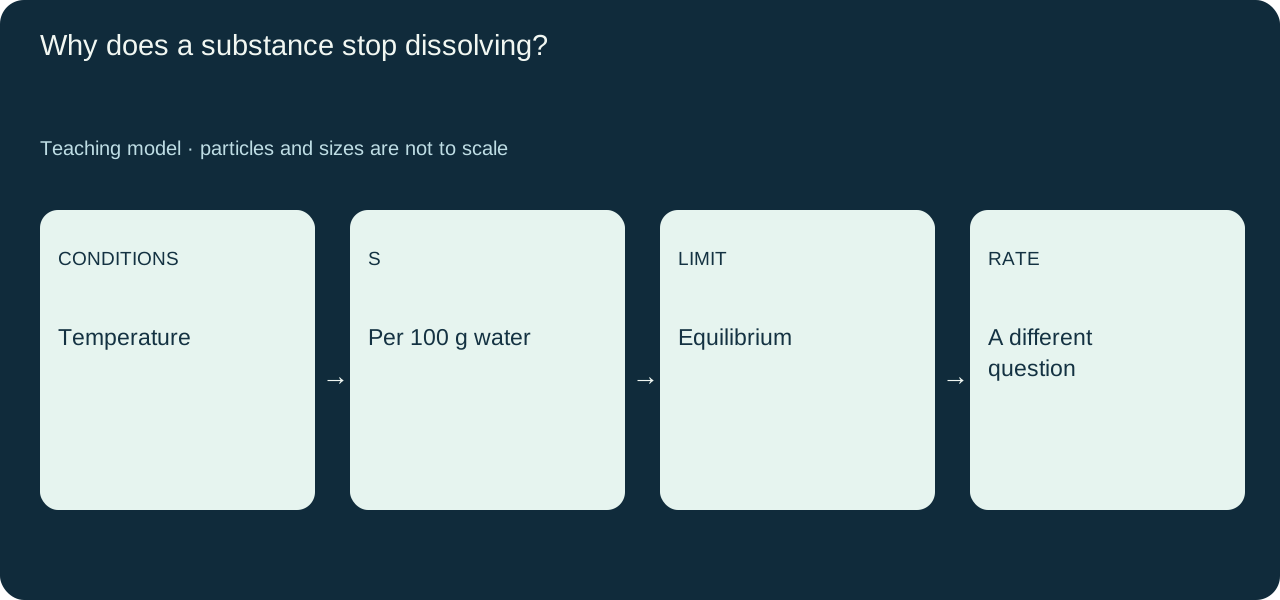
Model diagram
Use paper, a calculator and supplied data only. Do not heat, taste or smell samples, mix household chemicals or perform electrical experiments. Clarity and ordinary filtration do not establish drinking safety.
Situation and question
A report says some crystals remained after adding a solute. Does that necessarily establish saturation? Perhaps too little time elapsed. A conclusion needs temperature, composition and time to reach equilibrium. Analyse supplied information; do not heat substances at home.
New terms, fully explained
Solubility describes an equilibrium limit for a solute in a specified solvent under stated conditions. Here S is grams of solute per 100 g of water. A saturated solution reaches the limit; an unsaturated solution is below it. Concentrated and saturated are not synonyms.
Predict first
Predict whether stirring changes final solubility at the same temperature. Must a dark or thick-looking solution be saturated? Separate appearance, quantitative comparison with S, and process rate.
Investigate or analyse given data
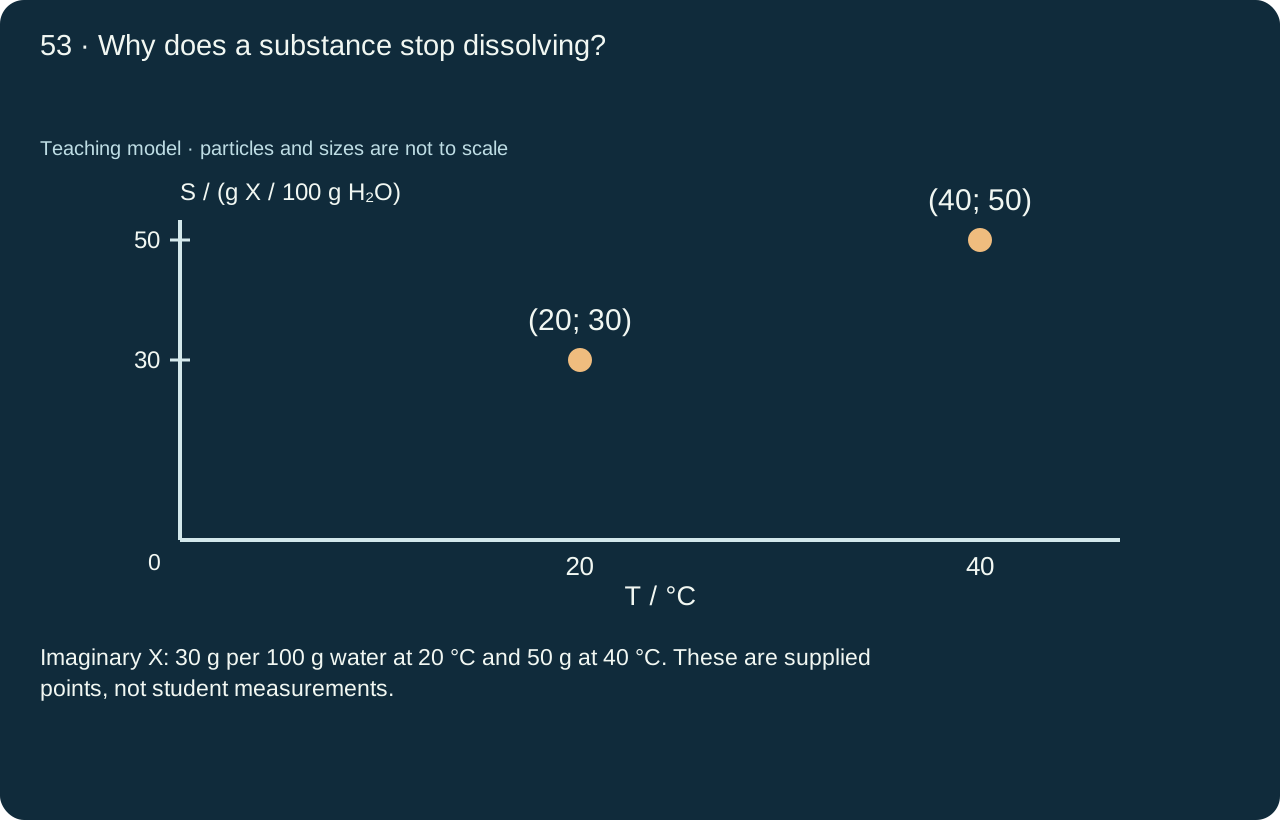
For imaginary X, S is 30 g per 100 g of water at 20 °C and 50 g per 100 g of water at 40 °C. These teaching figures describe X only. Find the limit for 50 g of water at each temperature. The denominator is water mass, not solution mass.
| Object / step | Given / calculation | Result |
|---|---|---|
| 20 °C | S = 30 g / 100 g H₂O | 15 g / 50 g H₂O |
| 20 g X | 15 g + 5 g | 65 g + 5 g |
| 40 → 20 °C | 50 g → 30 g | 20 g crystals |
Worked example
At 20 °C, 50 g of water dissolves up to 15 g of X. If 20 g is added and equilibrium reached, 15 g is dissolved and 5 g remains solid. Liquid solution mass is 65 g; the whole system including solid has mass 70 g. These are different weighed objects.
A common mistake
Mistake: treating a mixture including undissolved solid as homogeneous solution. Another is assuming heating increases every solubility. Temperature dependence varies; many gases become less soluble in water on heating at fixed partial pressure. Use data rather than a universal rule.
Transfer to a new case
Transfer: a saturated solution at 40 °C contains 100 g of water and 50 g of X. In a calculation model it reaches equilibrium at 20 °C without water loss. How much X crystallizes? No heating or cooling experiment is assigned.
Answer and recall
Check: 30 g of X remains dissolved and 20 g crystallizes. Liquid mass is 130 g, whole-system mass 150 g. Stirring changes rate but not the equilibrium limit under unchanged conditions. Reconstruct the labels: substance, solvent, temperature and basis of S.
Exercise
At 20 °C, S=30 g per 100 g water. Add 70 g of X to 200 g water. At equilibrium how much is dissolved and solid?
Answers
Show the answers
60 g dissolved and 10 g solid; liquid solution mass is 260 g.
When to revisit
Close the page and, after 10 minutes, reconstruct the map, define the terms in your own words and solve the new case. Repeat without hints after a day and a week. If an error persists, return to the worked example and write down the missing step.
Sources and limits
If you have found a mistake or a typo in this article, tell us about it
Comments (0)
Log in to leave a comment →
No comments yet. Be the first.