

Chemistry: investigate the world of substances Lesson 58 of 58
The salt case: how can we audit a solution report?
Combine solubility, mass fraction and molar concentration with explicit limits.
Support map
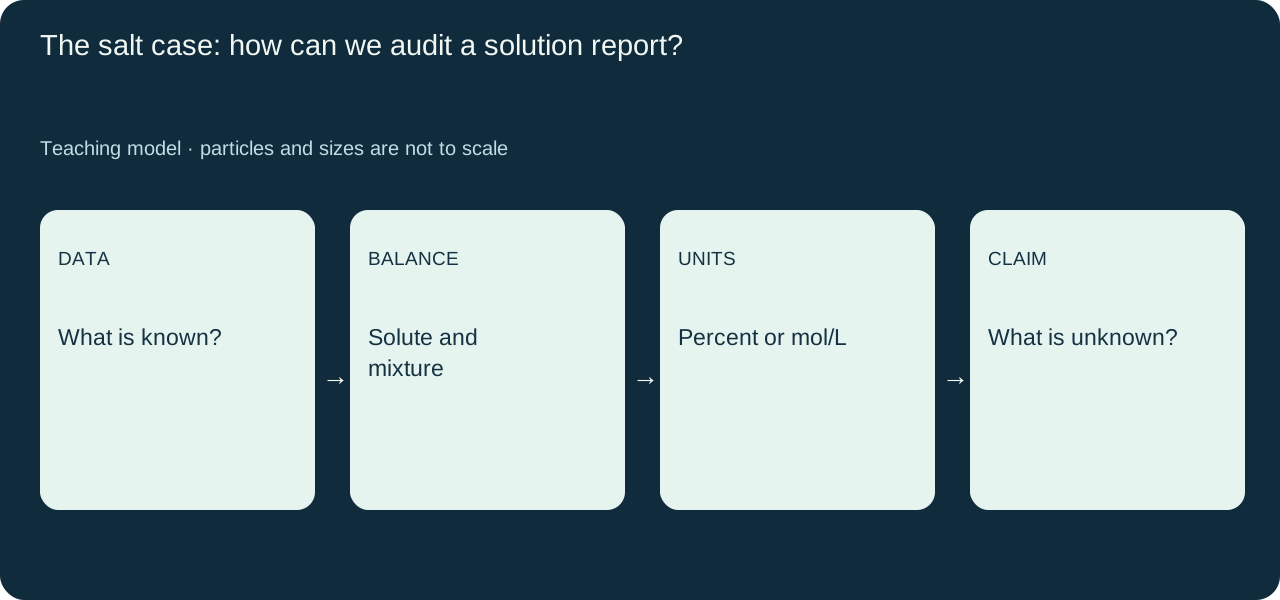
Model diagram
Use paper, a calculator and supplied data only. Do not heat, taste or smell samples, mix household chemicals or perform electrical experiments. Clarity and ordinary filtration do not establish drinking safety.
Situation and question
A notebook says: “10 g of salt was added to 90 g of water and dissolved completely. Another 100 g of water was added. The solution is clear, so pure. Concentration is 5 mol/L.” Which claims follow from the data and which need correction? Analyse without an experiment.
New terms, fully explained
A component balance compares its mass or amount before and after a change. Sufficient data means knowing every input needed for the chosen quantity. Mass fraction needs masses; molar concentration needs amount and final volume. Appearance alone establishes neither purity nor drinking safety.
Predict first
Predict how salt fraction changes when water is added without losses. Can a mass of 200 g automatically imply 0.200 L? List every extra assumption such a conversion would require before calculating.
Investigate or analyse given data
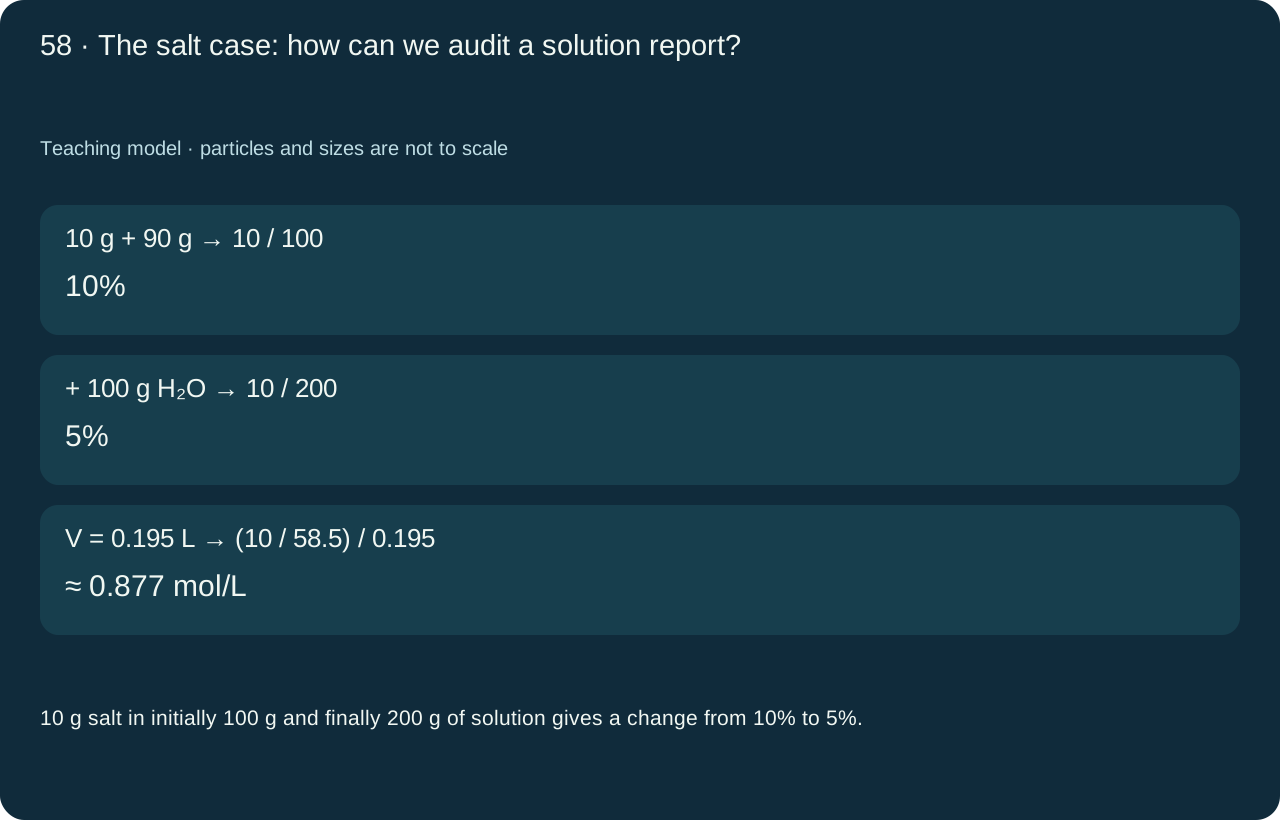
Write two rows: initially 10 g of salt, 90 g of water, 100 g total; finally 10 g of salt, 190 g of water, 200 g total. Additional supplied data give final volume of the second solution as 0.195 L and M(NaCl)=58.5 g/mol. These values are supplied, not measurements you made.
| Object / step | Given / calculation | Result |
|---|---|---|
| 10 g + 90 g | 10 / 100 | 10% |
| + 100 g H₂O | 10 / 200 | 5% |
| V = 0.195 L | (10 / 58.5) / 0.195 | ≈ 0.877 mol/L |
Worked example
Initially w=10/100=10%; after dilution w=10/200=5%. With the additional volume, n=10/58.5≈0.171 mol and c≈0.171/0.195≈0.877 mol/L. Without V, c cannot be determined. A mass percentage and mol/L describe different quantities.
A common mistake
Mistake: inferring purity from clarity, replacing litres with kilograms, or ignoring solid residue. For another imaginary X with S=30 g per 100 g of water at 20 °C, adding 20 g to 50 g of water leaves 5 g solid at equilibrium; the liquid requires its own balance.
Transfer to a new case
Final task: dissolve 12 g of sugar in 188 g of water. Take 50 g of homogeneous solution and add 25 g of water without losses. Find sugar mass in the portion and final mass fraction. Can molar concentration be found without final volume? Explain each step.
Answer and recall
Check: initial fraction is 6%, the portion contains 3 g of sugar, and dilution gives 3/75=4%. Molar concentration needs volume. Assess your explanation, balance, units and limits; revisit lesson 53, 54, 56 or 57 when a related error remains.
Exercise
Why cannot 5% be replaced by 5 mol/L? What extra data would allow conversion?
Answers
Show the answers
Different quantities; molar mass and solution volume, or density together with solution mass, are needed.
When to revisit
Close the page and, after 10 minutes, reconstruct the map, define the terms in your own words and solve the new case. Repeat without hints after a day and a week. If an error persists, return to the worked example and write down the missing step.
Sources and limits
If you have found a mistake or a typo in this article, tell us about it
Comments (0)
Log in to leave a comment →
No comments yet. Be the first.