

Chemistry: investigate the world of substances Lesson 65 of 67
How does dilution change pH, and where does the simple rule fail?
Connect conserved acid amount with the logarithm and water’s own contribution.
Support map
Model diagram
Use paper, a calculator and supplied data only. Do not taste, smell, mix or heat chemicals; do not open household products or unknown containers. Neutral pH does not establish safety. Do not apply teaching neutralisation to skin, eyes, spills or unknown mixtures.
Situation and question
The notebook describes 10 mL of 0.010 mol/L HCl reaching a final solution volume of 100 mL. “Tenfold dilution made pH ten times smaller,” a learner writes. Identify two errors. This is a calculation model, not a procedure for preparing an acid solution.
New terms, fully explained
Without loss, the amount of acid introduced is conserved: c₁V₁=c₂V₂. For a strong monoprotic acid whose contribution greatly exceeds water’s, with the concentration approximation applicable, c(H₃O⁺)≈c(HCl). Tenfold dilution raises pH by approximately one unit. “Acidic” and “safe” are not opposite classifications.
Predict first
Predict the direction: the model has more water but the same acid amount. Does hydronium concentration fall or rise? What does the minus sign before the logarithm do? Use final solution volume, not merely the added water volume; these are not interchangeable in general.
Investigate or analyse given data
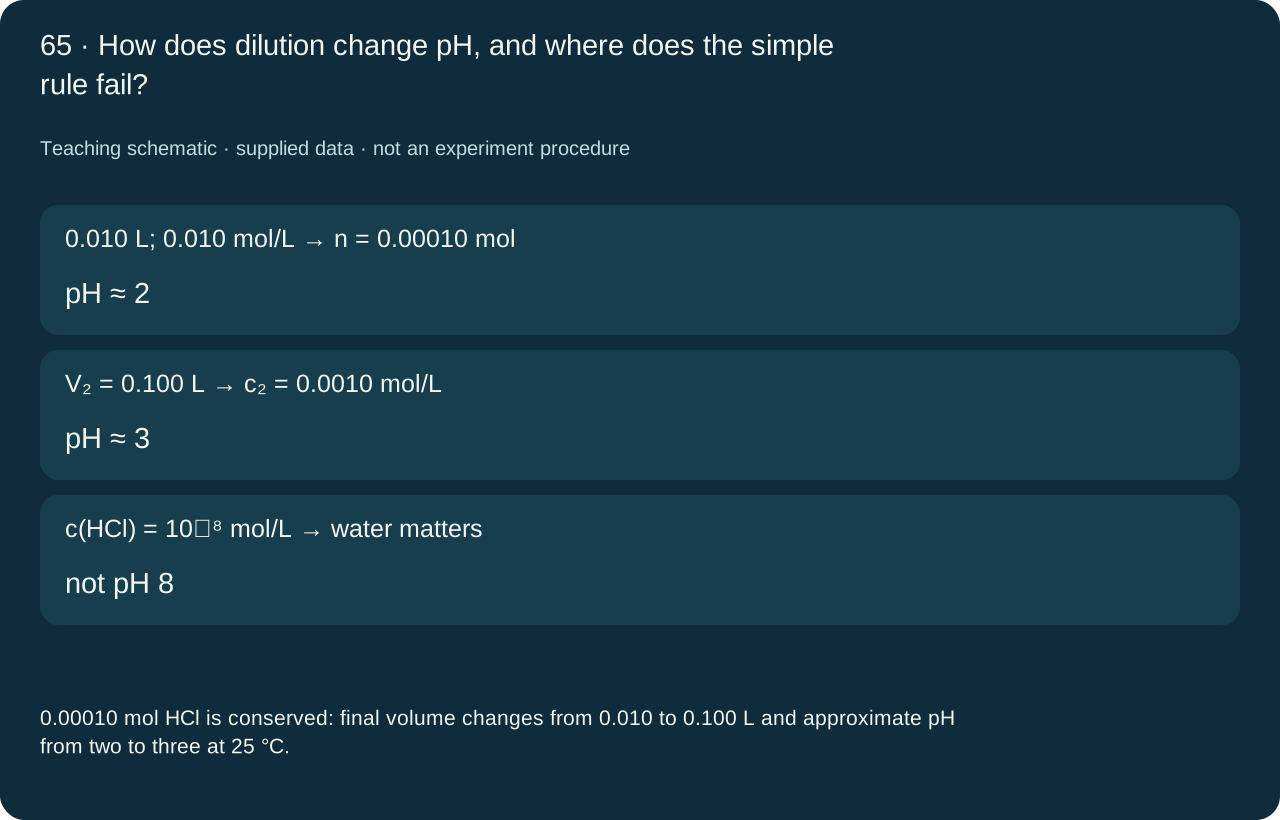
Calculate n=0.010×0.010 mol, then c₂=n/0.100 L. Find initial and final pH at 25 °C. Next consider a separate card with analytical c(HCl)=10⁻⁸ mol/L. Can water autoionisation be ignored to conclude that adding acid makes pure water basic?
| Object / step | Given / calculation | Conclusion |
|---|---|---|
| 0.010 L; 0.010 mol/L | n = 0.00010 mol | pH ≈ 2 |
| V₂ = 0.100 L | c₂ = 0.0010 mol/L | pH ≈ 3 |
| c(HCl) = 10⁻⁸ mol/L | water matters | not pH 8 |
Worked example
The amount is 0.00010 mol and final concentration 0.0010 mol/L. The approximation changes pH from two to three: concentration falls tenfold and pH rises by one. At a very small concentration such as 10⁻⁸ mol/L the approximation fails because water supplies comparable ions. Adding HCl does not make pure water basic.
A common mistake
Mistake: extending pH=−lg c(HCl) indefinitely without checking its limits, or retaining a weak acid’s old ionised fraction after dilution. Near neutrality, include water equilibrium; for weak acids, include acid equilibrium too. Even pH near seven does not establish purity or safety.
Transfer to a new case
Transfer case: a paper model takes 20 mL of 0.0010 mol/L strong monoprotic acid to a final 200 mL. Find c₂ and approximate pH at 25 °C. What extra condition is needed for the same calculation with a weak acid? Do not propose testing with real acid.
Answer and recall
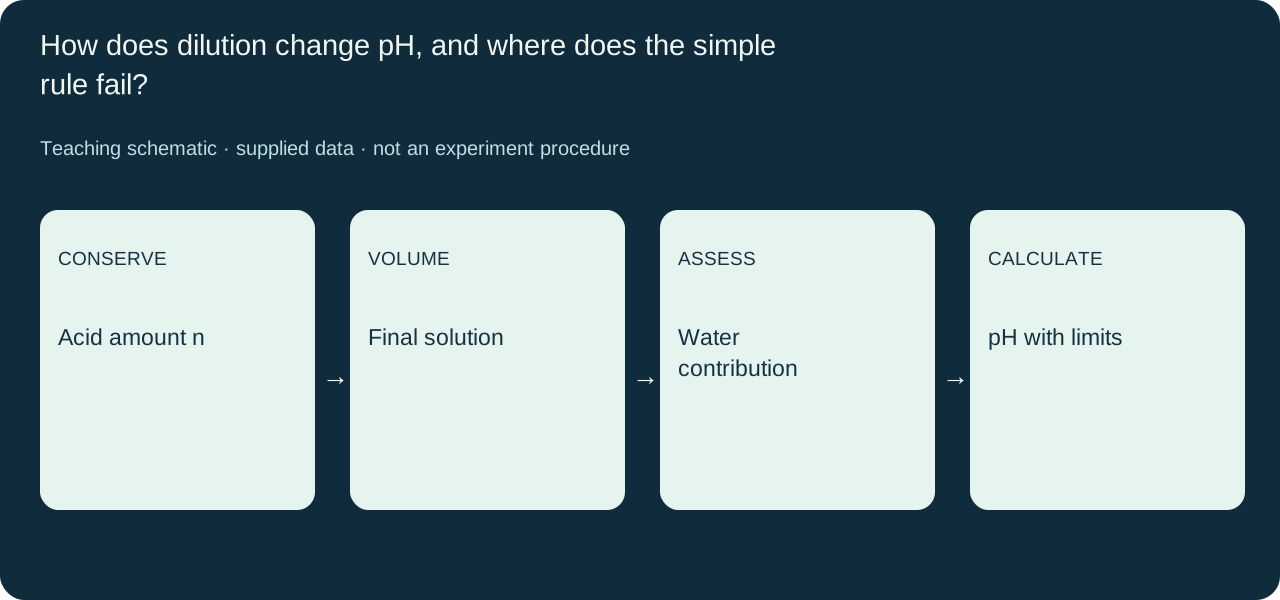
Check: c₂=0.00010 mol/L and pH≈4; the acid amount is 0.000020 mol before and after. A weak acid needs new equilibrium information: formal concentration alone is insufficient. Reconstruct “balance → final volume → applicability → pH” with every limitation stated.
Exercise
A model takes 10 mL of 0.0010 mol/L HCl to a final 100 mL. Find pH at 25 °C.
Answers
Show the answers
With negligible water contribution and an applicable concentration approximation, c₂=0.00010 mol/L and pH≈4; n=0.000010 mol is conserved.
When to revisit
Close the page and, after 10 minutes, reconstruct the map, define the terms in your own words and solve the new case. Repeat without hints after a day and a week. If an error persists, return to the worked example and write down the missing step.
Sources and limits
If you have found a mistake or a typo in this article, tell us about it
Comments (0)
Log in to leave a comment →
No comments yet. Be the first.