

Chemistry: investigate the world of substances Lesson 59 of 67
What distinguishes an acid from a base in an aqueous model?
Trace proton transfer and check conservation of atoms and charge.
Support map
Model diagram
Use paper, a calculator and supplied data only. Do not taste, smell, mix or heat chemicals; do not open household products or unknown containers. Neutral pH does not establish safety. Do not apply teaching neutralisation to skin, eyes, spills or unknown mixtures.
Situation and question
The notebook’s salt has dissolved, but the solution’s composition remains uncertain. Can clarity reveal whether it is acidic or basic? Lessons 50–58 distinguished molecules from ions. Now add acid–base interaction, using formulae and supplied information only, without handling samples.
New terms, fully explained
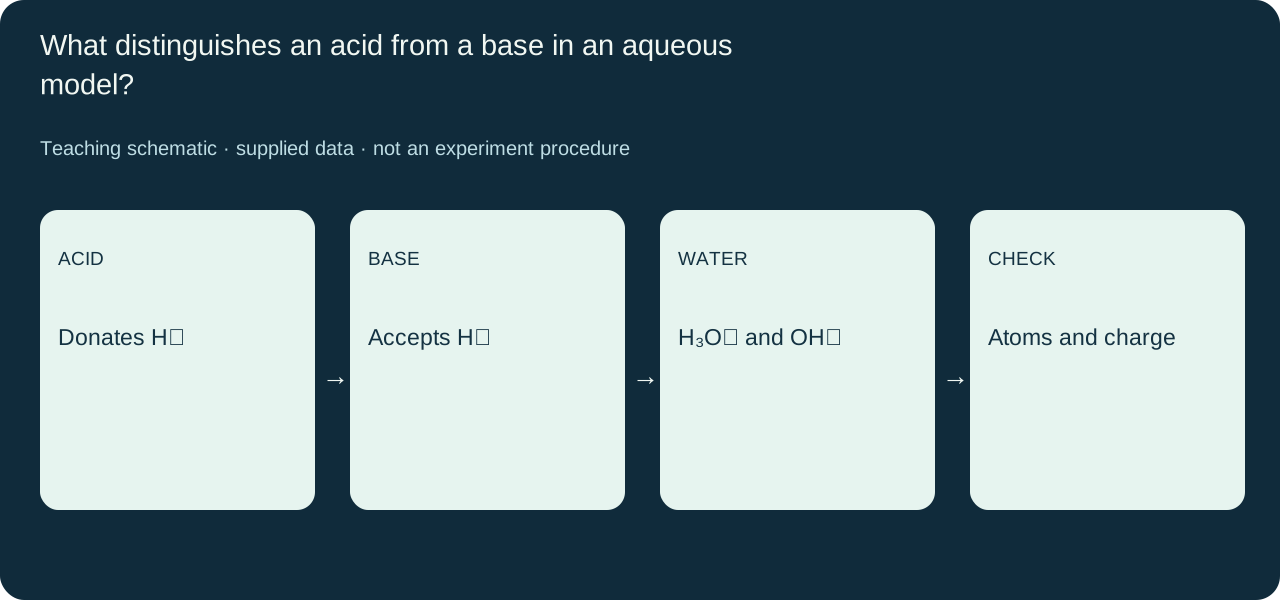
A Brønsted–Lowry acid donates a proton H⁺ and a base accepts one. In water, do not draw H⁺ as an isolated bare proton: use hydronium, H₃O⁺. The shorthand H⁺(aq) represents a hydrated proton. Acidity depends on the relative amounts per volume of H₃O⁺ and OH⁻, not colour or taste.
Predict first
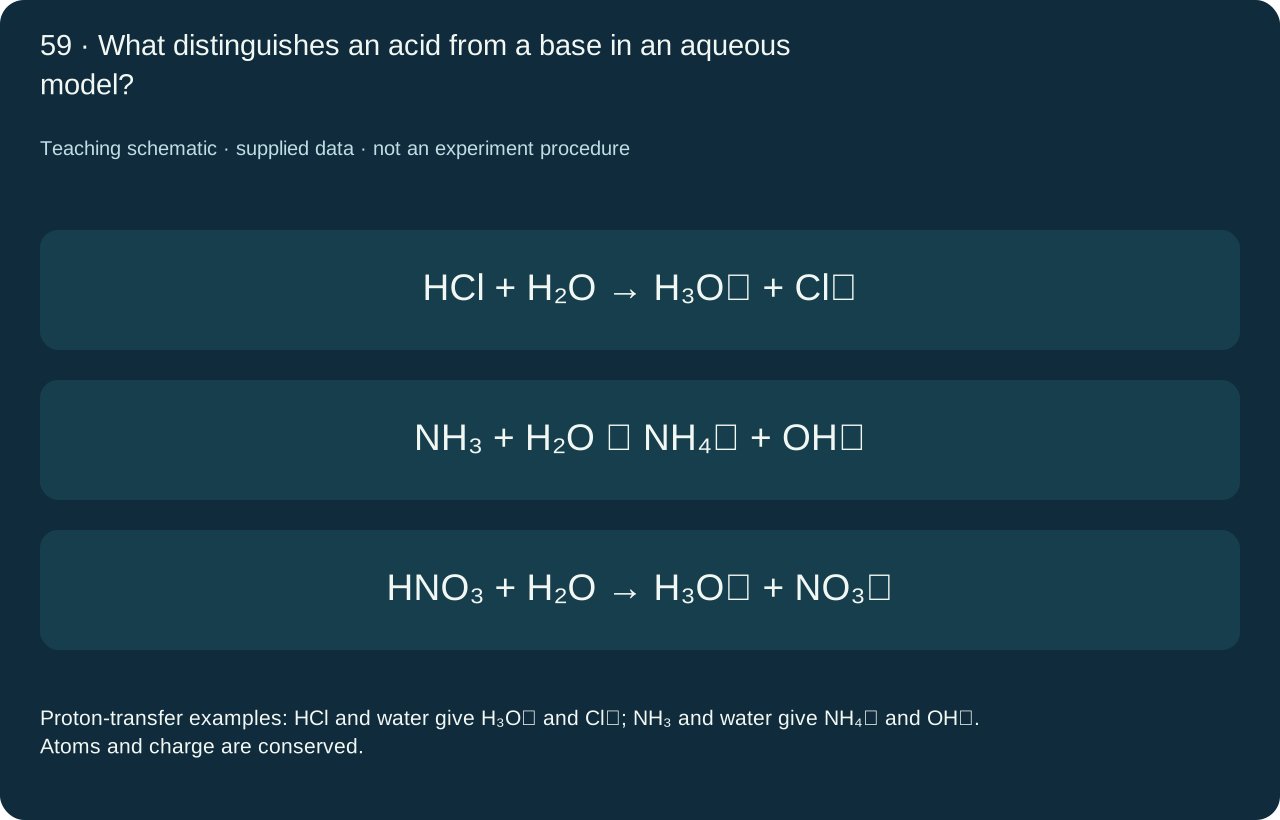
Consider HCl + H₂O → H₃O⁺ + Cl⁻. Predict the proton donor and acceptor. Then change the example to NH₃ + H₂O ⇌ NH₄⁺ + OH⁻. Can water play a different role? Before reading on, mark the change in the number of H atoms in each species.
Investigate or analyse given data
Copy both equations. Count H, O, Cl or N on each side, then add the charges. In the first equation, neutral reactants give +1 and −1 products. In the second, an equilibrium arrow allows reverse transfer; it does not mean equal amounts of every species.
| Object / step | Given / calculation | Conclusion |
|---|---|---|
| HCl + H₂O | → | H₃O⁺ + Cl⁻ |
| NH₃ + H₂O | ⇌ | NH₄⁺ + OH⁻ |
| HNO₃ + H₂O | → | H₃O⁺ + NO₃⁻ |
Worked example
With HCl, water accepts H⁺ and acts as a base, leaving Cl⁻. With NH₃, water donates H⁺ and acts as an acid, producing NH₄⁺ and OH⁻. A conjugate pair differs by one proton: HCl/Cl⁻, H₃O⁺/H₂O or NH₄⁺/NH₃. The transfer does not destroy atoms.
A common mistake
Mistake: requiring every base formula to contain OH. NH₃ has no such group but accepts a proton. An alkali is a water-soluble base; the school aqueous description and the proton-transfer model provide different explanatory levels. A neutral individual species does not establish that the whole solution is neutral.
Transfer to a new case
Transfer case: HNO₃ + H₂O → H₃O⁺ + NO₃⁻. Identify the donor, acceptor and two conjugate pairs. Does the oxygen count change between H₂O and H₃O⁺? Explain why total product charge is zero although the solution contains charged species.
Answer and recall
Check: HNO₃ donates and H₂O accepts; the pairs are HNO₃/NO₃⁻ and H₃O⁺/H₂O. Water and hydronium each contain one O; one proton is added. The +1 and −1 charges balance. Reconstruct both original equations and explain water’s different roles.
Exercise
In NH₃ + H₂O ⇌ NH₄⁺ + OH⁻, who donates H⁺? Name NH₃’s conjugate pair.
Answers
Show the answers
Water donates; NH₄⁺/NH₃. Total product charge is zero.
When to revisit
Close the page and, after 10 minutes, reconstruct the map, define the terms in your own words and solve the new case. Repeat without hints after a day and a week. If an error persists, return to the worked example and write down the missing step.
Sources and limits
The salt case: how can we audit a solution report?
What does an indicator colour show—and what can it not prove?
If you have found a mistake or a typo in this article, tell us about it
Comments (0)
Log in to leave a comment →
No comments yet. Be the first.