

Chemistry: investigate the world of substances Lesson 64 of 67
How do mole balances identify excess acid or alkali?
Convert volumes to litres and compare reagents using the equation, not millilitres alone.
Support map
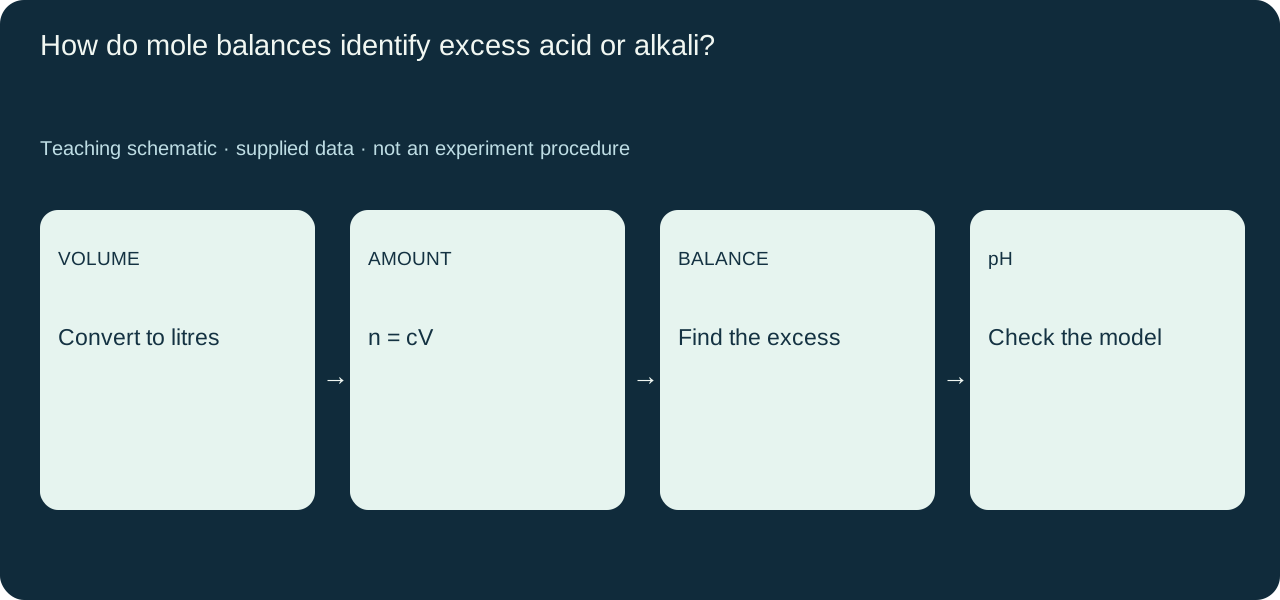
Model diagram
Use paper, a calculator and supplied data only. Do not taste, smell, mix or heat chemicals; do not open household products or unknown containers. Neutral pH does not establish safety. Do not apply teaching neutralisation to skin, eyes, spills or unknown mixtures.
Situation and question
A calculation card gives 25 mL of 0.20 mol/L HCl and 40 mL of 0.10 mol/L NaOH. A learner picks the excess reagent by the larger volume. Is that valid? Lessons 45–47 connected coefficients to substance amounts. Apply the same principle to solution data without actually mixing anything.
New terms, fully explained
For each solution, n=cV with V in litres. HCl + NaOH → NaCl + H₂O has a 1:1 mole ratio. Identify excess by comparing amounts—or n/coefficient when coefficients differ. Final volume is needed for the residue’s concentration, but not for the initial reagent comparison.
Predict first
Predict the outcome after converting 25 and 40 mL to litres. Can a smaller volume contain more moles? When may volumes be compared if concentrations are equal? Do not transfer an equal-volume rule to unequal concentrations or an equation with a different coefficient ratio.
Investigate or analyse given data
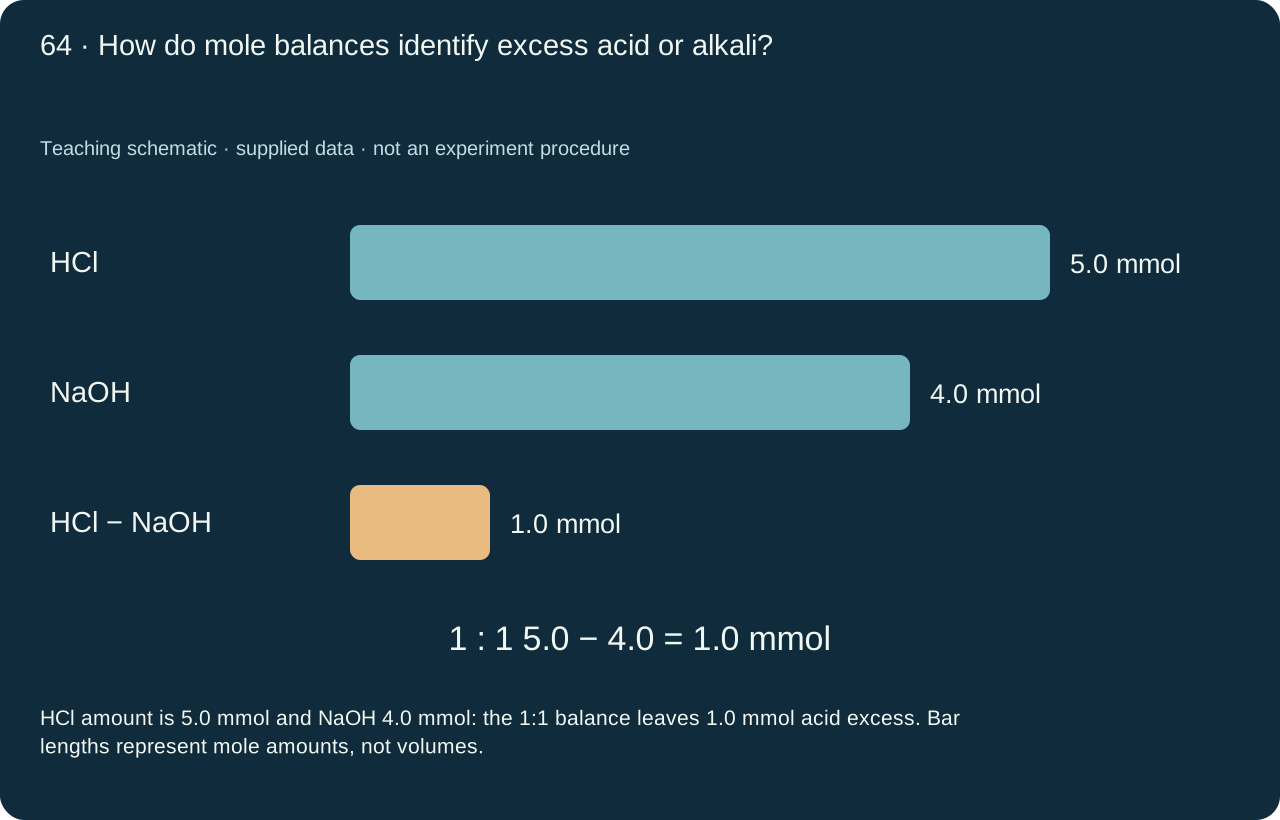
Calculate n(HCl)=0.20×0.025 and n(NaOH)=0.10×0.040. Record the amount of each consumed and what remains. A separate calculation supplies final volume 0.065 L at 25 °C. This is given information, not a universal rule that mixed volumes always add.
| Object / step | Given / calculation | Conclusion |
|---|---|---|
| 25 mL; 0.20 mol/L | 0.025 × 0.20 | 0.0050 mol HCl |
| 40 mL; 0.10 mol/L | 0.040 × 0.10 | 0.0040 mol NaOH |
| 0.0050 − 0.0040 | acid excess | 0.0010 mol |
Worked example
Initially there are 0.0050 mol HCl and 0.0040 mol NaOH. Each consumes 0.0040 mol; 0.0010 mol acid excess remains and 0.0040 mol NaCl forms. In the strong-acid model, c(H₃O⁺)≈0.0010/0.065≈0.0154 mol/L and pH≈1.81. Balance first, then take the logarithm.
A common mistake
Mistake: averaging starting pH values, or calling a mixture neutral because volumes look similar. This calculation requires known reagents, no additional reactions and an applicable concentration approximation. Account for salt and unreacted excess separately. Starting volumes alone cannot determine the residual acidity.
Transfer to a new case
Transfer case: 20 mL of 0.10 mol/L HCl and 30 mL of 0.10 mol/L NaOH. Find the remaining excess and NaCl amount. Final volume is supplied as 0.050 L at 25 °C. Find hydroxide concentration, pOH and pH using pH+pOH≈14 for this model.
Answer and recall
Check: 0.0020 mol acid and 0.0030 mol alkali leave 0.0010 mol OH⁻ and form 0.0020 mol NaCl. Hydroxide concentration is approximately 0.020 mol/L, pOH≈1.70 and pH≈12.30. Check the direction: excess alkali must give a basic, not acidic, result.
Exercise
10 mL of 0.10 mol/L HCl and 10 mL of 0.20 mol/L NaOH: find excess and NaCl amount.
Answers
Show the answers
0.0010 mol NaOH excess and 0.0010 mol NaCl formed. Equal volumes do not give equal moles at unequal concentrations.
When to revisit
Close the page and, after 10 minutes, reconstruct the map, define the terms in your own words and solve the new case. Repeat without hints after a day and a week. If an error persists, return to the worked example and write down the missing step.
Sources and limits
What changes in neutralisation, and which ions remain?
How does dilution change pH, and where does the simple rule fail?
If you have found a mistake or a typo in this article, tell us about it
Comments (0)
Log in to leave a comment →
No comments yet. Be the first.