

Chemistry: investigate the world of substances Lesson 66 of 67
Why is pH alone insufficient for a safety decision?
Read fictional labels and choose safe actions without contacting chemicals.
Support map
Model diagram
Use paper, a calculator and supplied data only. Do not taste, smell, mix or heat chemicals; do not open household products or unknown containers. Neutral pH does not establish safety. Do not apply teaching neutralisation to skin, eyes, spills or unknown mixtures.
Situation and question
The notebook proposes: “Liquid A is acidic and B is basic, so mix them to make them safe.” What information is missing? An acid’s name or a near-neutral pH does not describe every hazard. Use fictional paper labels only; do not open or investigate real containers.
New terms, fully explained
A hazard is a capacity to cause harm; risk also depends on exposure and circumstances. Labels and safety data sheets describe a product and its handling. pH is only one property: it cannot replace information about toxicity, oxidising properties, compatibility or concentration. No colour or smell does not mean no hazard.
Predict first
Predict which statement helps a decision: “A: pH 2” or “A: do not mix with other products; read manufacturer instructions”. Neither authorises an experiment. List missing information before the answer: exact composition, concentrations, conditions and possible interaction products.
Investigate or analyse given data
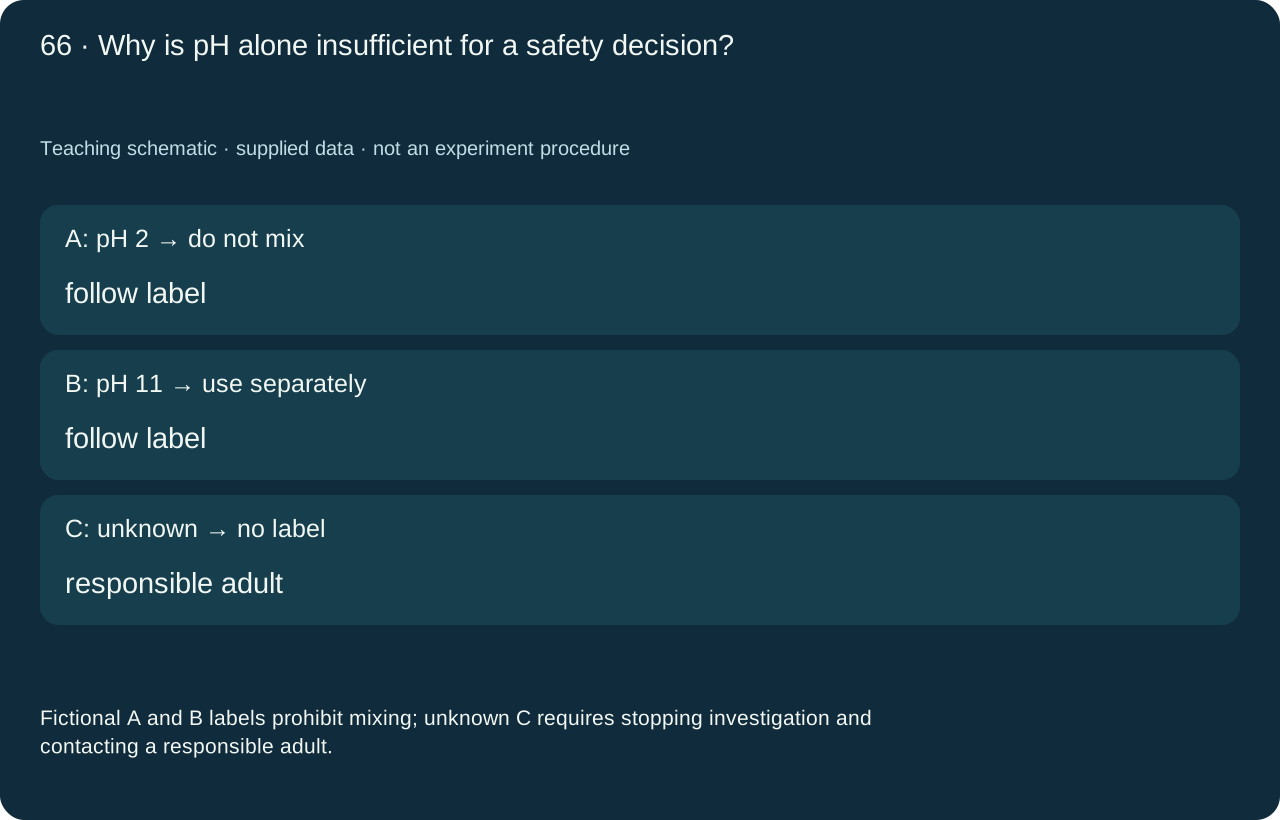
Fictional cards read: A—cleaning product, pH 2, “do not mix”; B—another product, pH 11, “use separately”; C—unknown liquid without a label. Choose actions: do not mix, do not use the unknown substance, and contact a responsible adult. Calculate no mixing proportions and assign no experiment.
| Object / step | Given / calculation | Conclusion |
|---|---|---|
| A: pH 2 | do not mix | follow label |
| B: pH 11 | use separately | follow label |
| C: unknown | no label | responsible adult |
Worked example
A and B retain their explicit mixing prohibitions. For C, unknown composition is itself reason to stop investigating and tell a responsible adult. A pure-reagent neutralisation equation cannot describe a multicomponent cleaner. Hazardous products or heat may result even if final acidity decreases.
A common mistake
Mistake: turning a calculation into instructions for treating a spill, skin or eyes, or trying to “correct” a hazardous mixture with another product. In a real situation follow manufacturer instructions and guidance from a responsible adult or emergency services. This lesson supplies no incident-cleanup procedure and does not replace specialist training.
Transfer to a new case
Transfer case: an online message says “After adding the product, pH became seven, so the liquid may now be poured away or drunk”. Which two conclusions are unsupported? Choose a safe response for the paper scenario. Do not seek extra evidence by touching or smelling a liquid.
Answer and recall
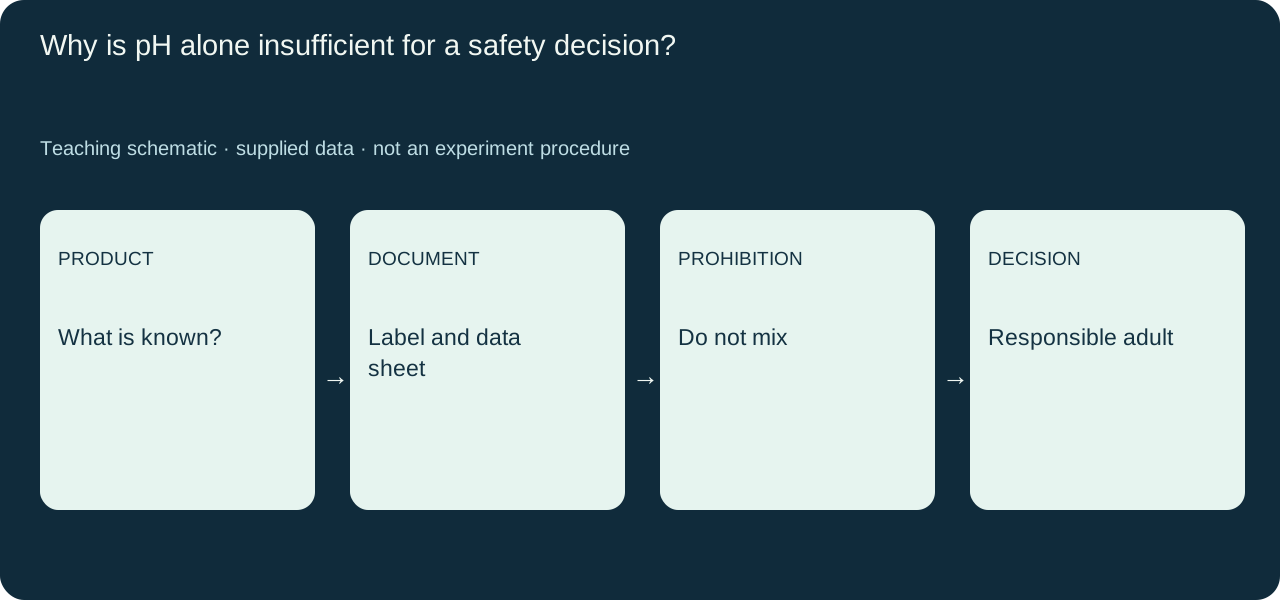
Check: pH seven establishes neither drinking safety nor disposal permission. An unknown mixture remains outside a learner’s permitted handling; tell a responsible adult and use official instructions. Reconstruct “identify → documentation → prohibitions → safe decision”, distinguishing chemical neutrality from safety.
Exercise
Two product cards show pH two and eleven. May you calculate household mixing proportions?
Answers
Show the answers
No. Composition and compatibility are unknown: do not mix; follow labels and contact a responsible adult.
When to revisit
Close the page and, after 10 minutes, reconstruct the map, define the terms in your own words and solve the new case. Repeat without hints after a day and a week. If an error persists, return to the worked example and write down the missing step.
Sources and limits
How does dilution change pH, and where does the simple rule fail?
If you have found a mistake or a typo in this article, tell us about it
Comments (0)
Log in to leave a comment →
No comments yet. Be the first.