

Chemistry: investigate the world of substances Lesson 67 of 67
The salt case: what does neutralisation actually prove?
Check a report using atoms, moles, pH and the limits of purity claims.
Support map
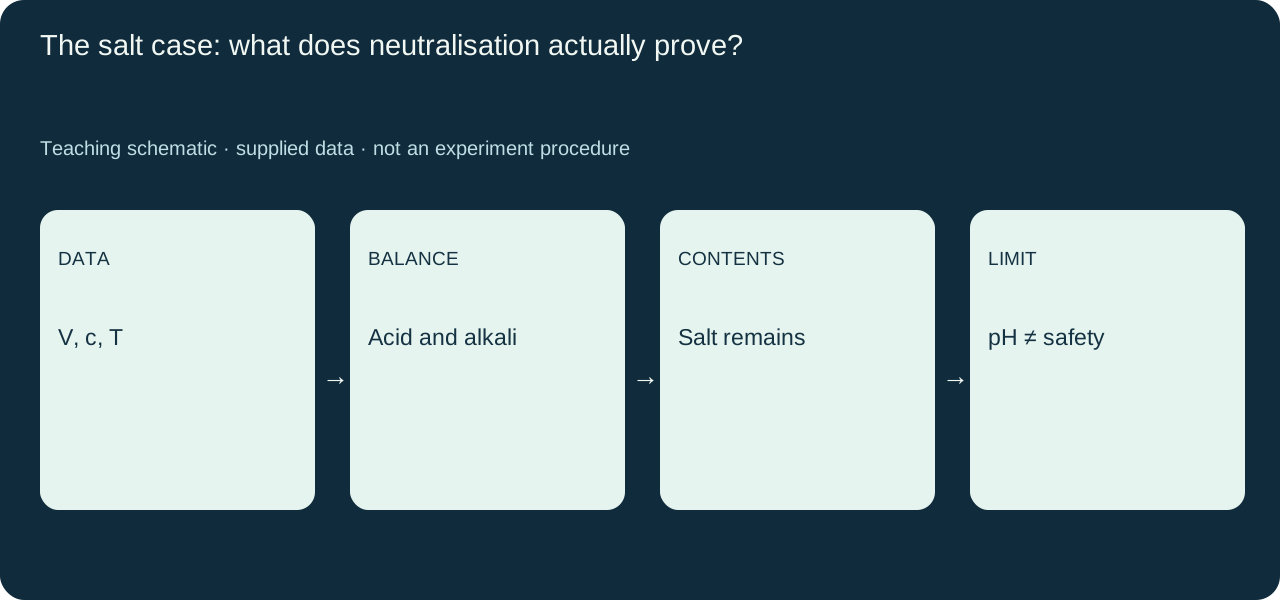
Model diagram
Use paper, a calculator and supplied data only. Do not taste, smell, mix or heat chemicals; do not open household products or unknown containers. Neutral pH does not establish safety. Do not apply teaching neutralisation to skin, eyes, spills or unknown mixtures.
Situation and question
The calculation notebook says: “20 mL of 0.10 mol/L HCl and 20 mL of 0.10 mol/L NaOH gave 40 mL of water. pH seven, salt disappeared, safe to drink.” Which parts follow from a model, and which do not follow? This is a final paper exercise, not an experiment performed by the learner.
New terms, fully explained
A report must separate input data, model, calculation and conclusion. Additional supplied conditions are final volume 0.040 L, temperature 25 °C, complete reaction without loss and an applicable ideal dilute model. Use M(NaCl)=58.5 g/mol. Purity and safety have not been supplied as conditions.
Predict first
Predict residual reagents before arithmetic using equal concentrations, equal volumes and a 1:1 coefficient ratio. What remains of Na and Cl? Can “neutral salt solution” be replaced by “pure water”? Write your own conclusion and its limitations before reading the analysis.
Investigate or analyse given data
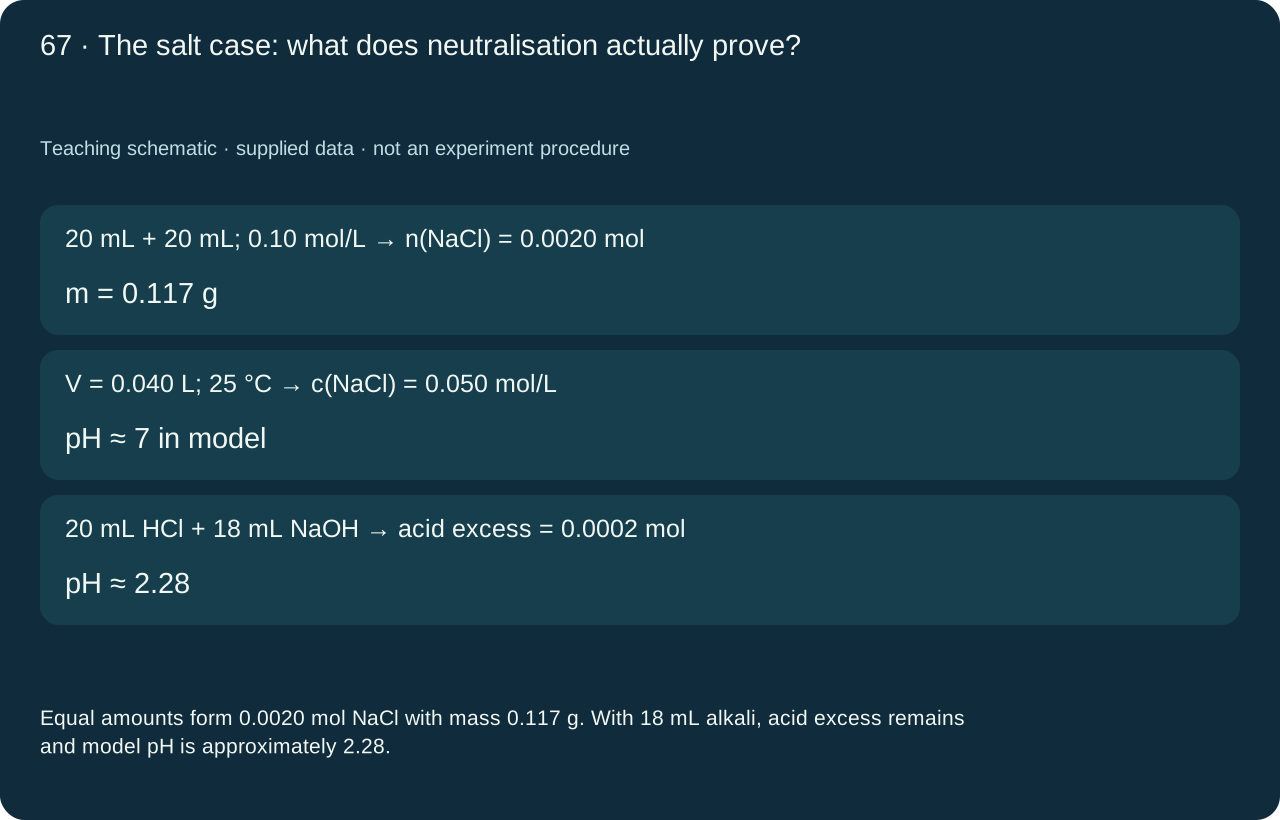
Build a chain: 20 mL → 0.020 L; n(HCl) and n(NaOH); NaCl amount; NaCl mass; formal salt concentration at V=0.040 L. Separately write H₃O⁺ + OH⁻ → 2H₂O and identify spectator ions. Do not infer final volume from starting volumes alone: it is explicitly supplied.
| Object / step | Given / calculation | Conclusion |
|---|---|---|
| 20 mL + 20 mL; 0.10 mol/L | n(NaCl) = 0.0020 mol | m = 0.117 g |
| V = 0.040 L; 25 °C | c(NaCl) = 0.050 mol/L | pH ≈ 7 in model |
| 20 mL HCl + 18 mL NaOH | acid excess = 0.0002 mol | pH ≈ 2.28 |
Worked example
The 0.0020 mol of each reagent is consumed. NaCl amount is 0.0020 mol, calculated mass 0.117 g and formal concentration 0.050 mol/L. Na⁺ and Cl⁻ remain in solution. Approximately pH seven follows from the chosen model at 25 °C, but no actual measurement or impurity analysis has been made.
A common mistake
Mistake: using pH as a measure of all solutes or permission to drink. An exact acid–base balance and safety answer different questions. An indicator with a broad transition does not establish exact mole equivalence. The ionic equation, calculation and composition claim must agree rather than replace one another.
Transfer to a new case
Transfer case: the alkali volume was actually 18 mL at the same concentration; final volume is supplied as 0.038 L. Find excess reagent, NaCl amount and mass, and approximate pH at 25 °C. Name two safety claims that remain unsupported after correcting the calculation.
Answer and recall
Check: NaOH is 0.0018 mol and HCl 0.0020 mol, leaving 0.0002 mol acid excess. NaCl is 0.0018 mol with mass 0.1053 g; c(H₃O⁺)≈0.00526 mol/L and pH≈2.28. Neither drinking nor disposal is authorised. Assess balance, units, model and conclusion limits; revisit lessons 61, 63, 64 or 66 as needed.
Exercise
Does NaCl remain in the original 20+20 mL case? Give its mass and the conclusion’s limit.
Answers
Show the answers
Yes: 0.0020 mol and 0.117 g using the supplied molar mass. Approximately pH seven is a model result at 25 °C, not proof of purity or safety.
When to revisit
Close the page and, after 10 minutes, reconstruct the map, define the terms in your own words and solve the new case. Repeat without hints after a day and a week. If an error persists, return to the worked example and write down the missing step.
Sources and limits
If you have found a mistake or a typo in this article, tell us about it
Comments (0)
Log in to leave a comment →
No comments yet. Be the first.