

Chemistry: investigate the world of substances Lesson 62 of 67
Why is a strong acid not necessarily concentrated?
Separate extent of ionisation from the amount of substance per litre.
Support map
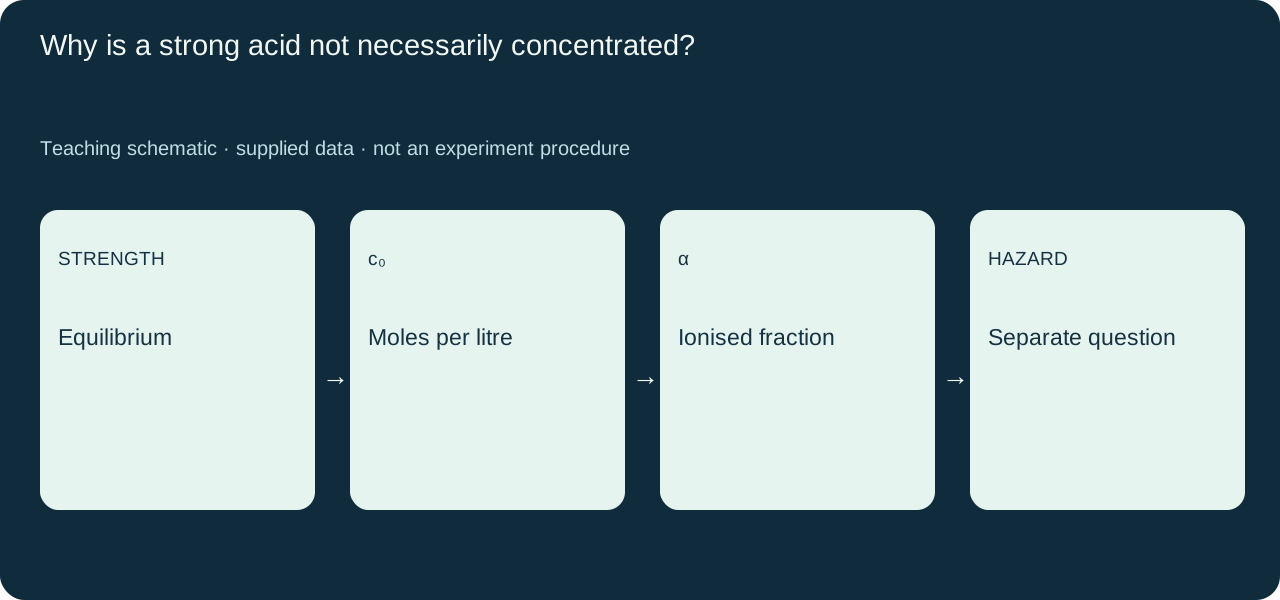
Model diagram
Use paper, a calculator and supplied data only. Do not taste, smell, mix or heat chemicals; do not open household products or unknown containers. Neutral pH does not establish safety. Do not apply teaching neutralisation to skin, eyes, spills or unknown mixtures.
Situation and question
Two notebook entries use “strong acid” and “concentrated solution” as synonyms. One describes behaviour in water; the other describes solution composition. What evidence is needed for each claim? Recall lesson 56 on molar concentration. No tasting or mixing of samples is required.
New terms, fully explained
Acid strength concerns ionisation equilibrium in a specified solvent: a strong monoprotic acid is essentially completely ionised in our dilute aqueous model; a weak acid is partly ionised. Analytical concentration c₀ counts the acid introduced regardless of its present form. The ionised fraction α is the share of original acid units that have ionised.
Predict first
Predict whether a more concentrated weak acid could provide more H₃O⁺ than a very dilute strong acid. Names alone cannot decide. Compare c₀ and equilibrium information. For a weak acid, α is not a fixed fraction that remains identical at every dilution.
Investigate or analyse given data
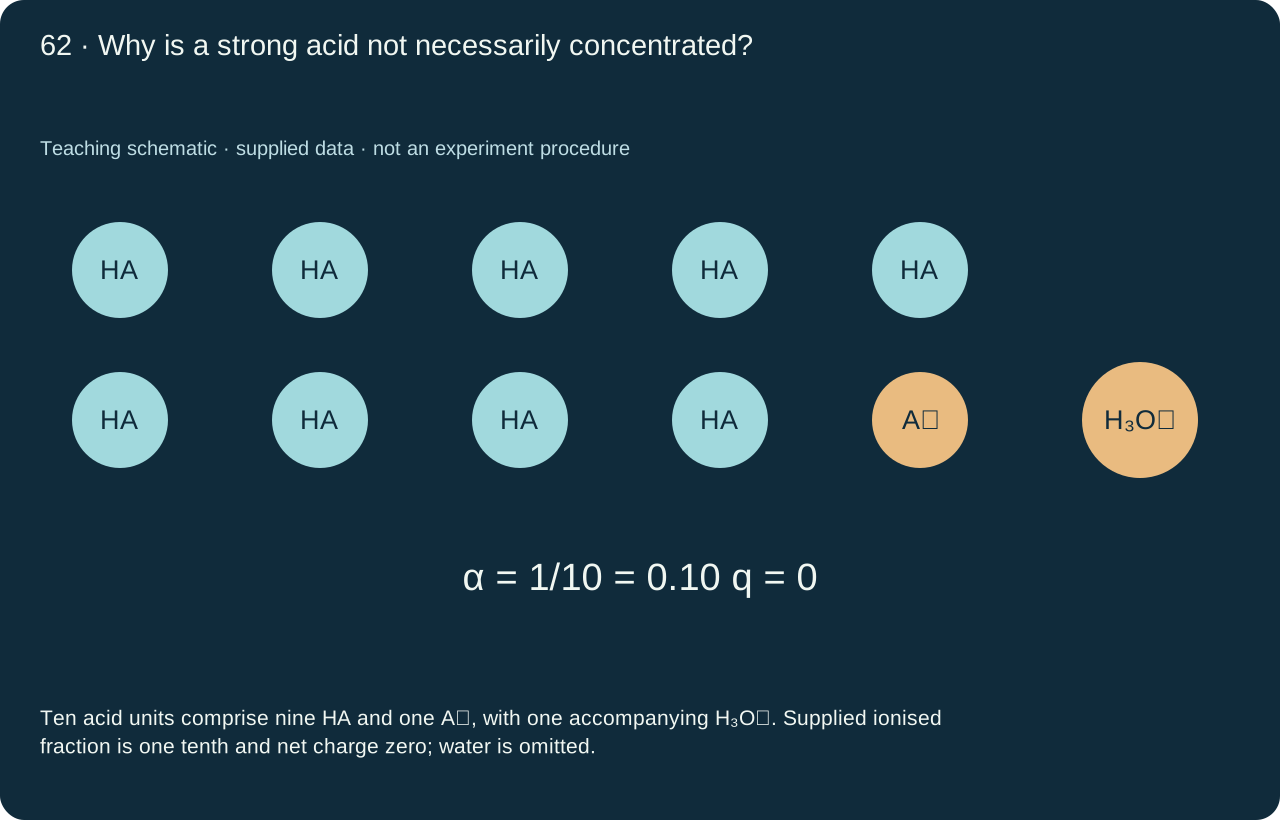
A supplied monoprotic HA model contains ten acid units: one appears as A⁻ with H₃O⁺, while nine remain HA. Water is omitted; this is a schematic given state, not a measured micrograph. Find α. Separate cards give c₀=0.010 mol/L with α=0.10, and c₀=0.00010 mol/L with α≈1.
| Object / step | Given / calculation | Conclusion |
|---|---|---|
| HA | 9 HA + A⁻ + H₃O⁺ | α = 1/10 |
| c₀ = 0.010; α = 0.10 | c₀ × α | 0.0010 mol/L |
| c₀ = 0.00010; α ≈ 1 | c₀ × α | ≈ 0.00010 mol/L |
Worked example
The picture has α=1/10=0.10. In the first numerical card, the acid contributes approximately 0.010×0.10=0.0010 mol/L hydronium; the second gives approximately 0.00010 mol/L. With water’s contribution negligible, the partly ionised example provides more hydronium. Each card supplies its own α.
A common mistake
Mistake: calling weak acids harmless or assuming strong acids must be concentrated. Hazards require composition, concentration and product documentation. Do not carry α=0.10 to a different solution without evidence. HA + H₂O ⇌ H₃O⁺ + A⁻ conserves atoms and charge at any applicable extent of ionisation.
Transfer to a new case
Transfer case: X contains a weak monoprotic acid with c₀=0.020 mol/L and supplied α=0.05. Y contains a strong acid with c₀=0.00020 mol/L. Find approximate hydronium concentrations and X/Y, assuming the dilute model applies and water contributes negligibly. What information is needed after diluting X?
Answer and recall
Check: X gives 0.0010 mol/L and Y 0.00020; the ratio is five. Diluted X needs a new equilibrium state or an acid constant and calculation; its old α cannot simply be retained. Explain why strength, concentration and hazard are three distinct descriptions.
Exercise
For c₀=0.030 mol/L and supplied α=0.020, find HA’s hydronium contribution. Does α survive every dilution unchanged?
Answers
Show the answers
0.00060 mol/L under the stated assumptions; no, a new equilibrium is needed.
When to revisit
Close the page and, after 10 minutes, reconstruct the map, define the terms in your own words and solve the new case. Repeat without hints after a day and a week. If an error persists, return to the worked example and write down the missing step.
Sources and limits
If you have found a mistake or a typo in this article, tell us about it
Comments (0)
Log in to leave a comment →
No comments yet. Be the first.