

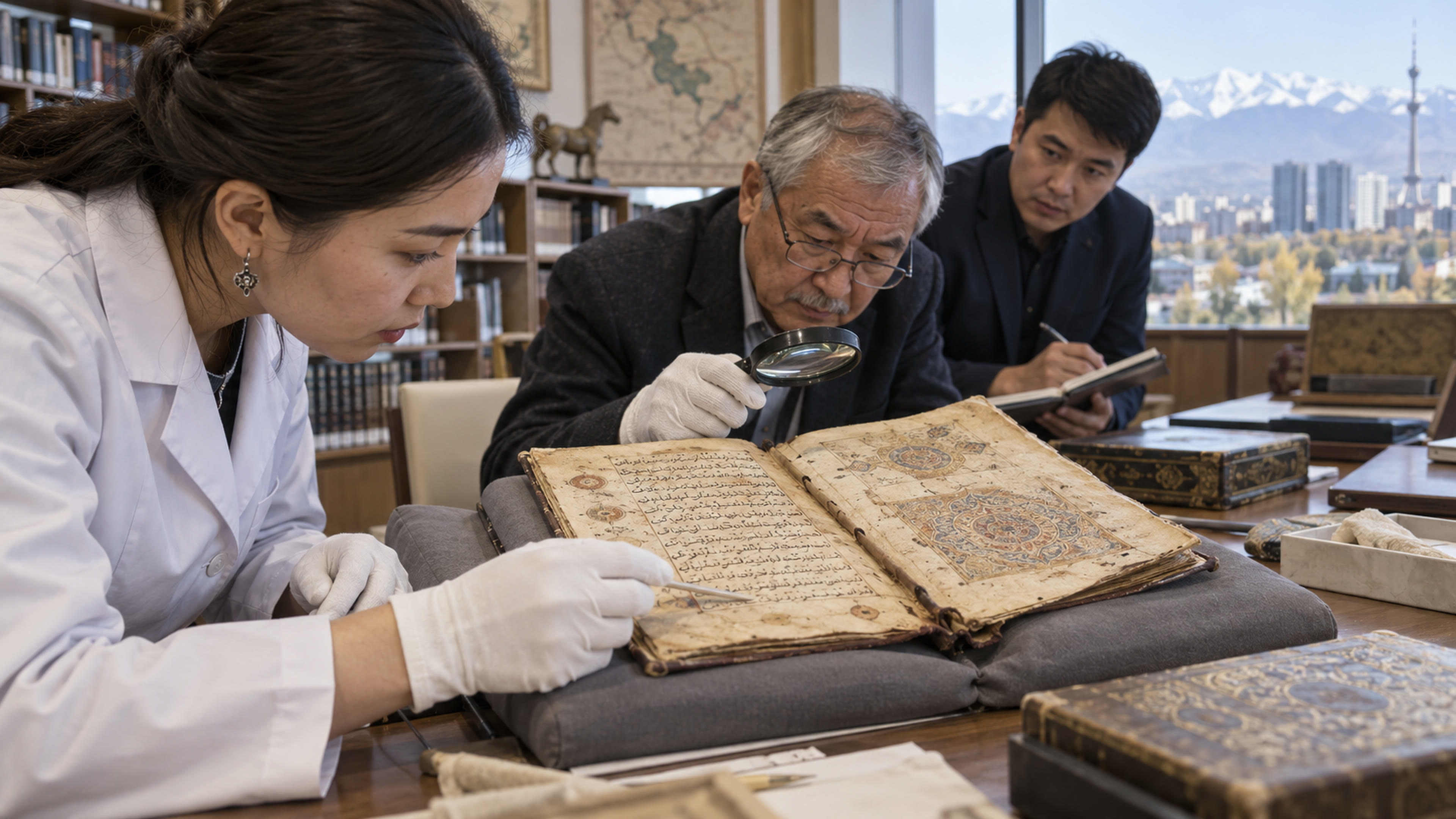
Five volumes of Eastern history: the manuscripts presented in Almaty
Researchers presented volumes III–V of Kurbangali Khaliduly’s work at Kazakhstan’s National Library on 6 October and discussed transcription and translation. Why does access to the original matter?
Central Asian history is often retold through later summaries. In Almaty on 6 October, researchers returned to the harder evidence: the manuscripts of Kurbangali Khaliduly. At the Kazakh manuscript scholars’ eighth meeting in the National Library, they presented volumes III–V of the five-volume Tawarikh-i Khamsa-i Sharqi, a research collection and a consolidated version of the work.
The work behind a readable book
Orientalists, Turkologists, historians and philologists discussed preservation, transcription, translation and scholarly publication. These are distinct steps. A researcher first establishes how to read the old script, then conveys its meaning, and finally explains where a source comes from and where its testimony is limited.
Without that work, an elegant facsimile remains inaccessible to most readers. Yet a translation should not erase ambiguities in the original: disputed names, dates and places need notes that let others review the evidence.
The next step for the public
The ministry’s account confirms the presentation but gives no link to an open digital edition or its access terms. A public catalogue, high-quality scans and scholarly notes would make the citations independently checkable. That is how a written heritage becomes a living source of knowledge rather than only the subject of a ceremonial report.
Primary source: https://www.gov.kz/memleket/entities/mam/press/news/1?lang=ru.
If you have found a mistake or a typo in this article, tell us about it
Comments (0)
Log in to leave a comment →
No comments yet. Be the first.