

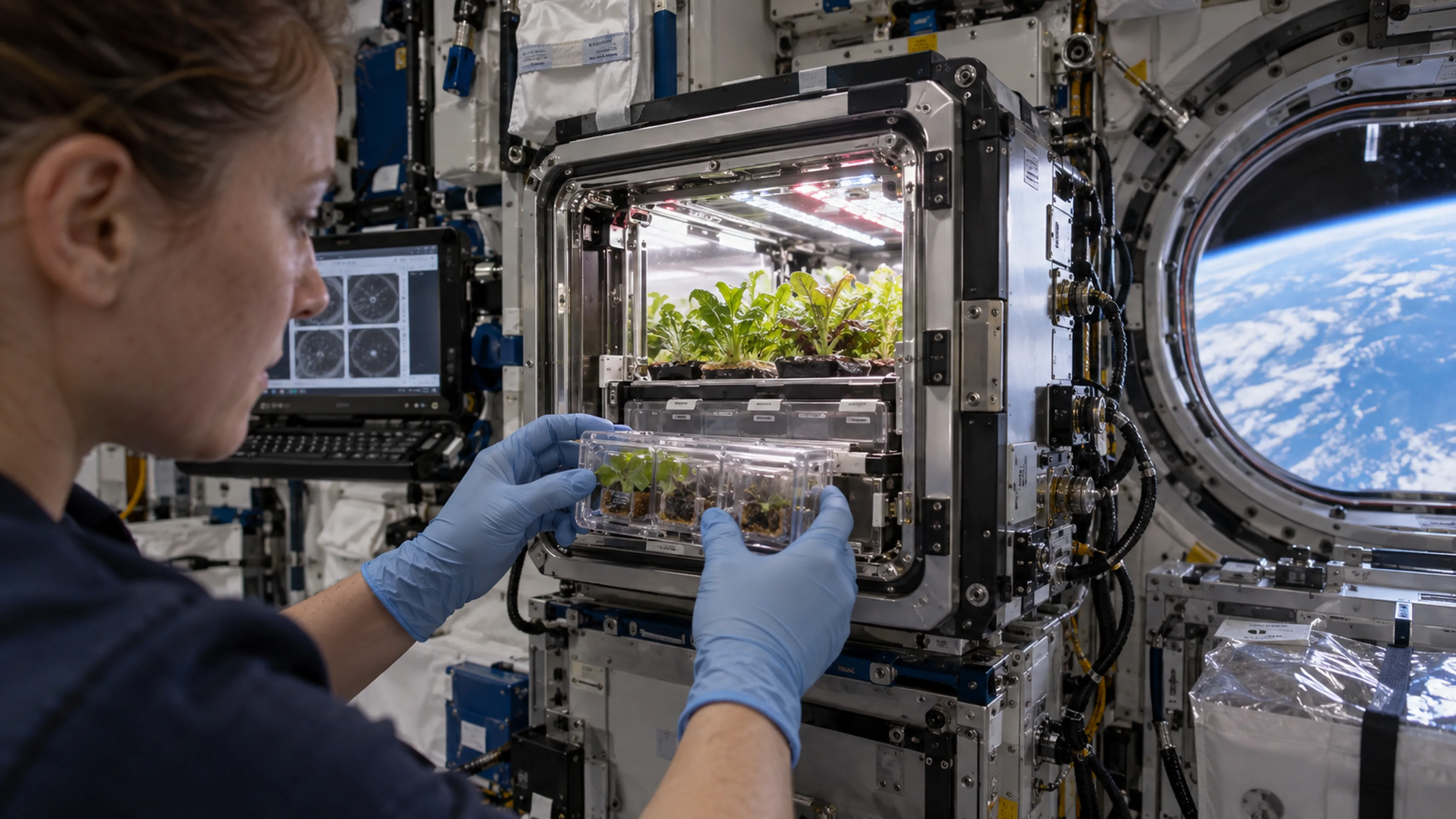
Tiny Brain Models and Resistant Bacteria: NASA Plans New ISS Research
NASA outlined the science planned for SpaceX’s CRS-35 cargo mission on October 12. Lab-grown brain models, plant studies and faster crew-health tests are among the investigations. These are planned experiments, not completed medical breakthroughs.
NASA has outlined research scheduled to travel to the International Space Station on SpaceX’s 35th commercial resupply mission for the agency. Announced on October 12, four investigations cover human and plant health and antibiotic-resistant bacteria. The purpose is to test processes that can be difficult to study under ordinary gravity.
One experiment will send small lab-grown models of the human brain to the station for five weeks. Another will test a compact device that can measure health-related biomarkers in orbit. If it works as intended, crews could obtain some results without waiting for samples to return to Earth.
A separate study tracks antibiotic-resistant bacteria. Astronauts will repeatedly sample station surfaces to watch how these organisms survive and change. The question matters on long missions where treatment and resupply are limited. The mission also includes a crop-disease investigation with potential relevance to farming on Earth. A brain model is not a whole human brain, however, and the experiments have yet to produce results. The announced work is a research agenda, not a claim of a new treatment.
Source
If you have found a mistake or a typo in this article, tell us about it
Comments (0)
Log in to leave a comment →
No comments yet. Be the first.