

Russia strikes Kyiv bridges: what the new tactic signals about the war’s next phase
Three days of Russian attacks disrupted traffic on three of Kyiv’s six road bridges and damaged the Northern Bridge, while the wider front remains largely deadlocked. We examine why Moscow is shifting pressure to urban logistics, what may follow this winter and why a rapid peace settlement remains unlikely.
What happened over the past three days
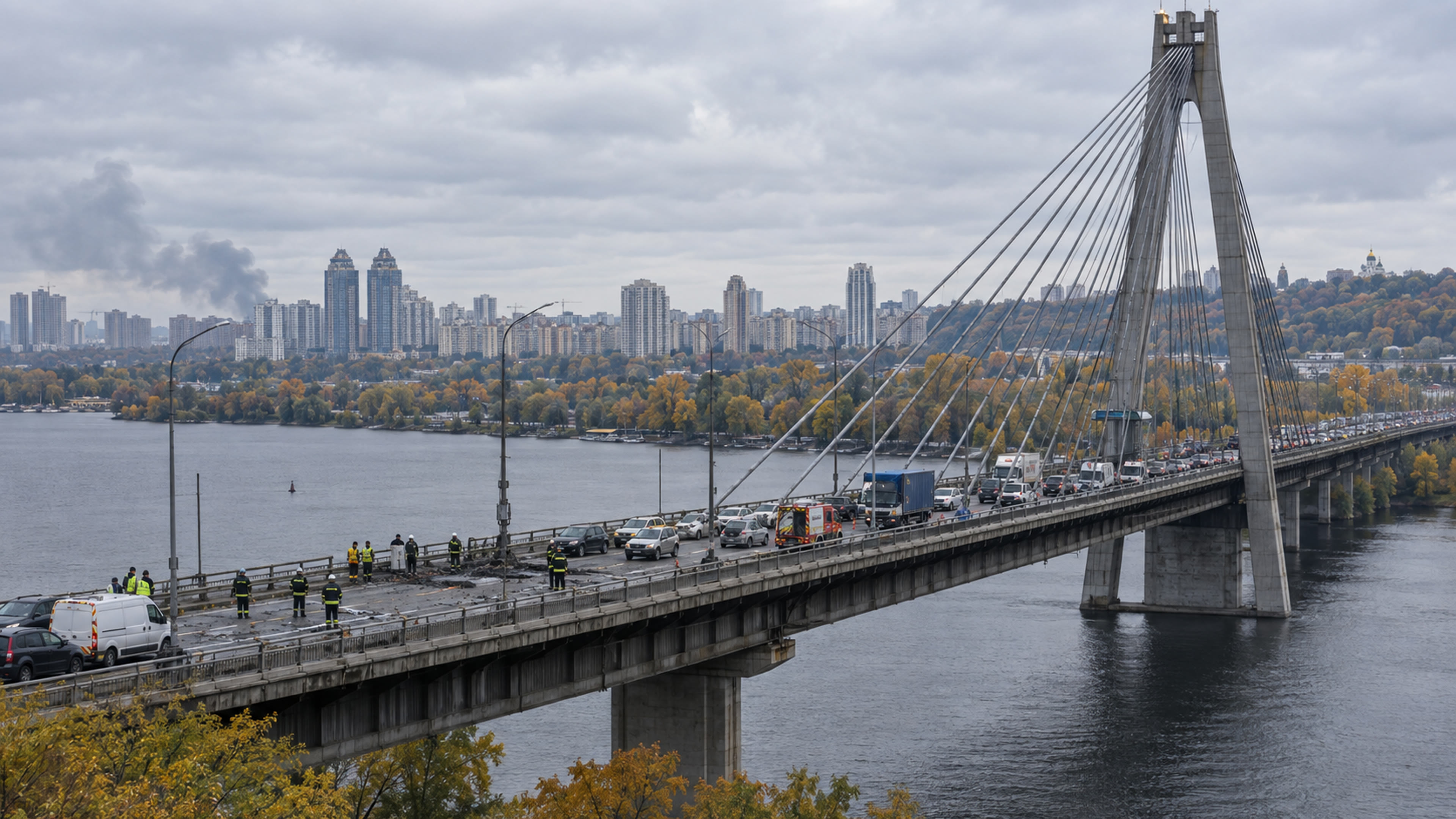
A Russian strike damaged Kyiv’s Northern Bridge and halted traffic. Mayor Vitali Klitschko said the road surface and trolleybus cables were damaged and two people were wounded. It was the third day of attacks that fully or partly restricted traffic on three of Kyiv’s six road bridges across the Dnipro.
Associated Press reported at least six deaths in Russian attacks across Ukraine: five in and around Kharkiv and a sailor killed when a civilian cargo ship was struck in Odesa Region. Russia’s Defence Ministry confirmed the Northern Bridge strike, claiming the crossing supported military logistics. Moscow also said it would continue “mass retaliatory strikes” against Ukrainian cities.
Why target bridges when the front barely moves
The roughly 1,250-kilometre front has remained largely positional in recent months. The Institute for the Study of War assessed that Russian forces seized or consolidated about 90.35 square kilometres in August, an average of 2.91 square kilometres per day, without achieving an operational breakthrough.
Bridges become attractive targets in this setting for three reasons. They connect the capital’s two halves, affect civilian travel and logistics, and force Ukraine to spread limited air defences. Even minor repairs create congestion and psychological pressure. A temporary closure, however, does not mean a crossing has been destroyed or that Kyiv is strategically isolated.
What the new strike wave shows
Russia is increasingly using jet-powered drones that fly faster than conventional Shaheds and leave defenders less time to intercept. Strikes on bridges, energy sites, warehouses, data centres and urban infrastructure form an attrition campaign designed to raise the economic cost of war and disrupt daily life far from the front.
Ukraine is responding with long-range attacks on Russian oil and military infrastructure. Both sides are extending the geographic reach of their strikes, increasing civilian risks and the chance of spillover. On 4 October, Moldova said Russian aerial weapons had violated its airspace.
What the evidence suggests comes next
The most likely near-term scenario is continued Russian pressure on transport and energy infrastructure, attempts at mechanised assaults on selected sectors in Donetsk Region and further Ukrainian strikes on Russian logistics. This is an analytical scenario, not certain knowledge of the future.
Without a sharp change in manpower, ammunition, drones or external support, neither side appears positioned for a rapid strategic breakthrough. The baseline is therefore a prolonged war of attrition with heavier pressure on cities during winter. Moscow’s threats to continue strikes and its refusal to abandon maximalist demands make a durable near-term settlement unlikely.
Cover: editorial reconstruction of Kyiv’s Northern Bridge.
Sources: Associated Press — events of 3–4 October, United Nations — 2026 civilian casualties, ISW — front-line and advance-rate assessments
If you have found a mistake or a typo in this article, tell us about it
Comments (0)
Log in to leave a comment →
No comments yet. Be the first.