

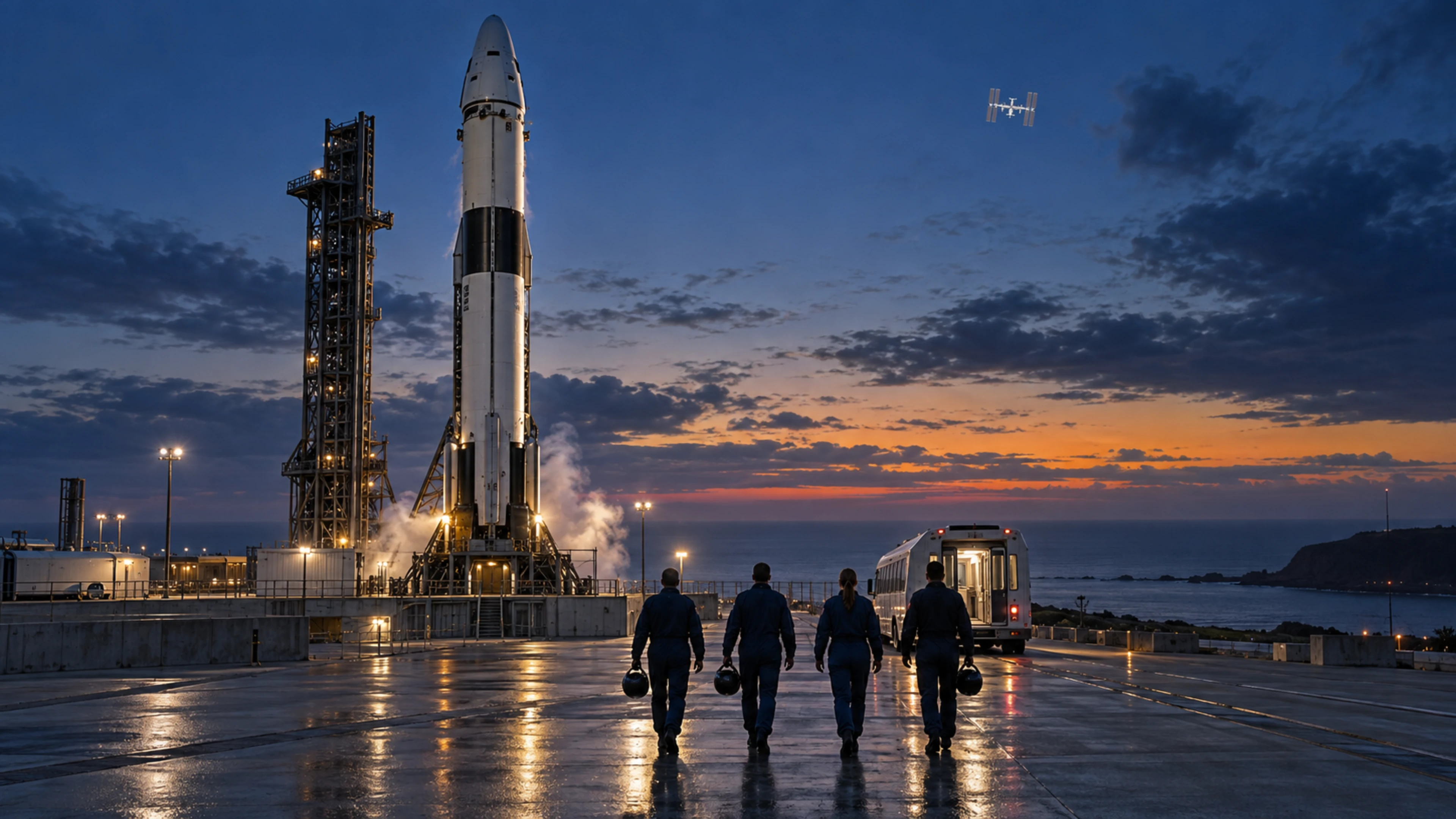
Crew-13 prepares for an October 1 ISS launch: what NASA reviewed
NASA, SpaceX, and international partners have cleared the Crew‑13 mission to continue preparations after a flight readiness review. Launch to the International Space Station is targeted for no earlier than October 1. We explain who is flying, what teams review before launch, and why the announced time remains a target until the final countdown decisions.
The Crew‑13 mission has passed a key flight readiness review. On September 25, managers from NASA and SpaceX, together with international partners, agreed to continue preparing the spacecraft, rocket, ground services, and International Space Station for the incoming crew.
Launch is targeted for no earlier than 11:10 a.m. EDT on October 1, or 8:10 p.m. in Kazakhstan. A Falcon 9 rocket is scheduled to lift off from Space Launch Complex 40 at Cape Canaveral Space Force Station in Florida.
Who will fly to the station
The four-person crew consists of:
- commander Jessica Watkins, NASA;
- pilot Luke Delaney, NASA;
- mission specialist Joshua Kutryk, Canadian Space Agency;
- mission specialist Sergey Teteryatnikov, Roscosmos.
The international group reflects how the ISS itself operates: the station depends on coordination among several space agencies, ground control centers, and national programs.
What a flight readiness review means
A Flight Readiness Review is neither a ceremony nor a weather forecast. It is a joint technical and operational assessment in which responsible teams examine the transportation system, mission plan, ground support, and the station’s readiness to receive the spacecraft and crew.
Participants must establish that known risks have been identified, responsibilities are assigned, and remaining work can be completed before launch. A decision to continue preparations means that no issue requiring the entire schedule to stop was identified at that review. It does not replace the checks that follow.
Remaining work includes weather analysis, confirmation of rocket and spacecraft status, launch complex readiness, conditions in potential emergency splashdown zones, and approval from control teams. Any of those factors can move the launch time.
Why NASA says “no earlier than”
The phrase sets a target floor. The mission will not launch before that time, but technical conditions, weather, or orbital operations may move it later.
A flight to the ISS depends on more than weather over the pad. The trajectory must place the spacecraft in the right position to meet the station, and land and sea recovery areas along an abort path must meet safety requirements. The time therefore remains a target until the final launch poll.
What to watch next
The next verifiable events are the crew’s arrival at Kennedy Space Center, completion of prelaunch work, and confirmation of the launch time in the official mission blog. After liftoff, NASA will separately report orbital insertion, rendezvous, and docking.
The boundary for readers is simple: the readiness review is complete, but the mission has not launched. Timing can change until the rocket actually leaves the pad.
Source
The launch time comes from NASA’s September 25 update and may be changed by mission managers.
If you have found a mistake or a typo in this article, tell us about it
Comments (0)
Log in to leave a comment →
No comments yet. Be the first.