

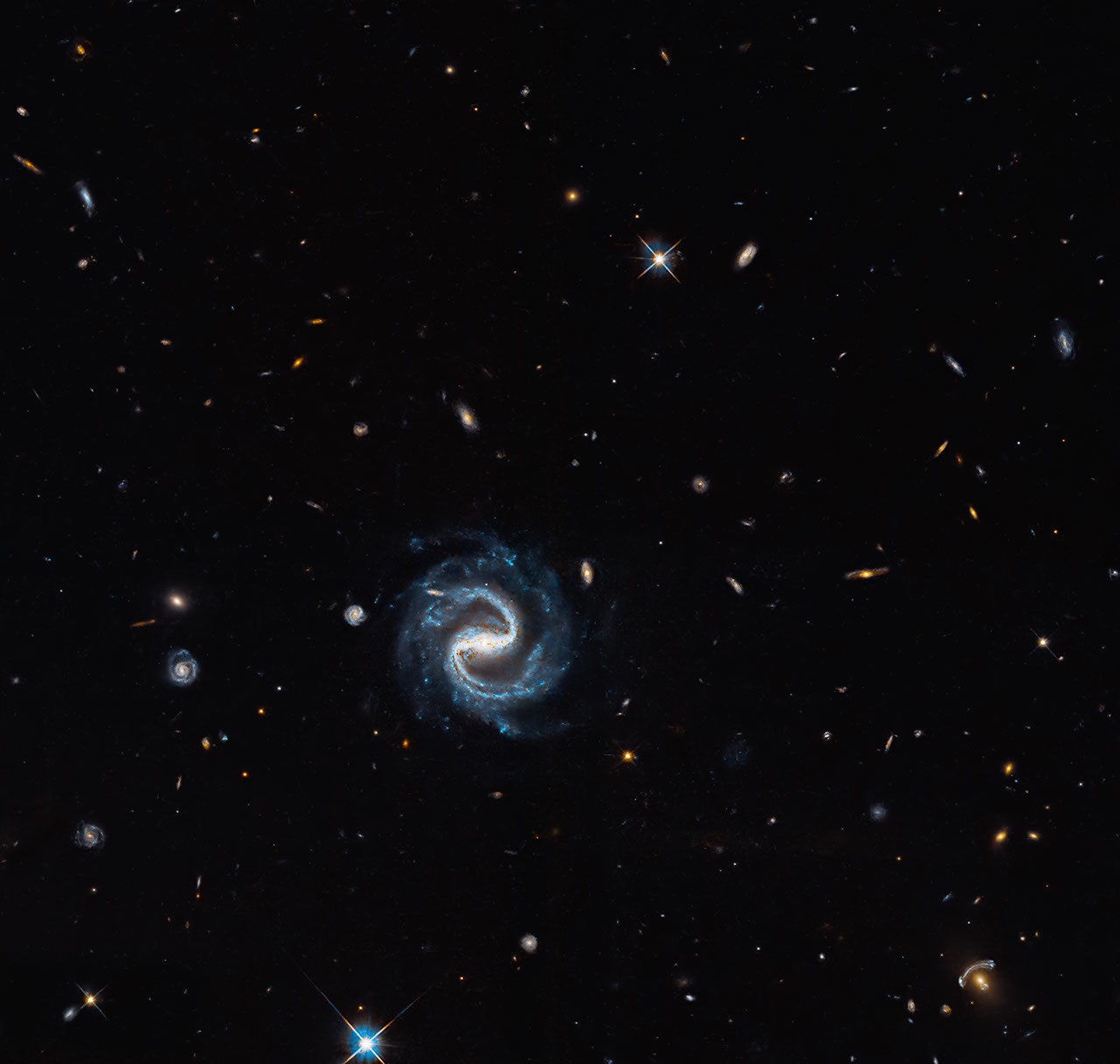
Hubble gravitational lens helps prepare Roman dark-matter studies
A newly published image supports methods for studying dark matter through the distortion of distant galaxies’ light.
NASA released a Hubble image of a gravitational lens on 22 October. A foreground galaxy bends and magnifies the light of a more distant galaxy, which appears as two arcs.
The publication places the galaxies roughly 4.5 billion and 8 billion light-years away, respectively. This is not a collision between neighbouring galaxies: the effect results from their alignment along the observer’s line of sight.
Such observations support models of mass distribution, including dark matter. Hubble provides detailed views of individual targets, while Roman’s wider surveys will examine more lenses. The news date refers to NASA’s release of the image and explanation, not the date when the observation was made.
Primary source: https://science.nasa.gov/missions/hubble/nasas-hubble-charts-path-for-roman-with-gravitational-lenses/.
NASA, ESA, X. Huang (University of San Francisco); Processing: Gladys Kober (NASA/Catholic University of America).
If you have found a mistake or a typo in this article, tell us about it
Comments (0)
Log in to leave a comment →
No comments yet. Be the first.