

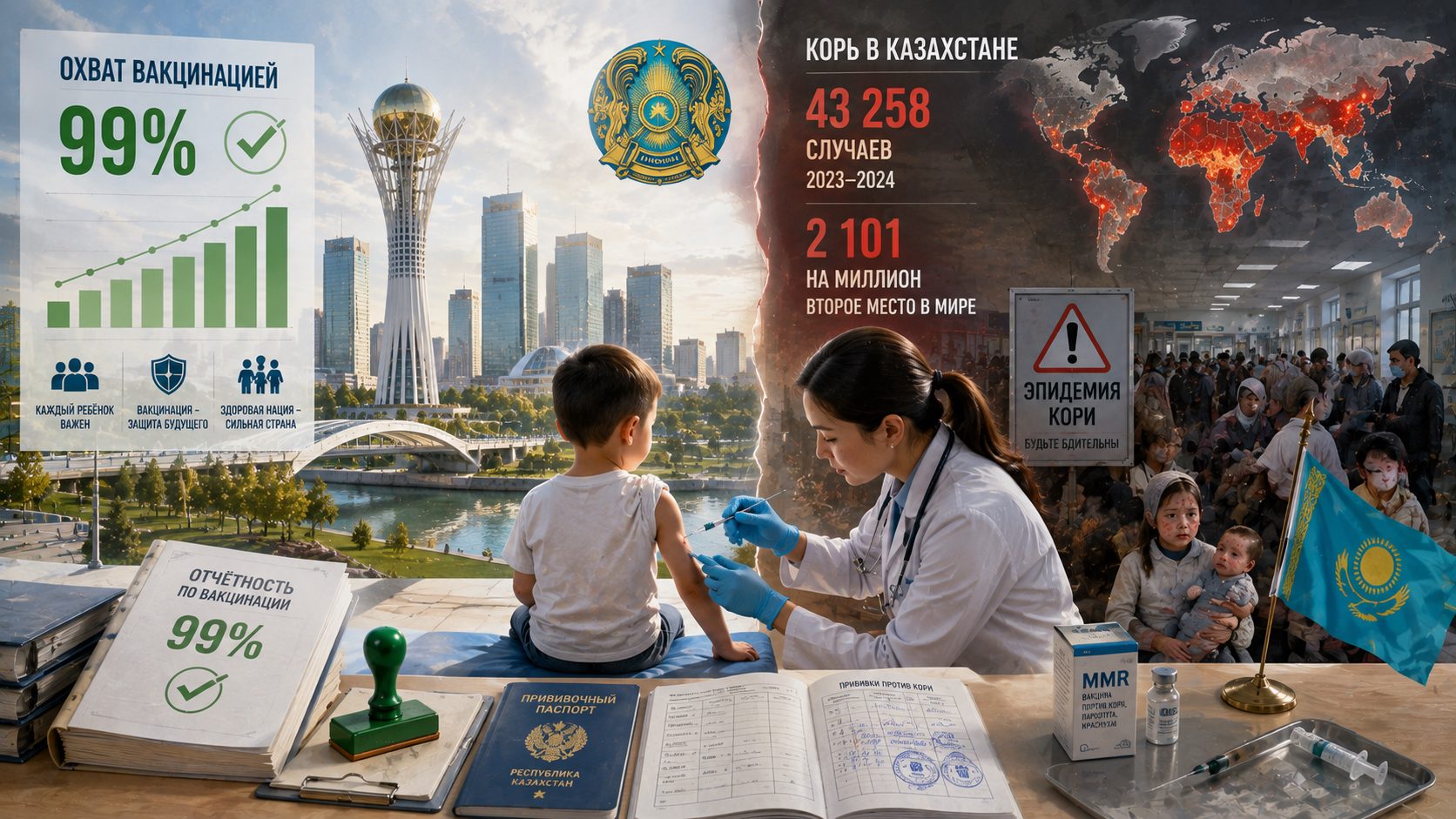
Measles conducted an audit of Kazakhstan's reporting
The WHO records 15,111 measles cases in Kazakhstan for 2023 and 28,147 for 2024 — forty-three thousand people. Beside that stands the official vaccination coverage figure: 99%. The two do not add up. We recounted the whole world and examine how the discrepancy surfaced and what it says about official reporting.
The week was rich in headlines. On August 18, U.S. national debt crossed the $40 trillion mark for the first time. In Bangladesh, measles deaths exceeded 922, nearly all of them children. The Prime Minister of Qatar met with Hamas leadership in Doha to discuss a roadmap for Gaza. Moderna and Merck reported successful late-stage trials of a melanoma vaccine.
Four news stories, four continents, thousands of publications.
Not one of them contains a number with the most direct relevance to a resident of Kazakhstan. This number wasn’t published because no one was counting it.
The Number
The World Health Organization tracks measles cases by country. Kazakhstan, the last two years with complete data: 15,111 cases in 2023 and 28,147 in 2024. Forty-three thousand sick.
In the 2024 global tally, that’s fourth place in absolute numbers—after the DRC, Iraq, and Ethiopia, but ahead of Pakistan and Russia, whose populations are twelve and seven times larger than ours. And per capita—second place in the world after the DRC: 1,367 cases per million inhabitants.
The first thing that comes to mind: our vaccination coverage has collapsed.
But the data refute this. Official measles immunization coverage in Kazakhstan, according to World Bank and UNICEF estimates: 99% in 2019, 99% in 2022, 99% in 2023, 93% in 2024. In 2019, when 13,326 people fell ill, reports showed 99%. In 2023, with 15,111 cases—again 99%.
With genuine 99% coverage, an epidemic of this scale is physically impossible: the virus has nowhere to multiply. Therefore, one of the two official numbers does not describe reality.
At this point, a typical article would conclude with “the reports are embellished.” We decided to dig deeper.
The Whole World in One Picture
We took all countries with a population over one million — 155 in total — and calculated two values for each: measles incidence per million residents for 2023–2024 and reported coverage of the first vaccine dose for 2019, 2021, 2022, and 2023. All data is open; the calculation can be reproduced in half an hour.
The vast majority of countries behave predictably: the lower the coverage, the more cases. DRC — 57% coverage, incidence of 5,701 per million. Yemen — 51% and 1,374. Romania — 84% and 1,532. Afghanistan — 55% and 295. Azerbaijan — 71% and 3,116. No mystery: a country honestly reports low coverage and honestly gets an epidemic.
The opposite corner is more interesting — countries that report coverage above 95% while simultaneously having a real epidemic. Logically, this combination should not exist.
Of 155 countries in the world, there turned out to be four:
| Country | Cases per million | Reported coverage |
|---|---|---|
| Kazakhstan | 2,101 | 98.5% |
| Uzbekistan | 608 | 98.8% |
| Armenia | 368 | 95.0% |
| Russia | 247 | 97.2% |
Fifth, with 94.8% coverage, comes Kyrgyzstan — 2,967 cases per million, the worst figure in this group.
All five are on one map, in one corner of the world. Together they accounted for 123,000 measles cases over two years: 9.2% of global incidence with 2.6% of the planet’s population. Exceeding their share by three and a half times.
A coincidence of four countries is not yet a pattern. We began checking explanations.
What Doesn’t Explain It
Poverty? Doesn’t hold up. The world’s most severe epidemics — in DRC, Yemen, Ethiopia — are accompanied by honestly low coverage figures. A poor country doesn’t pretend to be prosperous; it simply can’t vaccinate children and writes exactly that. Our corner of the map isn’t about lack of money.
Labor migration? The theory looked convincing: measles travels with people, and the region is tied together by massive worker flows. But it shatters against the very first fact. The world leader in remittances is Tajikistan, where they make up 47.2% of GDP — meaning the country lives on outbound labor. Measles incidence in Tajikistan: 28 cases per million. Seventy-five times lower than ours.
Soviet legacy? Closer, but still doesn’t add up. Belarus reports 97.8% coverage and has 104 cases per million. Latvia — 97.2% and one case per million. Lithuania, Estonia, Georgia, Moldova — all at the bottom of the list. The shared past exists; the epidemic does not.
None of the obvious explanations held up to scrutiny. So we were looking in the wrong place.
A Zero That Doesn’t Happen
Then we looked not at those who have many, but at those who have few.
Turkmenistan reported zero measles cases for 2022, 2023, and 2024. Not single digits — zero, three years in a row. Reported vaccination coverage: 98.2%.
A country of seven million people borders Uzbekistan, which had 20,940 cases in 2024; Kazakhstan, which had 28,147; and Afghanistan, which had 12,561 over two years.
Tajikistan reported zero for 2024 — situated between Kyrgyzstan with its 14,380 cases and Uzbekistan with 20,940.
To understand how strange this is, one property of measles is needed. It is the most contagious infection known to humans: one sick person in an unvaccinated environment infects twelve to eighteen people. For influenza, this figure is about two. Measles crosses a border with one passenger and, two weeks later, produces an outbreak.
Theoretically, zero is possible: a country with truly universal vaccination can extinguish an importation. But then one would have to accept that a virus infecting twelve to eighteen people from a single sick individual, for three consecutive years, bypassed a country squeezed between two epidemics — and never once produced a single confirmed case.
This is not an epidemiological fact. This is a statement about who does the counting.
What we are actually measuring
And then the picture flips.
The global measles incidence map is to a significant degree not a map of disease. It is a map of where disease is registered. A country with a functioning laboratory network, with mandatory diagnosis confirmation, with a system that carries a case from the district to the national report and on to Geneva, looks bad on this map. A country where this chain does not work looks excellent.
Kazakhstan counts the sick. Twenty-eight thousand cases were registered, confirmed, and passed upward by someone.
Only this is no reason to be proud. It is a reason to understand what exactly has exposed us.
The Clue
Let us return to the two rows of numbers and place them side by side — year by year.
| Year | Reported coverage | Measles cases |
|---|---|---|
| 2018 | 99% | 576 |
| 2019 | 99% | 13,326 |
| 2020 | 93% | 3,270 |
| 2021 | 97% | 2 |
| 2022 | 99% | 4 |
| 2023 | 99% | 15,111 |
| 2024 | 93% | 28,147 |
Look not at the levels, but at the movement.
In 2019, incidence rose twenty-three-fold — from 576 cases to 13,326. Reported coverage did not budge: 99%.
In 2020, incidence fell fourfold. And it was precisely this year that coverage first sagged — to 93%. The number moved downward when the disease was retreating.
The explanation is simple, and it’s not about Kazakhstan: in 2020, the entire world reported vaccination disruptions due to the pandemic. Reporting a drop in coverage was not only safe — it was expected. Everyone did it.
Next — 2023, fifteen thousand cases. Coverage: 99%. And only in 2024, when the count reached twenty-eight thousand and ignoring it became impossible, did the figure “acknowledge” 93%.
The result: over seven years, reported coverage shifted twice. Both times — not because of an epidemic. Once because that’s how the entire world reported, and a second time because denial became impossible.
This number does not react to disease. It reacts to what is expected of it.
The Number That Wasn’t There
From this follows a conclusion that should be stated plainly.
Ninety-nine percent is not an approximate estimate, not an optimistic count, and not a methodological margin of error. It is false. Not because someone thinks so, but because arithmetic does not permit it: with 99 percent coverage, fifteen thousand cases do not happen. Two numbers produced by one government about one country in the same year are incompatible. One of them is false, and it is not the one that counts sick children.
How does a number become false if no one sat down to fabricate it?
Very routinely. Vaccination coverage is a planned indicator. It is collected from the bottom up: a clinic reports to a district, a district reports to a region, a region reports to the ministry. At every level, the report is compiled by the very person who is evaluated by that report. At the top, the numbers are added together. What comes out is a single figure, and there is no one to verify it: no independent measurement is conducted where people would visit random homes and check children’s vaccination cards.
A metric produced by the very party it evaluates, with no one to verify it, will always converge to the planned target. No conspiracy or order is needed for this. It is enough that no one along the way finds it profitable to write the truth.
An objection comes to mind: surely all closed countries do this. We checked this too, comparing disease incidence with the World Bank’s government accountability index.
The result was the opposite. Among 27 countries worldwide that had a genuine epidemic in 2023–2024, countries with low accountability reported an average coverage of 72%, while countries with higher accountability reported 80%. Yemen, which has one of the worst accountability scores in the world, reports 51%. South Sudan — 71%. Azerbaijan — 71.5%. No embellishment.
They are not more honest than us. They have nothing to inflate. Chad and South Sudan lack the apparatus capable of producing a complete, plausible nationwide figure every year; they report the little they see.
Inflation is not a temptation; it is a skill. It requires a functioning reporting machine that carries the figure from the local clinic to the ministry and compiles it into a neat national percentage. Countries from the impossible quadrant have such a machine, and it works flawlessly. It simply measures not what the scale says.
This is how the system learned to produce the desired number. And it would keep producing it, were it not for one circumstance.
Who Conducted the Audit
The audit was carried out by measles.
She did what neither an audit, nor a commission, nor an inspection had done: she compared the report with reality. Forty-three thousand cases — this is not the opinion of opponents, not a journalistic investigation. This is the bill presented by the disease itself, and it cannot be disputed, because behind every single unit stands a child with a rash and a fever.
And what exposed us was specifically the functioning part of the system. Doctors who made the diagnosis. Laboratories that confirmed it. Registries that passed the case upward. If this part worked the same way as coverage reporting, we would now look like Turkmenistan: zero cases, 98% coverage, complete well-being on paper.
That is the true meaning of our second place in the world. It does not say that we have the worst measles situation of all — it is entirely possible that our neighbors are no better. It says that we still have that part of the state which counts honestly — and it has just caught that part which counts conveniently.
What to do about it
Three things follow from this, and all of them are tedious.
First. Demand not reported coverage, but independent measurement — household surveys that check children’s vaccination cards, not agency summaries. This is done in many countries and costs incomparably less than an epidemic.
Second. Look separately at the second dose and separately at the worst district, not at the national average. The average is what hides the hole, and measles arrives precisely at the hole.
Third, for the parent, and the only one that depends personally on you: is your child vaccinated with two doses. The national percentage does not protect your child. We have just examined what it is worth.
Forty trillion dollars of U.S. debt was discussed all week. No one wrote that one of our own official numbers turned out to be false — even though the proof lies in two open tables and takes half an hour to calculate.
Sources
- Our World in Data / WHO: registered measles cases by country
- World Bank: measles vaccination coverage, children 12–23 months
- World Bank: population by country
- World Bank: remittances, % of GDP
- World Bank: Voice and Accountability index
- WHO: measles fact sheet
- U.S. Treasury: U.S. government debt, daily data
- The Business Standard: measles death toll in Bangladesh reaches 922
- CNBC: U.S. government debt passes $40 trillion mark for the first time
If you have found a mistake or a typo in this article, tell us about it
Comments (3)
Log in to leave a comment →
Проверьте прививочную карту ребёнка: две дозы от кори или одна? ВОЗ пишет, что после первой иммунитет формируется не у всех, и весь мировой разрыв (84% против 77%) — именно во второй. Напишите, что нашли, и укажите область — соберём и посмотрим, как это выглядит у читателей.
Sign in to vote. 0 Sign in to vote.Балаңыздың вакцинация тарихын тексеріңіз: қызылшаға қарсы екі доза ма, әлде бір доза ма? ДДСҰ бірінші дозадан кейін барлығы бірдей иммунитет қалыптастырмайтынын және бүкіл әлемдік алшақтық (84% vs 77%) екінші дозада екенін мәлімдейді. Зерттеу нәтижелерін жазып, аймақты көрсетіңіз - біз оларды жинақтап, оқырмандарымыз үшін қалай болатынын көреміз.
Sign in to vote. 0 Sign in to vote.Check your child's vaccination record: two measles doses or one? The WHO states that not everyone develops immunity after the first dose, and the entire global gap (84% vs. 77%) is in the second dose. Write down your findings and indicate the region—we'll compile them and see how it stacks up for our readers.
Sign in to vote. 0 Sign in to vote.