

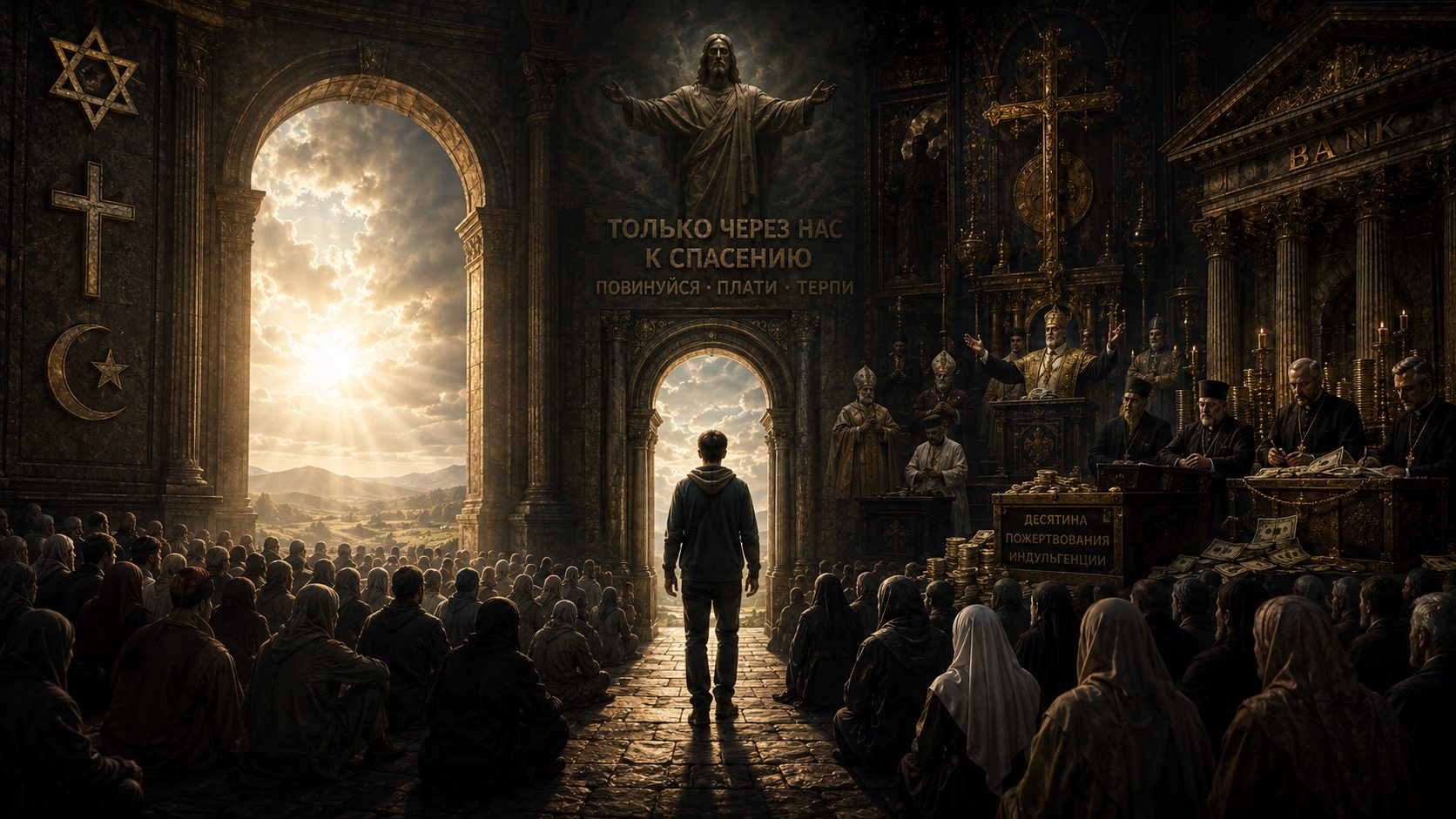
The Middleman Between You and the Sky: On Faith, Religion, and Power
Faith is a personal search; religion is an institution with a hierarchy, a dogma and a cash desk. How the living search for the sacred was appropriated by those who declared themselves the compulsory middleman: to heaven only through us. Dostoevsky's Grand Inquisitor, indulgences, and the throne-and-altar pact.
This piece proves nothing and calls for nothing. It is about how the living search for the sacred was captured, for centuries, by institutions that made themselves the mandatory broker — and declared this holy, and therefore beyond question.
Faith and religion are not the same thing
Faith is a personal, inward search: conscience, meaning, the sense of something greater than us. It is older than any temple and asks no one’s permission. Religion as an institution is a hierarchy, a doctrine, a ritual, an apparatus. Sometimes the institution serves faith. But too often it does something else: it appropriates faith — steps in between the person and what they are seeking, and charges a toll for passage.
The middleman no one invited
The move is simple: “to God, to salvation, to truth — only through us.” Through the correct rite, the correct book, the correct rank, the correct tithe. Once that is accepted, the institution becomes indispensable and unaccountable: to doubt the middleman is to doubt heaven itself.
We have seen this move before. Medicine is judged by whether the protocol was followed, not by whether the patient was healed. Interest on loans was made “holy” and placed beyond judgment. Here it is the same, taken to the limit: the sacred itself is placed off-limits to questions. And those who sought directly, bypassing the broker — mystics like al-Hallaj or Meister Eckhart — too often ended as heretics. The direct seeker needs no broker, and is therefore dangerous to him.
The Grand Inquisitor
The sharpest verdict came not from an atheist but from a deeply religious man. Dostoevsky put the church’s condemnation into the mouth of the Grand Inquisitor — from inside faith itself. The Inquisitor tells the returned Christ: we have “corrected” your work. You wanted to give people freedom — an unbearable gift; we took it away and gave them “miracle, mystery, and authority” instead, along with bread and peace. And people are happier — obedient. It is the portrait of an institution that betrayed the very thing it served, for the sake of power and order.
The herd, “us” and “them”
An ancient, animal instinct lives in us — the pull toward our own, the wariness of strangers. In itself it is neither good nor evil. But whoever rises a little above the crowd and grasps this lever wields it easily: faith becomes the banner of the tribe, sorting people into “ours” and “the rest.” That is why, if you dig, almost every war has a religious lining beneath it — even when its real causes are land, power, and money. Heaven here is not the source of the enmity but its convenient mask.
The cross and the frog’s paw
Watch honestly: a cross around the neck and a dried paw around a hunter’s neck “work” the same way — for luck, for healing, for salvation. Not because there is power in the object, but because the person decided it helps and believed it unshakably. The power is in the belief of the wearer, not in the thing. This does not prove there is no heaven; it only shows that the mechanism of a felt miracle is psychological, and it is the same under any symbol. And where a miracle can be switched on by belief, a ticket to it is easy to sell.
A business built on submission
The alliance of throne and altar is as old as the world: “divine right” sanctified any power, and “endure here, and you will be repaid there” pacified those left to endure. Institutions amassed vast wealth, sold indulgences — tickets to paradise for cash — and kept the fear of hell as hard currency. As a business model this is exactly a long income stream built on submission: selling the cure for a fear you yourself inflame.
Thinkers offered different lenses — not as verdicts but as invitations to think: Feuerbach saw in God a projection of what is best in the human being; Marx called religion “the opium of the people” — both comfort and sedative at once; Freud, an ancient wish for someone to watch over us. You need not agree. What matters is that the question can be asked at all — while for centuries the institution answered it with the stake.
Faith against the question
“Blessed are those who have not seen and yet have believed.” Belief without proof, and even against it, was raised to the highest virtue, and doubt was made a sin. So the system becomes self-sealing. But a claim fenced off from questions does not become true thereby — and here honesty demands a mirror: to say “it is proven that all of it is false” would be the same blind certainty. We do not know whether heaven exists. We know something else: any truth that forbids questions deserves suspicion — including the one that calls itself the only true faith, and the one that calls itself the only sober view.
But don’t throw out the baby
And honestly — the other side. Faith gave humanity what money cannot buy: meaning in the face of death, comfort in grief, community, a moral compass, the greatest art, and mercy. And one more thing must be said plainly, so as not to lie: a shared pattern of power does not make all religions morally equal. Between a community that feeds the poor and a cult that gassed people in a subway, the difference is not in the law or the “steeple” — it is in the number of the living and the dead. One can criticize the structure without pretending that massacre and mercy are the same thing.
The enemy, then, is not the search for the sacred, nor the sincere believer. The enemy is the capture of that search by an unaccountable power that stepped between the human being and the sky and charges a toll for passage.
One pattern in every temple
And most important: this pattern is not about one “bad” faith. It repeats everywhere the institution has appropriated the sacred: wealth and inquisition here, clerical power there, temple economies, castes, the sale of holiness — all alike. To point at one people or one religion as the source of the world’s evil is not analysis but the very scapegoat that draws the eye away from the structure.
From the author — as a possibility, not a truth
And now — not a sermon, but the quiet surmise of one person, which I do not present as fact. I lean toward the thought that a spark of the creator is in every living thing — from a blade of grass to a whale — and that life is given as a test, a step with another beyond it. Perhaps it is so. Perhaps otherwise. I ask no one to believe it and call no one anywhere. I only say what I began with: the sacred — if it exists — is sought directly, not bought from a middleman. The freedom to ask is itself sacred. And perhaps the one closest to heaven is not the one who dutifully pays the broker, but the one who dared to seek for himself.
Sources for reflection: F. M. Dostoevsky, The Brothers Karamazov (The Legend of the Grand Inquisitor) · L. Feuerbach, The Essence of Christianity · K. Marx, introduction to A Contribution to the Critique of Hegel’s Philosophy of Right · S. Freud, The Future of an Illusion.
If you have found a mistake or a typo in this article, tell us about it
Comments (1)
Log in to leave a comment →
От автора: А как чувствуете вы — к тому, что больше нас, идут напрямую, или без посредника всё же не обойтись? Пишите честно, без ярлыков: тут можно и соглашаться, и спорить.
Sign in to vote. 0 Sign in to vote.