


Physics around us: from a first experiment to your own lab Lesson 5 of 8
Measuring length: scale, division, repeat
Measure from the hanging point to the weight's centre and see why a ruler cannot justify unlimited decimal places.
Where we are on the map
The map shows the reasoning order. Its numbers are worked examples unless the lesson explicitly identifies your own measurement. You are in the first of eleven blocks.
A question from daily life
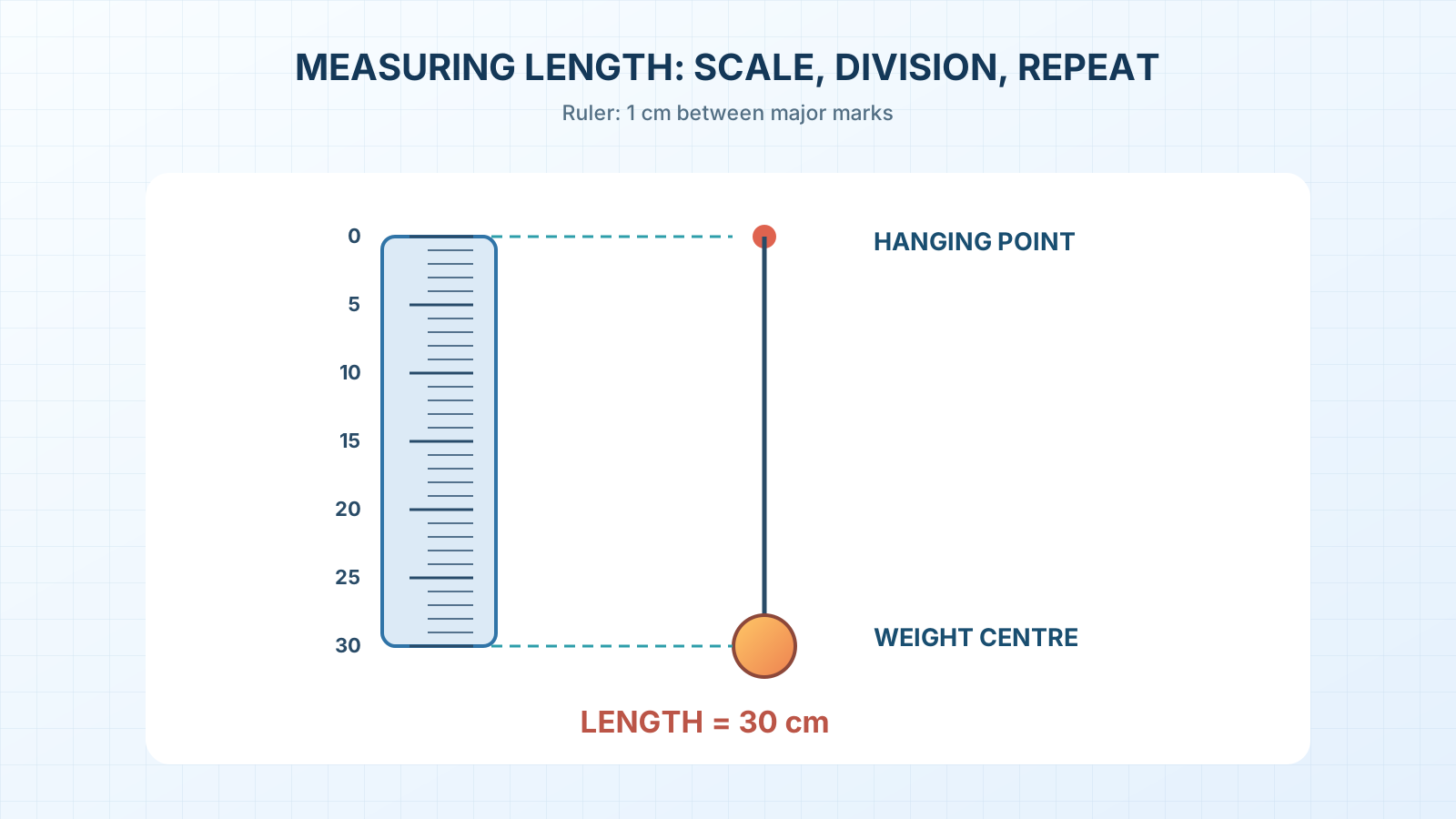
Two learners report a pendulum length of 30 cm. One measured the entire string; the other measured to the centre of the weight. They measured different things.
Words and meanings
A scale is an ordered set of marks on an instrument. The smallest division is the distance between neighbouring small marks in the units shown. The hanging point is where the string is fixed. Our pendulum’s length runs from that point to the weight’s centre, not just along the string. A repeat is another measurement of the same quantity by the same method. Spread is the difference among repeated results; it warns us that a measurement is imperfect.
Predict before checking
A ruler has marks 1 mm apart. Could you honestly write 30.00001 cm? Predict what precision the ruler supports.
Do it and record it
Use a lightweight washer or a small soft weight without sharp edges, string, and a ruler. Hang nothing over your head. Mark the hanging point and the weight’s centre. Measure their separation three times, placing the ruler afresh and looking straight at the scale each time. If you lack the materials, use only the worked data below.
A worked example
Worked measurements: 29.9 cm; 30.0 cm; 30.1 cm. The mean is their sum divided by their count: (29.9 + 30.0 + 30.1) / 3 = 30.0 cm. The spread from largest to smallest is 0.2 cm. This does not prove that the exact length is precisely 30.0 cm.
A common mistake
If the string from the pivot to the weight’s top is 29 cm, ‘pendulum length = 29 cm’ is incorrect: the centre is lower. Extra decimal zeros do not make an instrument more precise.
A new situation
A friend measures from a knot in the string rather than the fixed hanging point and gets a shorter result. How will you agree on both ends of the segment before comparing measurements?
Notebook entry and self-check
Record both ends of the measured segment, the ruler’s smallest division, three results with units, and their mean. If you did not do the experiment, label the numbers ‘worked example’.
If you have found a mistake or a typo in this article, tell us about it
Comments (0)
Log in to leave a comment →
No comments yet. Be the first.