


Physics around us: from a first experiment to your own lab Lesson 6 of 8
Measuring time and a pendulum's period
Count complete swings and obtain the time for one from the time for ten.
Where we are on the map
The map shows the reasoning order. Its numbers are worked examples unless the lesson explicitly identifies your own measurement. You are in the first of eleven blocks.
A question from daily life
One swing is brief; pressing a stopwatch button may take a noticeable fraction of that time. Time ten swings, then divide by ten.
Words and meanings
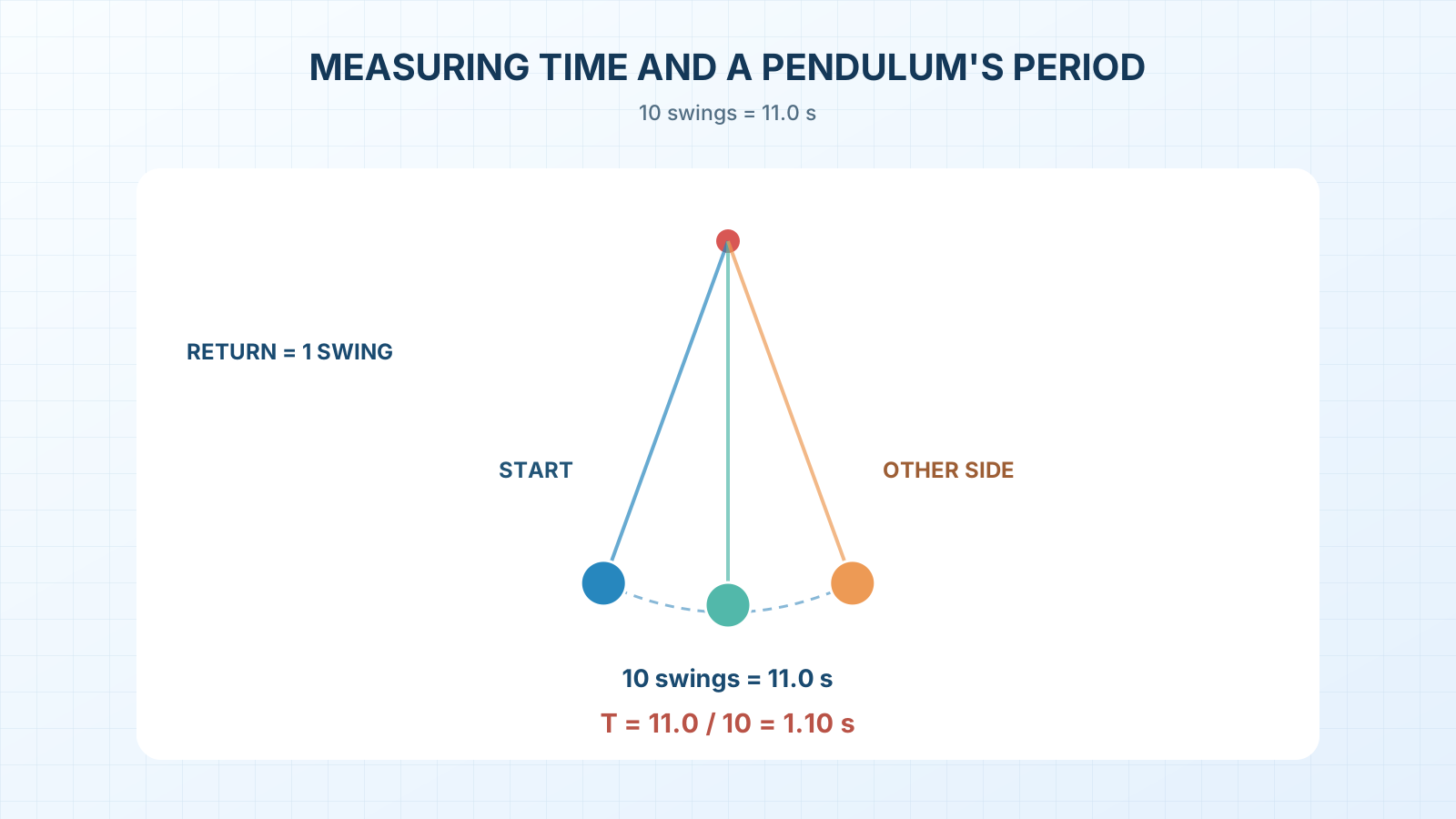
A complete swing starts at one extreme and ends when the weight next returns to that same extreme after visiting the other side. The period is the time for one complete swing. Let t₁₀ be the time for ten swings and T the period: T = t₁₀ / 10. A stopwatch measures a time interval. Use the same start and end points for every repeat.
Predict before checking
If ten swings take 11.0 s, is one period longer or shorter than 11.0 s? Predict a number before dividing.
Do it and record it
Use a lightweight weight on strong string in clear space away from faces and fragile objects. Set the distance from the hanging point to the weight’s centre near 30 cm. Move it a little to one side and release without a push. Start the timer at the chosen extreme, count complete returns 1–10, and stop on the tenth. Repeat three times. If materials are unavailable, use the worked data.
A worked example
Worked times for ten swings at 30 cm: 10.9 s; 11.1 s; 11.0 s. Mean t₁₀ = (10.9 + 11.1 + 11.0) / 3 = 11.0 s. Thus mean period T = 11.0 / 10 = 1.10 s. These are illustrative numbers, not your measurements.
A common mistake
Treating left-to-right travel as a complete swing gives about half the correct period. The return to the starting side matters. Timing ten swings reduces the effect of starting and stopping, but does not remove it entirely.
A new situation
A friend gets t₁₀ = 12.0 s and writes T = 120 s. Explain why division by ten is needed and obtain 1.20 s. What might change if they push the weight every time?
Notebook entry and self-check
Record what counts as one swing, the length with its unit, three t₁₀ times, their mean, and T. Label supplied numbers as worked data. We have not yet derived a formula relating T to length.
If you have found a mistake or a typo in this article, tell us about it
Comments (0)
Log in to leave a comment →
No comments yet. Be the first.